-
by sayum
08 August 2026 1:54 PM







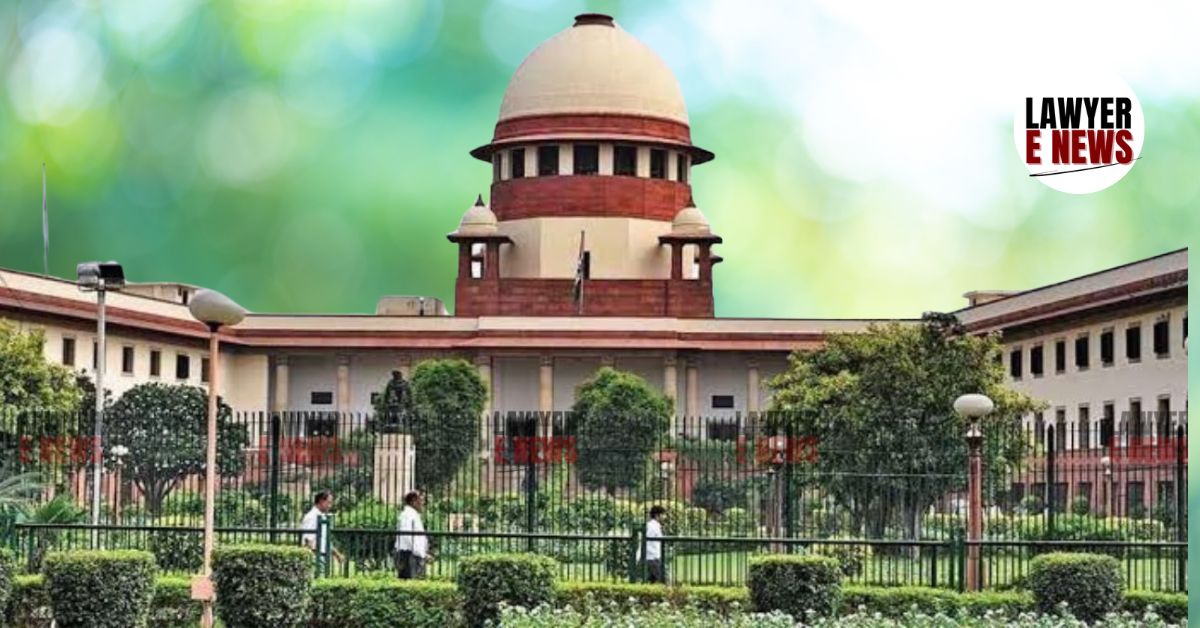
Constitution Didn’t Empower the Speaker to Frustrate the Tenth Schedule - Speaker Must Act, Not Sleep Over Disqualification Petitions, On 31st July 2025, the Supreme Court of India, in a significant pronouncement in Padi Kaushik Reddy & Others v. State of Telangana & Others, delivered a stern reminder to constitutional authorities that inaction can be as damaging as misuse of power. The Bench comprising Chief Justice B.R. Gavai and Justice Augustine George Masih set aside the Telangana High Court Division Bench’s order which had overturned a Single Judge’s direction to fix a timeline for hearing disqualification petitions against ten allegedly defecting MLAs.
In scathing observations, the Supreme Court held that “the Speaker, while acting under Paragraph 6(1) of the Tenth Schedule, acts as a Tribunal”, and is “amenable to judicial review” under Articles 136, 226 and 227 of the Constitution. The Court held that when the Speaker fails to act, courts can step in to “aid the constitutional process”, and such judicial review “does not amount to interference with legislative proceedings”.
Post-Election Alleged Defections and Deliberate Silence from the Speaker
Following the Telangana Assembly elections in December 2023, three MLAs — Danam Nagender, Kadiyam Srihari, and Venkata Rao Tellam — elected as candidates of the Bharat Rashtra Samithi (BRS), allegedly joined the Indian National Congress (INC) between March and April 2024.
Their defection triggered disqualification petitions filed by Padi Kaushik Reddy and Kuna Pandu Vivekanand, themselves BRS MLAs, and BJP MLA Alleti Maheshwar Reddy, under Paragraph 2(1) of the Tenth Schedule read with Article 191(2) of the Constitution and the Disqualification Rules, 1986.
But despite the seriousness of the issue, the Speaker of the Telangana Legislative Assembly took no action for more than seven months. Notices were issued only after the petitioners approached the Supreme Court in January 2025.
“It could thus be seen that the Speaker did not even find it necessary to issue notices in the petitions filed by the present petitioners for a period of more than seven months and only after the proceedings were filed before this Court, did the Speaker find it necessary to issue notice,” the Court noted sharply.
Earlier, a Single Judge of the High Court had directed the Assembly Secretary to place the petitions before the Speaker and schedule hearings within four weeks. The Division Bench reversed this order, holding that courts could not intervene before the Speaker had decided. That view now stands emphatically rejected.
“Quia Timet Is Not a Shield for Constitutional Negligence” – Speaker Cannot Hide Behind Procedural Immunities
The Speaker’s defence rested on the concept of Quia Timet action, which refers to pre-emptive judicial intervention. But the Court clarified that such a bar applies only when the courts interfere to stop the Speaker from acting, not when they act to compel him to discharge his constitutional duty.
In a key clarification, the Court ruled:
"What was meant by passing an order in Quia Timet action in the case of Kihoto Hollohan was passing an order injuncting the Speaker from making a decision... It did not, in any manner, interdict judicial review in aid of the Speaker arriving at a prompt decision as to disqualification under the provisions of the Tenth Schedule."
The Court drew heavily on the precedent in Keisham Meghachandra Singh v. Speaker, Manipur Legislative Assembly, where it had set a three-month outer limit for deciding disqualification petitions.
"Absent exceptional circumstances for which there is good reason, a period of three months... is the outer limit within which disqualification petitions filed before the Speaker must be decided if the constitutional objective... is to be adhered to.
"The Tenth Schedule Was Brought to Curb Political Defections, Not to Be Buried by the Speaker's Silence"
The judgment meticulously recounted parliamentary debates from the 1985 introduction of the Tenth Schedule, including the words of then Law Minister A.K. Sen, who had warned:
"We are not going to allow this matter to be dilly-dallied and tossed about in the courts of law or in the Election Commission’s office... If defection is to be outlawed effectively, then we must choose a forum which will decide the matter fearlessly and expeditiously."
However, the Court remarked that the very premise on which Parliament entrusted this function to the Speaker has been repeatedly betrayed.
"With the experience of over 30 years... the question that we will have to ask ourselves is as to whether the trust which the Parliament entrusted in the high office of the Speaker... has been adhered to... We need not answer this question, since the facts of the various cases... themselves provide the answer."
It added, candidly: "If we do not issue any direction, it will amount to permitting the Speaker to repeat the widely criticized situation of ‘operation successful, patient died’."
Supreme Court’s Binding Directions: “Delay Is a Dereliction, Not Discretion”
Setting aside the High Court’s Division Bench ruling, the Supreme Court restored the Single Judge’s direction and went a step further. It ordered:
"We direct the Speaker to conclude the disqualification proceedings pending against the 10 MLAs... within a period of three months from the date of this judgment."
Further, anticipating delaying tactics, the Court warned: "The Speaker would not permit any of the MLAs... to protract the proceedings. In the event any of such MLAs attempt to protract... the Speaker would draw an adverse inference."
It also questioned the very legitimacy of the Legislative Secretary’s appeal:
"There was absolutely no occasion for the Secretary, Telangana Legislative Assembly, to have challenged the order... nothing adverse could be found in the said order."
Constitutional Accountability Triumphs Over Procedural Excuses
The ruling is a landmark in India’s anti-defection jurisprudence, sending a clear message that delays by high constitutional functionaries are not immune from scrutiny.
In affirming that the Speaker functions as a judicial tribunal in disqualification matters and cannot be allowed to sabotage constitutional schemes through deliberate inertia, the Court has reaffirmed the primacy of constitutional morality.
As the Court aptly noted: "The Speaker did not even issue notices for seven months. Only when petitions were filed in this Court did the Speaker wake up. This conduct cannot be called 'expeditious' by any standard."
The judgment not only enforces a three-month limit for deciding disqualification petitions but also rekindles the hope that constitutional duties cannot be indefinitely delayed without consequences.
Date of Judgment: 31st July 2025