-
by sayum
27 August 2026 3:32 PM







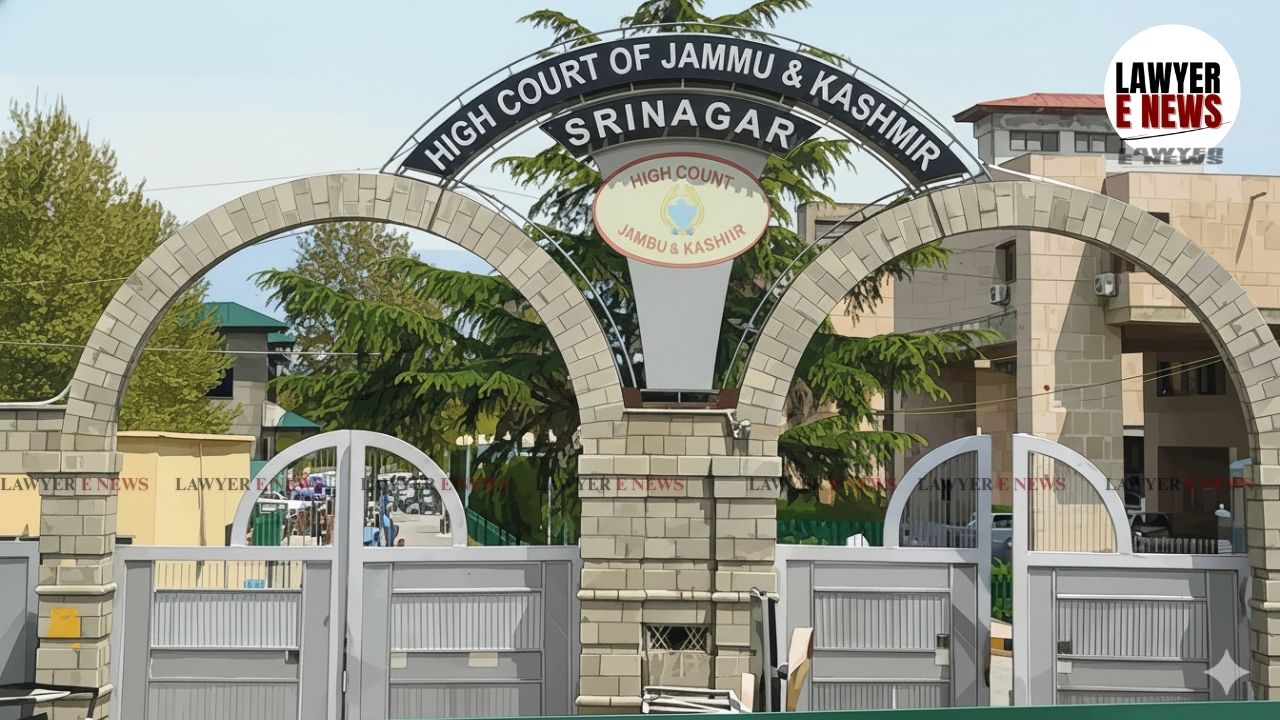
"Depriving Person Of Shelter Before Appeal Heard Would Render Remedy Nugatory – Competent Authority Retains De Jure Custody While Appellant Holds De Facto Possession", Jammu & Kashmir and Ladakh High Court has delivered a significant judgment balancing statutory protection of migrant properties with constitutional fairness, holding that appellants challenging eviction orders need only surrender symbolic possession rather than vacate premises, thereby preserving their right of appeal while ensuring properties remain under official custody.
Background of the Case
Rehmatullah Naik was ordered to be evicted by the District Magistrate, Ramban under Section 5 of the Jammu and Kashmir Migrant Immovable Property (Preservation, Protection and Restraint on Distress Sales) Act, 1997. The order was passed on an application by Sham Singh and others seeking his removal as an unauthorized occupant from migrant property. Faced with proviso (b) to Section 7 of the Act—which bars appeals against eviction orders unless possession is first surrendered to the competent authority—Naik bypassed the statutory appeal route and directly invoked the constitutional jurisdiction of the High Court under Article 226, challenging the provision itself as violative of Articles 14, 19 and 21 of the Constitution.
Legal Issues and Arguments
The respondents contended the writ petition was not maintainable given the availability of an efficacious statutory appeal under Section 7. Naik, while conceding this general principle, argued the appeal remedy was rendered "totally unconstitutional" and "unworkable" by the harsh pre-condition requiring surrender of possession—effectively forcing him to vacate his home before his case could even be heard on merits. The constitutional validity of conditioning appeal rights on surrender of possession thus became the central legal issue.
Court's Observations and Judgment
The Division Bench commenced by reaffirming foundational principles regarding statutory appeals. "Right of appeal is a statutory right and not a vested or fundamental right, therefore, the legislature which provides such statutory right of appeal is well within its competence to impose reasonable conditions for availing such right," the Court stated, while immediately cautioning that such conditions must not be arbitrary, excessive or confiscatory.
Establishing the constitutional standard, the Court held: "Any condition attached to the right of appeal which practically defeats the right of appeal may be struck down as unreasonable and hit by Article 14 of the Constitution of India."
The Court examined the legislative history and purpose behind the 1997 Act, enacted urgently to address the crisis of migrant properties left unattended after the 1989 exodus from Kashmir Valley. "Incidence of unlawful encroachments on the migrant properties, left unattended on account of migration coupled with the instances of distress sales by the migrants, was the immediate provocation for bringing the legislation," the judgment observed, contextualizing the protective intent behind statutory provisions.
Critical to the Court's reasoning was its analysis of Section 4, which vests custody of migrant properties in District Magistrates. The Court noted this provision recognizes both actual and deemed custody—a statutory duality that became the foundation for interpreting the surrender requirement. "The Section essentially recognizes custody, where physical possession is taken over by the District Magistrate and also deemed custody where the possession of the property was not to be taken over by the District Magistrate but shall be deemed to be in his custody by fiction of law," the judgment explained.
The Court then confronted the harsh practical reality of requiring actual physical surrender. Taking the example of a residential property, the Bench observed that requiring an occupant to vacate before filing appeal would leave him and his family potentially homeless while awaiting adjudication—a consequence that would effectively nullify the appeal right for those lacking alternate accommodation.
"Unless it is conclusively determined that he is unauthorized occupant, depriving him of the shelter would be rendering him incapacitated to avail the remedy of appeal," the Court held, identifying the constitutional infirmity in a literal interpretation.
The judgment emphasized: "Reading the proviso to mean 'surrendering of physical possession of the subject property' would render the remedy of appeal harsh, arbitrary and totally unworkable, more particularly when such property is a house in which the aggrieved person is living with or without family."
Drawing on principles of jurisprudence, the Court noted that "possession in law includes actual, constructive and symbolic possession," with the specific meaning determined by statutory context, legislative purpose and the nature of rights involved.
Applying purposive interpretation, the Court concluded that the deemed custody concept already embedded in Section 4 necessarily encompassed deemed surrender. "The concept of deemed custody of the competent authority would necessarily encompass the concept of surrender of symbolic possession to the competent authority," the judgment reasoned.
The Court invoked the doctrine of reading down to rescue the provision from unconstitutionality. "We have done nothing more than reading down 'surrender of possession of the property to the competent authority' to mean not only actual surrender of possession but also constructive and symbolic possession. Such interpretation shall also save the provision from the vice of arbitrariness as also from rendering the remedy of appeal meaningless and nugatory," the Bench stated.
Significantly, the Court found support in its own precedent. A Division Bench had previously ruled in Shabir Ahmad Rufai v. UT of J&K that taking over property by way of symbolic possession constitutes compliance with Section 7's pre-condition, reinforcing the interpretative approach now adopted.
The Court explicitly validated the petitioner's argument while rejecting his ultimate relief: "We are in agreement with the learned counsel for the petitioner that the proviso (b), if construed to mean and include only surrendering of actual possession, would be hit by Article 14 of the Constitution of India, as it would render the remedy of appeal nugatory, meaningless, totally unworkable and would be suffering from the vice of arbitrariness."
Explaining the practical mechanics of the read-down provision, the Court articulated a workable framework: "The competent authority shall have de jure possession whereas person ordered to be evicted will continue to have de facto possession of property in dispute till his appeal is decided." This formulation preserved both the protective purpose of the legislation—ensuring properties remain under official custody—and the constitutional imperative of meaningful appellate remedy.
The judgment justified this interpretative intervention by reference to established doctrine: "Reading down is a judicial interpretative tool used to limit or restrict or sometime broaden the scope of a statutory provision making it constitutional and workable without invalidating the entire law. The reading down is applied by the Courts to harmonize the legislation with constitutional mandates preserving the validity of law wherever possible."
Having thus upheld the provision as constitutional subject to this purposive reading, the Court turned to maintainability. With an efficacious statutory remedy now available—no longer rendered illusory by an impossible pre-condition—the Court held the writ petition could not be entertained. "We do not find this petition maintainable before us in the face of availability of alternate and equally efficacious remedy of appeal available to the petitioner under Section 7 of the Act, 1997," the judgment concluded.
The Jammu & Kashmir and Ladakh High Court dismissed the writ petition while fundamentally reinterpreting the statutory appeal mechanism. Proviso (b) to Section 7 of the Migrant Immovable Property Act, 1997 was upheld as constitutional, with "surrender of possession" read down to include constructive and symbolic possession rather than requiring actual physical vacation of premises. The petitioner was granted four weeks to file statutory appeal with time spent in writ litigation excluded from limitation, and status quo was maintained for four weeks. The judgment demonstrates sophisticated constitutional adjudication—saving legislation through purposive interpretation while ensuring fundamental fairness, harmonizing migrant property protection with appellants' rights, and establishing that competent authorities retain legal custody during appeals even as occupants remain in actual possession pending final determination.
Date of Decision: 11.03.2026