-
by sayum
27 August 2026 3:32 PM







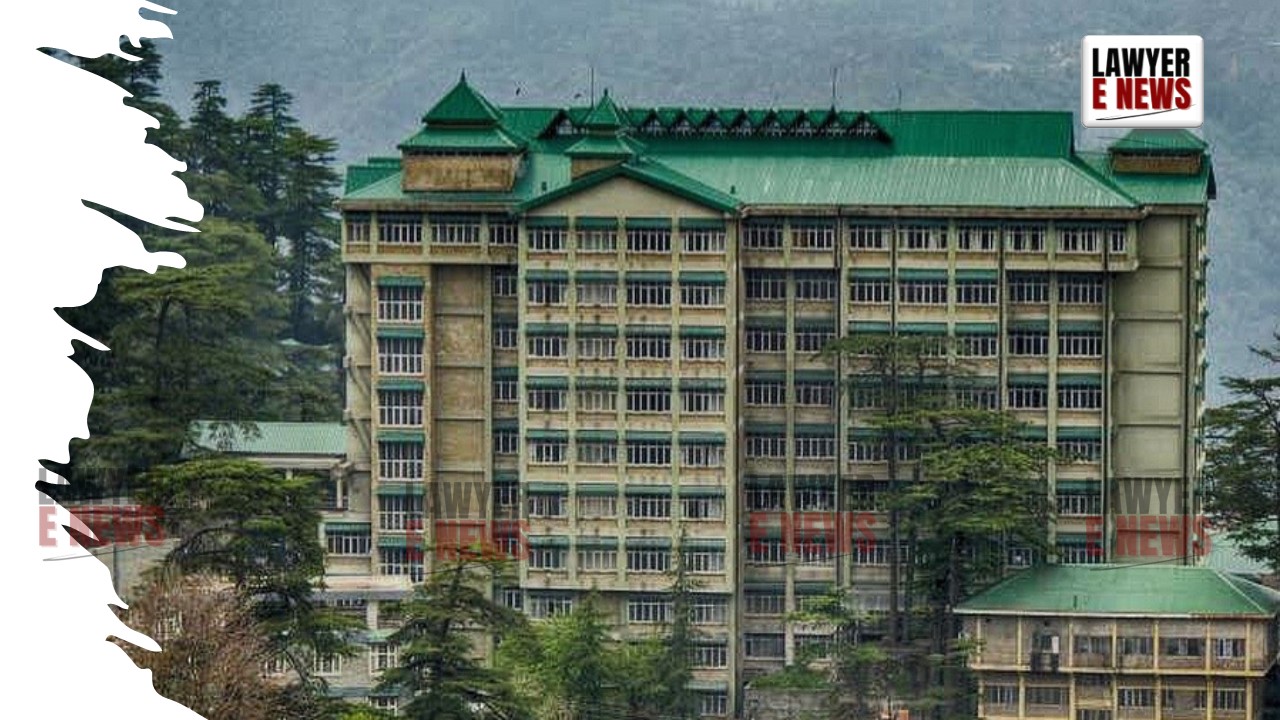
"Power under Section 279 BNSS must be exercised judicially and fairly without impairing the cause of administration of criminal justice." Himachal Pradesh High Court, in a significant ruling, held that a trial court should not straightway dismiss a criminal complaint in default due to a singular instance of non-appearance by the complainant.
A single bench of Justice Sandeep Sharma observed that such a dismissal has the serious consequence of acquittal and therefore, the Magistrate must exercise the discretion to adjourn the matter or dispense with personal attendance to ensure substantial justice.
The appellant, Anita Kanwer, had filed a criminal complaint under Section 138 of the Negotiable Instruments Act against the respondent. On April 8, 2025, the Additional Chief Judicial Magistrate (ACJM), Shimla, dismissed the complaint in default after the matter was called repeatedly and neither the complainant nor her counsel appeared. The appellant challenged this dismissal before the High Court, contending that unavoidable circumstances prevented her appearance and she expected her counsel to seek an adjournment.
The primary question before the court was whether a trial court is justified in dismissing a complaint in default under Section 279 of the Bharatiya Nagarik Suraksha Sanhita (BNSS) for a single instance of non-appearance. The court also examined whether such a dismissal, which amounts to an acquittal, violates the principles of judicial discretion and fair trial.
Discretionary Power of Magistrate Under Section 279 BNSS
The Court began by analyzing Section 279 of the BNSS, which corresponds to the erstwhile Section 256 of the CrPC. The bench noted that this provision confers a choice upon the Magistrate to either acquit the accused or adjourn the hearing to another day. The proviso to the section further empowers the Magistrate to dispense with the personal attendance of the complainant if they are represented by an advocate or if their presence is not deemed necessary.
"Magistrate may, dispense with his attendance and proceed with the case."
Finality of Acquittal and Section 403 BNSS
Justice Sharma emphasized the gravity of a dismissal in default, noting that under Section 403 of the BNSS (erstwhile Section 362 CrPC), once a court signs its judgment or final order, it cannot alter or review the same except to correct clerical errors. Since a dismissal for non-appearance in a summons case results in an acquittal, it becomes final and cannot be restored by the trial court itself, necessitating an appeal to the High Court.
Court Not To Straightway Proceed To Acquit In Invitum
Citing the Supreme Court's decision in Associated Cement Co. Ltd. v. Keshvanand, the High Court reiterated that while the law protects an accused against dilatory tactics, it does not mean a court must automatically acquit the accused if the complainant is absent. The bench held that the trial court, instead of "axing down" the complaint, could have issued a fresh notice or adjourned the matter to another date to ensure the cause of justice was not impaired.
"Power must be exercised judicially and fairly without impairing the cause of administration of criminal justice."
Singular Default vs. Track Record of Complainant
The Court observed that there was nothing on record to suggest the complainant had a history of defaults in pursuing the case. Highlighting the precedent in Mohd. Azeem v. A. Venkatesh, the Court held that a singular default in appearance should not result in a failure of justice. The bench remarked that the trial court ought to have ignored the one-time absence and adjourned the matter to do substantial justice between the parties.
"Default being singular, ought to have been ignored by the Court and to do substantial justice, it ought to have adjourned the matter."
Application of Supreme Court Precedents on Section 138 Cases
The Court relied on S. Anand v. Vasumathi Chandrasekar and M/s BLS Infrastructure Limited v. M/s Rajwanti Singh, where the Apex Court deprecated the practice of dismissing complaints for non-appearance. The Court noted that if evidence has already been led, the Magistrate could even proceed to decide the matter on merits rather than ordering a dismissal. In the present case, the High Court found the ACJM's order to be "wholly unjustified" given the serious consequences involved.
"Magistrate was not justified in straight away dismissing the complaint(s) and ordering acquittal of the accused on mere non-appearance."
Final Directions and Restoration of Complaint
Concluding that the trial court failed to exercise its discretion with the requisite care and caution, the High Court set aside the impugned order. The Court ordered the restoration of Criminal Complaint No. 1351/2023 to its original number and directed the trial court to proceed from the stage at which it was dismissed. The parties were directed to appear before the trial court on May 6, 2026.
The High Court reaffirmed that the power to dismiss a complaint for non-appearance is a discretionary tool intended to check harassment, not a mechanical trap to penalize a complainant for a single instance of absence. By setting aside the acquittal, the Court ensured that the statutory remedy under the NI Act is not frustrated by technical defaults.
Date of Decision: 16 April 2026