-
by sayum
11 August 2026 7:51 AM







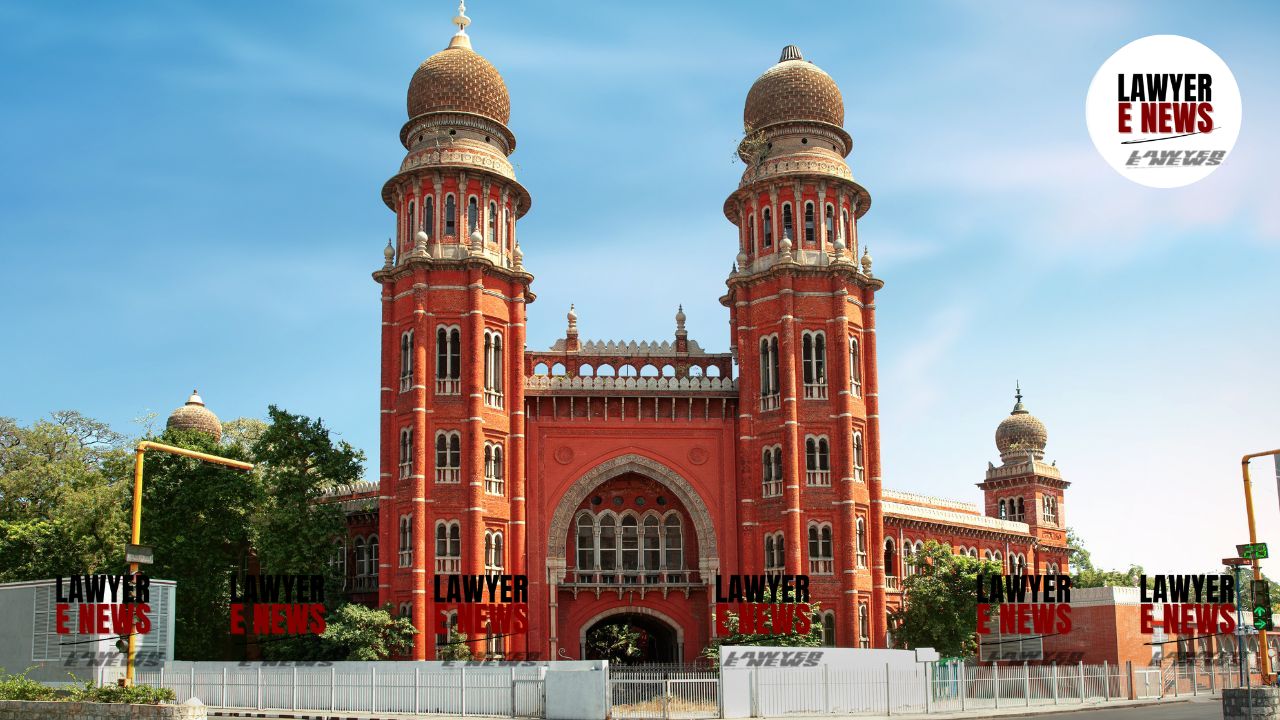
"The stand taken by the husband that the wife was unfit for matrimonial life merely because she had sustained a hip fracture prior to the marriage reflects an unfortunate and insensitive attitude and hard heartedness towards persons who have some health issues and the insistence of the husband on seeking dissolution of marriage solely on account of the wife's physical disability also shows lack of empathy and compassion towards a spouse who became the victim of an unfortunate accident," Madras High Court.
Madras High Court, in a significant ruling, held that seeking dissolution of marriage solely on the ground of a spouse's pre-existing physical disability resulting from an accident is legally unsustainable and contrary to constitutional values of dignity and equality. A division bench comprising Justice N. Anand Venkatesh and Justice K.K. Ramakrishnan observed that branding a partner unfit for married life due to accidental injuries reflects a complete lack of empathy and humanity.
The appellant-husband and respondent-wife were married in June 2010 and had a son born in 2011, though a second pregnancy was terminated medically. The husband approached the Family Court seeking divorce under Section 13(1)(i-a) of the Hindu Marriage Act, 1955, alleging that the wife had suppressed a pre-marital hip fracture and resultant physical disability, and suffered from mental depression leading to suicidal threats and cruelty. The wife contested the petition, asserting that the husband was fully aware of her medical history prior to the marriage and that she was subjected to harassment and cruelty by her in-laws. The Family Court dismissed the husband's divorce petition in September 2020, prompting the present civil miscellaneous appeal before the High Court.
The primary question before the High Court was whether the husband had established that the wife subjected him to mental cruelty within the meaning of Section 13(1)(i-a) of the Hindu Marriage Act, 1955. The court was also called upon to determine whether pre-marital physical disability and alleged non-disclosure thereof constitute valid grounds for dissolution of marriage.
Court's Observations And Judgment Husband Admits Disability Was Main Reason
During his deposition, the husband candidly admitted that the principal reason for seeking a divorce was the wife's hip fracture and partial disability. The bench noted that making this the core foundation for a dissolution petition reveals an unfeeling and discriminatory approach towards victims of unfortunate accidents.
"Physical Disability Does Not Render One Unfit For Marriage"
The court emphasized that physical disability or the consequences of an accident do not render a person incapable of leading a fulfilling matrimonial life. Across society, countless persons with disabilities discharge their family responsibilities with dignity, and humanity demands compassion rather than contempt.
Constitutional Ethos And Statutory Limits Section 5 Hindu Marriage Act Does Not Bar Disability
The bench underscored that Section 5 of the Hindu Marriage Act does not contemplate past accidental injury as a ground affecting the validity of a marriage. To recognize disability as a ground for divorce would legitimize discrimination, directly contravening the constitutional ethos of equality, dignity, and non-discrimination.
"Disability Can Not Be Seen As A Crime Or Sin"
The court observed that treating a partner's misfortune as a matrimonial offence undermines the very institution of marriage, which fundamentally requires mutual tolerance, adjustment, and support during adversities.
Unsubstantiated Allegations Of Depression And Cruelty
The court held that the allegations regarding the wife's mental depression and frequent suicide threats remained entirely unproven, supported only by the interested testimony of the husband. Mere allegations, however serious, cannot substitute legal proof.
"Cruelty Must Be Established By Cumulative Effect"
Citing Supreme Court precedents including Samar Ghosh v. Jaya Ghosh and Achin Gupta v. State of Haryana, the bench reiterated that ordinary spousal tension, trivial irritations, and normal wear and tear of married life do not amount to legal cruelty.
Condonation Of Prior Incidents
The evidence revealed that the husband issued an initial legal notice in January 2013, after which the parties resumed cohabitation and normal marital relations. The court applied the doctrine of condonation, holding that the resumption of cohabitation acts as forgiveness of past matrimonial offenses, barring them from being raised subsequently.
Rejection Of Irretrievable Breakdown Argument
The court reiterated that the doctrine of irretrievable breakdown is not a statutory ground under the Hindu Marriage Act. Citing the Supreme Court Constitution Bench ruling in Shilpa Sailesh v. Varun Sreenivasan, the bench reaffirmed that only the Supreme Court can dissolve a marriage on this ground under Article 142 of the Constitution in exceptional circumstances.
Paramount Welfare Of The Child "Children Are Not Chattels Or Property"
Emphasizing that children are the worst sufferers of broken marriages, the court held that courts must protect the welfare of the child and decline divorce where spousal disputes arise merely from minor incompatibilities and intolerance.
Finding no sustainable legal ground to interfere with the lower court's findings, the High Court dismissed the civil miscellaneous appeal and confirmed the dismissal of the divorce petition. Additionally, the wife's civil miscellaneous petition seeking to receive additional documents was closed as unnecessary, given her established bona fide willingness to resume matrimonial life.
Date of Decision: 28 July 2026