-
by sayum
27 August 2026 7:40 AM







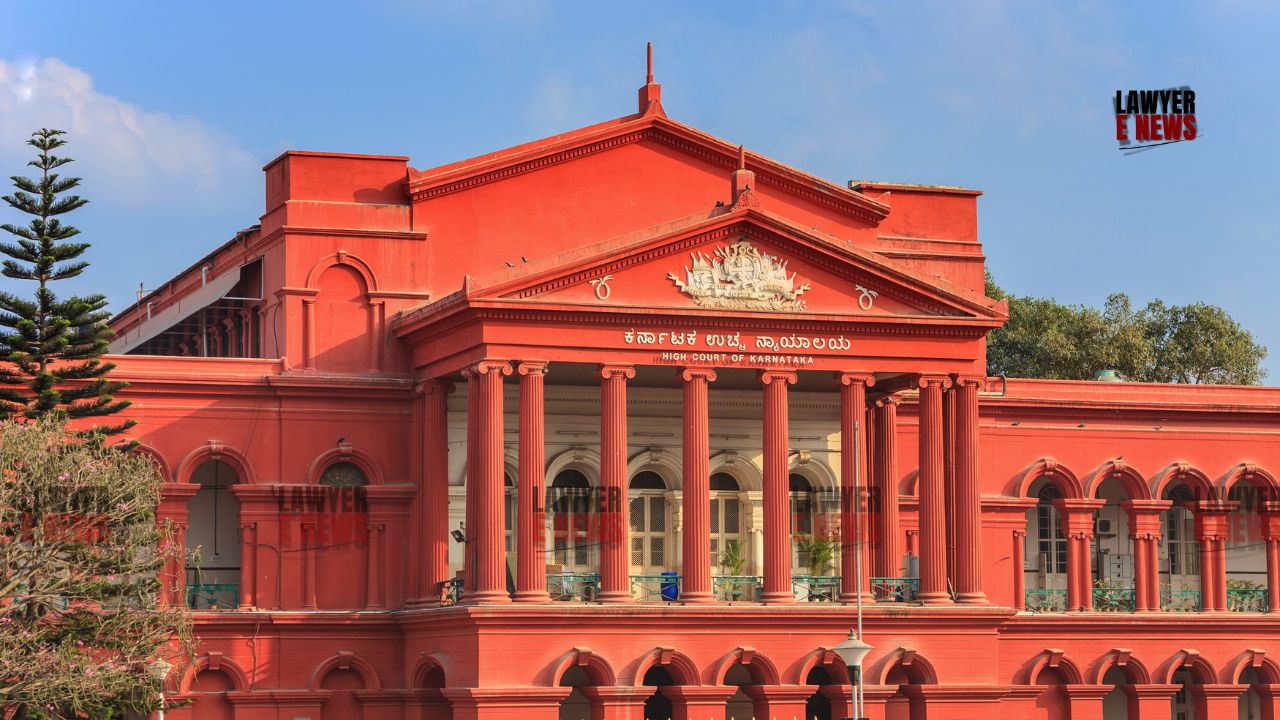
"If a case lacks prima facie material, absolute bar under Section 18 of the Act would not come in the way of the Court exercising discretion". When a complaint under the Scheduled Castes and Scheduled Tribes (Prevention of Atrocities) Act, 1989 does not even prima facie disclose the essential ingredients of the offence, the absolute bar on anticipatory bail under Section 18 of the Act simply does not operate — and Courts retain full discretion to grant relief. The Karnataka High Court has reaffirmed this principle while granting anticipatory bail to six accused persons whose alleged caste-based abuse, on a plain reading of the complaint, was witnessed by no one from the general public.
Justice M.G.S. Kamal, hearing an appeal against the rejection of anticipatory bail by the Sessions Court at Shivamogga, allowed the appeal after finding that the complaint failed to make out a prima facie case under Section 3(1)(s) of the Act and appeared to be part of an orchestrated series of litigations arising from a family property feud.
The case has its roots in a sprawling agricultural land dispute among the descendants of one Puttappa Gouda, who owned vast tracts of land in Yelavalli, Maradi and Thavarekoppa villages in Karnataka. His estate was partitioned among three branches of his descendants. The appellants — accused Nos. 1 to 6 — belonged to one branch, while the rival branch was led by one G.P. Veeresha Gouda.
The dispute had already spawned a civil suit (O.S. No. 11/2024) as well as cross-criminal complaints. On 23 December 2025, the rival branch registered Crime No. 1/2026 against forty members of the appellants' branch. The appellants filed a counter-complaint the same day, registered as Crime No. 3/2026, against seventeen persons including the very complainant who would later file the present case.
The complaint subject matter of this appeal was filed by one Mahendra, alleging that on 8 February 2026, the appellants intercepted him near Mavalli Circle, assaulted him and abused him in the name of his caste — purportedly because he had been a witness to the mahazar in Crime No. 1/2026. The Sessions Court rejected the anticipatory bail application, holding that the bar under Section 18 of the Act was absolute. The appellants challenged that order before the High Court.
Two questions arose for consideration: first, whether the absolute bar on anticipatory bail under Section 18 of the SC/ST (POA) Act is truly absolute even when the complaint does not prima facie make out an offence under Section 3; and second, whether the complaint in the present case satisfied the essential ingredient of Section 3(1)(s) — that caste-based abuse must occur "at a place within public view."
On the Absolute Bar Under Section 18 — It Is Not Without a Rider
The Court drew on the Supreme Court's recent exposition in Kiran v. Rajkumar Jivran Jain (2025 LiveLaw SC 869), which had crystallised the legal position with precision. While Section 18 of the Act does create an absolute bar against anticipatory bail for persons accused of offences under the Act, this absoluteness is not unconditional. "In a given case where on the face of it the offence under Section 3 of the Act is found to have not been made out and that the accusations relating to the commission of such offence are devoid of prima facie merits, the Court has a room to exercise the discretion to grant anticipatory bail," the Supreme Court had held — and the High Court applied this principle directly.
The Court also found guidance in Dr. Anand Rai v. State of Madhya Pradesh (2026 SCR 45), where the Supreme Court had explained the contours of threshold scrutiny. The test at the prima facie stage is not whether the accused is guilty, but whether the material on record discloses the essential ingredients of the offence. "Where these ingredients are conspicuously absent, interference is justified, as continuation of proceedings would amount to an abuse of the process of law," the apex court had held — a passage the High Court found directly applicable.
"Place Within Public View" — Only the Employer's Son Was Present
The Court then examined whether the complaint made out a prima facie case under Section 3(1)(s), which punishes abusing a member of a Scheduled Caste "by caste name in any place within public view." This ingredient is not a technicality — it is an essential element of the offence.
The Court relied on the Supreme Court's recent reaffirmation in Sohanvir alias Sohanvir Dhama v. State of U.P. (2025 SCC OnLine SC 2730), which had reiterated the settled interpretation: "To be a place 'within public view', the place should be open where the members of the public can witness or hear the utterance made by the accused to the victim. If the alleged offence takes place within the four corners of the wall where members of the public are not present, then it cannot be said that it has taken place at a place within public view."
Applying this test to the complaint, the Court found it wanting. The only person stated to have been present near the scene of the alleged offence was Shivaraj, son of Sureshappa Gouda — who had, in fact, escorted the complainant Mahendra to hospital after the incident. There were no averments in the complaint disclosing the presence of any member of the general public who witnessed the caste-based abuse. The complaint was therefore prima facie deficient on this essential ingredient.
The Web of Litigation — Complaint "Engineered in Furtherance of Prior Disputes"
The Court found considerable force in the argument that the present complaint was not an independent grievance but a tactical move in an ongoing family war. The links were striking: the complainant Mahendra's name appeared in Crime No. 1/2026 filed by the rival branch; Shivaraj — the sole "witness" in the present complaint — was the son of defendant No. 3 in the civil suit filed by the appellants' branch; and Mahendra himself was employed as a tractor driver under Shivaraj's father Sureshappa Gouda.
The Court noted that the appellants were local agriculturalists with no criminal antecedents and that the entire dispute traced back to a family property division. In this backdrop, the complaint appeared engineered to overreach the appellants through misuse of the SC/ST Act's stringent provisions.
The High Court set aside the Sessions Court's order and granted anticipatory bail to all six appellants, subject to conditions including execution of a personal bond of Rs. 1,00,000/- each with two sureties, obtaining regular bail within ten days, reporting to the jurisdictional police once every fifteen days until charge sheet is filed, regular appearance before the Trial Court, and a prohibition on tampering with witnesses or leaving the court's jurisdiction without permission.
The judgment reinforces a vital safeguard: the SC/ST Act's protective machinery — including its bar on anticipatory bail — is activated only when a complaint actually discloses the statutory ingredients of an atrocity offence. A complaint that fails this threshold test, particularly one emerging from complex civil and criminal disputes between rival factions, cannot invoke the Act's absolute bar to defeat a legitimate bail application.
Date of Decision: 09 April 2026