-
by sayum
27 August 2026 3:32 PM







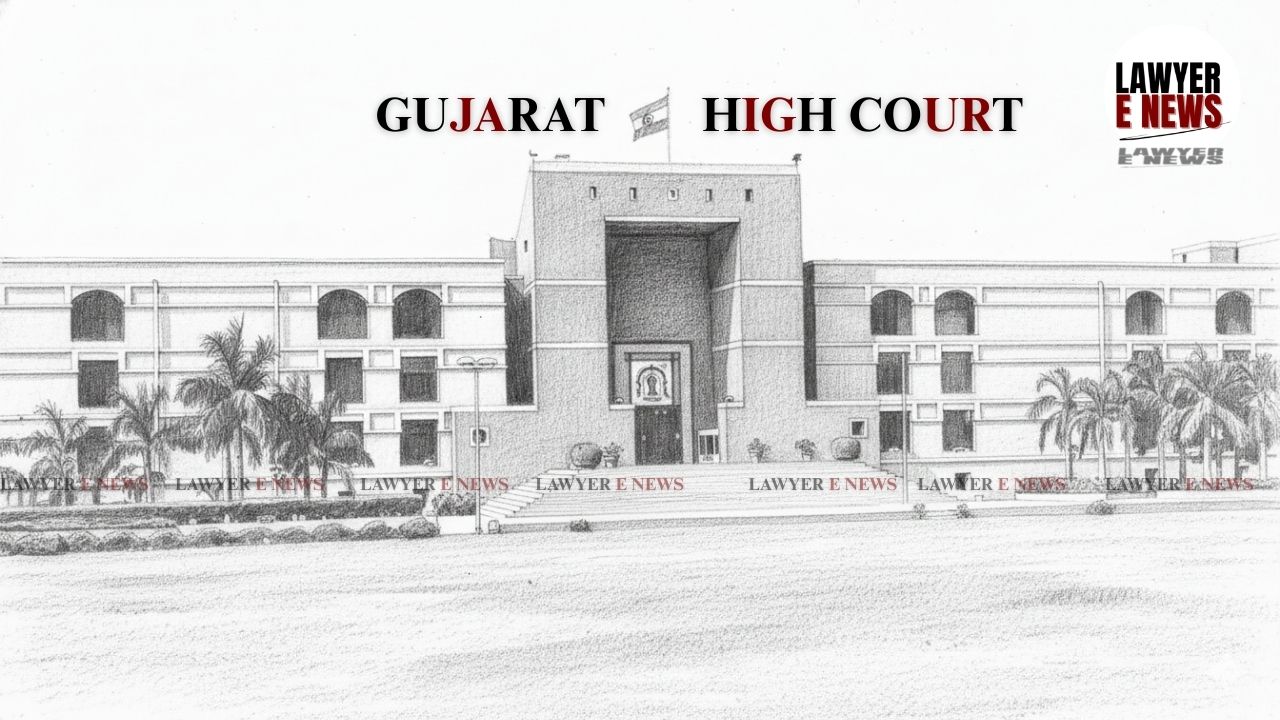
"It is by now well settled that the provision of section 53A operates only as a shield and not as a sword which can be used as a defense to resist dispossession but cannot be invoked as a basis to assert ownership or to seek affirmative relief such as specific performance or declaration of title," Gujarat High Court, in a decision dated May 6, 2026, has affirmed that the registration of a sale deed constitutes constructive notice to the public at large under Section 3 of the Transfer of Property Act, 1882.
A division bench comprising Justice Bhargav D. Karia and Justice L. S. Pirzada held that a suit challenging a sale deed seven years after its registration, based on an agreement to sale from 1984, is "hopelessly barred by limitation." The Court observed that such litigation, which employs clever drafting to create an illusion of a cause of action, must be rejected at the threshold under Order VII Rule 11 of the CPC.
The primary question before the court was whether the suit, filed 33 years after the agreement to sale and 7 years after the registered sale deed in favor of the third party, was barred by limitation. The Court also considered whether a plaintiff could invoke Section 53A of the Transfer of Property Act (TPA) to seek an affirmative declaration of title and whether a registered document serves as constructive notice under law.
Registered Documents Provide Constructive Notice Under TPA
The Court emphasized that the registration of a document serves as a legal notice to the world. Referring to Section 3 of the TPA, the bench noted that when any transaction relating to immovable property is required to be and has been effected by a registered instrument, any person acquiring such property shall be deemed to have notice of such instrument from the date of registration.
The Court held that the sale deed executed in 2010 was a registered public document. Consequently, the plaintiffs are deemed to have had constructive notice of its execution. The bench observed that the plaintiffs' plea of "lack of knowledge" until 2017 was untenable because they failed to assert their rights within the prescribed period of limitation following the 2010 registration.
Section 53A TPA Operates Only As A Shield, Not A Sword
The Court dealt extensively with the scope of Section 53A of the TPA, which concerns part performance. The bench clarified that this provision does not confer ownership or any enforceable title upon the transferee. It is a settled legal position that the doctrine of part performance can only be used as a defense to protect possession against the transferor.
The bench observed that the plaintiffs could not rely on Section 53A to support a cause of action for the enforcement of contractual rights or a declaration of title. "The plaintiffs, therefore, cannot rely upon section 53A in support of cause of action for enforcement of any contractual right as per the settled legal position," the Court noted, adding that such a plea is untenable once the primary claim for specific performance is barred.
"Clever Drafting" Cannot Circumvent The Law Of Limitation
The High Court scrutinized the averments in the plaint, characterizing them as an exercise in "clever drafting" designed to avoid the bar of limitation. The bench noted that while the plaintiffs claimed knowledge only from a 2017 newspaper notice, they failed to explain their silence between 1984 and 2017.
The Court held that the suit was essentially based on an agreement from 1984, and the right to seek specific performance had accrued decades ago. By merely challenging a later deed from 2010 in 2017, the plaintiffs could not revive a stale claim. The bench remarked that allowing such suits to proceed would amount to permitting an abuse of the judicial process.
Absence Of Prayer For Specific Performance Fatal To Suit
The Court further noted that the plaintiffs had sought a declaration of ownership and the setting aside of the 2010 deed but had conspicuously omitted a prayer for specific performance of the 1984 agreement. Under Section 34 of the Specific Relief Act, a court shall not make a declaration where the plaintiff, being able to seek further relief than a mere declaration of title, omits to do so.
The bench found that since the plaintiffs failed to seek the substantive relief of specific performance, which was already time-barred, they were not entitled to a mere declaratory decree or a permanent injunction. The Court held that "once the plaintiffs have failed to get any substantive relief of cancellation of the sale deed and failed to get any declaratory relief... the prayer for permanent injunction must fail."
The High Court concluded that the Trial Court committed no error in rejecting the plaint under Order VII Rule 11 of the CPC. It held that the suit was a "meaningless litigation" that did not disclose a valid cause of action and was clearly barred by the Limitation Act. The appeal was accordingly dismissed, affirming that the registration of property documents creates a legal presumption of knowledge that parties cannot ignore for decades.
Date of Decision: 06 May 2026