-
by sayum
27 August 2026 3:32 PM







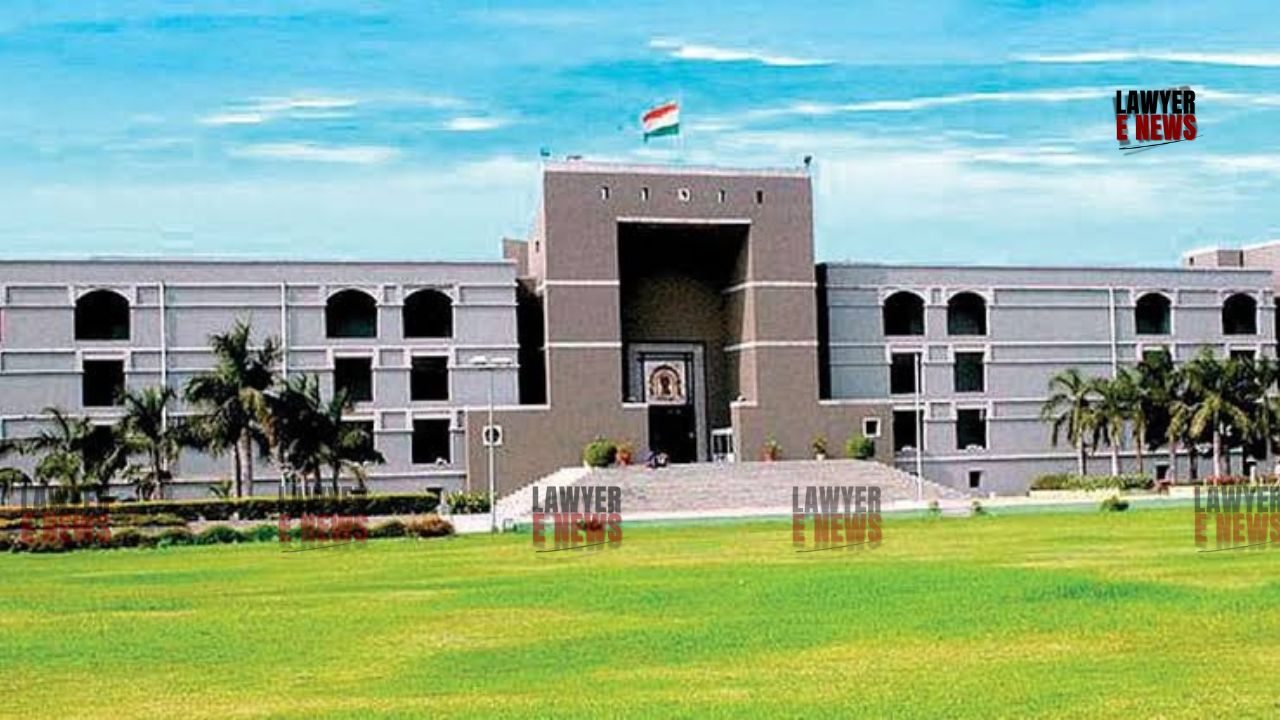
"Whenever there exists any suspicion as to the execution of the Will, it is the responsibility of the propounder to remove all legitimate suspicions before it can be accepted as the testator's last Will. In such cases, the initial onus on the propounder becomes heavier," Gujarat High Court, in a significant judgment, held that the mere proof of a signature on a Will is insufficient to grant probate if the propounder fails to dispel legitimate suspicious circumstances.
A Single Judge Bench of Justice J. C. Doshi observed that the court’s conscience must be satisfied that the instrument was the free and conscious act of a testator in a sound state of mind. The Court set aside a 1995 Trial Court order that had granted probate in favor of a beneficiary, noting that the propounder failed to explain how a testator suffering from advanced jaw cancer could have executed the document just seven days before his death.
The dispute arose between two brothers, Bhaskar and Harishchandra Pednekar, over a tenement property in Ahmedabad following the death of their father, Ramchandra, in July 1981. Bhaskar (the Plaintiff) moved a probate application claiming that his father had executed a Will on July 18, 1981, bequeathing the property solely to him. Harishchandra (the Defendant) contested the Will, alleging it was a fabricated document created to grab the property. He pointed out that their father was suffering from advanced tongue and jaw cancer at the time of the alleged execution and died within a week. The City Civil Court at Ahmedabad granted probate in 1995, which was subsequently challenged in the present first appeal.
The primary question before the court was whether the propounder of the Will had successfully dispelled the suspicious circumstances shrouded around its execution as required under the Indian Succession Act. The Court also had to determine if the Trial Court was correct in granting probate to a beneficiary when the Will did not specifically appoint an executor. Additionally, the court examined whether the medical condition of the deceased and contradictions in witness testimonies rendered the Will invalid.
Only Appointed Executor Entitled To Grant Of Probate
The High Court first pointed out a significant procedural flaw in the Trial Court's judgment. It observed that under Section 222 of the Indian Succession Act, probate can be granted only to an executor appointed by the Will. In this case, the Will at Exh.80 did not appoint Bhaskar as an executor but only named him as a beneficiary.
The Bench noted that a beneficiary must seek Letters of Administration with the Will annexed rather than a probate. While the Court chose not to dismiss the case on this technicality alone, it emphasized that the Trial Court failed to understand this "thin line difference" which has a large aftermath effect on testamentary jurisdiction.
Trial Court Erred In Converting Probate Into Regular Civil Suit
The Court expressed disapproval of the Trial Court’s decision to convert the probate proceedings into a regular civil suit and passing a "decree." Justice Doshi clarified that as per Section 295 of the Indian Succession Act, contentious probate proceedings must be conducted "as nearly as may be" in the form of a regular suit, but they do not lose their character as testamentary proceedings. The Court noted that such a practice of granting a formal decree in a probate matter is unknown to the provisions of the Act.
Propounder Must Satisfy The Court's Conscience
Citing the landmark Supreme Court ruling in H. Venkatachala Iyengar v. B.N. Thimmajamma, the High Court reiterated that the proof of a Will is not a simple "lis" between two parties but a matter of the Court’s conscience. It held that the propounder is required to lead "cogent and convincing" evidence to remove any clouds of suspicion.
The Court observed that suspicious circumstances include a shaky signature, a feeble mind of the testator, or an unfair disposition of property where the propounder takes a leading part in the making of the Will.
Severe Medical Ailment Casts Doubt On Testamentary Capacity
The Court took serious note of the fact that the deceased was suffering from advanced "malignant neoplasm" (cancer) of the jaw and tongue. Medical records showed that the deceased had undergone surgery and intensive treatment shortly before the Will's execution. The Bench questioned whether a person in such a state could have traveled 10 kilometers to a court to instruct an advocate and speak clearly.
The Court found it suspicious that the Plaintiff did not examine any medical experts to prove that the deceased was in a sound disposing state of mind despite the terminal illness. It noted that the deceased died within seven days of the alleged execution, which, when coupled with the lack of mental capacity evidence, creates a "significant suspicious circumstance."
Contradictions In Witness Testimonies Regarding Execution
Upon perusing the depositions of the Plaintiff, the attesting witness, and the scribe, the Court found glaring inconsistencies. The Plaintiff claimed to be present during the execution, whereas the attesting witness admitted during cross-examination that the Plaintiff was not present.
Furthermore, the scribe testified that he read over the Will and the deceased acknowledged it as "Ok," but this critical assertion was missing from the testimonies of the other witnesses. The Court held that such contradictions regarding the physical presence of parties at the time of signing go to the root of the matter and create doubt about the genuineness of the Will.
Unusual Features Of The Disputed Will
The Court highlighted several "non-normal" features of the document. Firstly, the deceased had not signed the first page of the Will. Secondly, the Will only mentioned one property despite the deceased owning other assets. Thirdly, the names of other legal heirs were conspicuously missing.
The Bench observed that while a testator has the right to dispose of only one property, it is unusual not to mention other family members or the reasons for their exclusion. This, the Court noted, suggested an "intention to grab a specific property" rather than a bona fide testamentary disposition.
Posthumous Registration Does Not Validate A Suspicious Will
The Court addressed the fact that the Will was registered posthumously by the attesting witnesses. Relying on the Supreme Court's decision in Rani Purnima Debi v. Kumar Khagendra Narayan Deb, the Bench held that mere registration does not establish the genuineness of a Will if suspicion exists.
The Court found that the Plaintiff failed to explain why the Will was executed just seven days before death and why it was registered only after the testator had passed away. These unexplained factors remained "non-normal circumstances" that vitiated the disposition.
The High Court concluded that the Trial Court had been "swayed by the execution of the Will" and failed to properly analyze the surrounding suspicious circumstances. Since the Plaintiff failed to discharge the heavy burden of proof required in testamentary matters, the Court held that he could not avail the benefit of the document. The appeal was allowed, and the judgment of the City Civil Court granting probate was quashed and set aside.
Date of Decision: May 1, 2026