-
by sayum
06 November 2026 3:50 PM







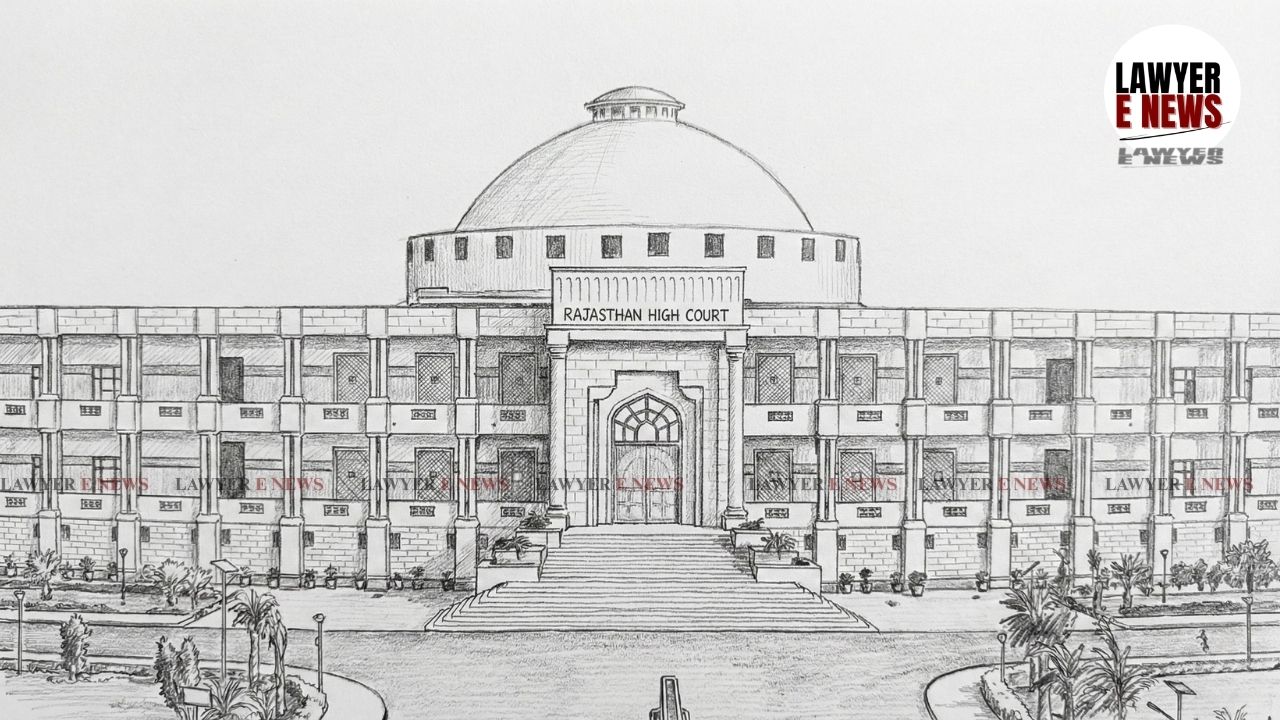
"A prisoner convicted under Section 376 IPC or POCSO Act is not totally ineligible for transfer to an Open Air Camp. However, such a prisoner has no automatic right to admission in Open Air Camp, and the nature and gravity of the offence including the age of the victim and the facts of the case are legitimate considerations for the Advisory Committee..." Rajasthan High Court, in an authoritative Full Bench ruling delivered on October 26, 2026, held that convicts sentenced under Section 376 of the Indian Penal Code (IPC) or the Protection of Children from Sexual Offences (POCSO) Act are not entirely barred from being transferred to Open Air Camps under the Rajasthan Prisoners Open Air Camp Rules, 1972.
A Bench comprising Chief Justice Sanjay K. Agrawal, Justice Sameer Jain, and Justice Praveer Bhatnagar resolved divergent Division Bench views, declaring that the expression "ordinarily" in Rule 3 does not impose an absolute disqualification. The Court clarified that while such convicts possess no automatic entitlement to admission, the Advisory Committee cannot summarily refuse consideration and must carry out an individualized, reasoned assessment based on institutional conduct and reformative potential.
The reference arose out of conflicting views expressed by co-ordinate Division Benches of the High Court concerning the interpretation of Rule 3(d) read with Rule 4 of the 1972 Rules. While one set of rulings adopted a liberal approach holding that disqualification under Rule 3 is not absolute, another line of judgments took a restrictive stance, ruling that convicts under Section 376 IPC or the POCSO Act are ineligible solely due to the gravity of their crimes and the safety of families and children residing in Open Air Camps. Confronted with this persistent divergence, a Single Judge referred the legal question to a Larger Bench to definitively settle the law.
The primary question referred to the Full Bench was whether a prisoner convicted for offences under Section 376 IPC or the POCSO Act, undergoing a sentence of imprisonment in jail, can be shifted to an Open Air Camp in view of Rule 3 of the Rajasthan Prisoners Open Air Camp Rules, 1972. The Bench was also called upon to determine whether the qualifying statutory term "ordinarily" operates as a rebuttable threshold admitting exceptions or as an inflexible policy-level exclusion.
Open Air Camps As Instruments Of Reformative Penology
The Full Bench commenced its analysis by highlighting that Open Air Camps in Rajasthan serve as a pre-release halfway mechanism framed under Section 59(18) of the Prisons Act, 1894, to encourage good conduct, self-discipline, and social readjustment. Relying on the Supreme Court ruling in Rama Murthy v. State of Karnataka, the Bench recalled that open prisons represent one of the most successful applications of individualizing penalties to foster social reintegration and prevent convicts from relapsing into crime.
The Court also referenced the landmark decision in Suhas Chakma v. Union of India, wherein the Apex Court commended the Rajasthan model as a best practice while observing that open correctional institutions remain severely underutilized due to stringent criteria. The Bench underscored that the Supreme Court had explicitly directed States to revisit and rationalise eligibility criteria to focus on demonstrated reformative potential, institutional conduct, and individualised transparent assessments rather than rigid exclusions.
Statutory Framework Under Rules 3 And 4 Of The 1972 Rules
Examining the regulatory framework, the Bench observed that Rule 3 enumerates categories of prisoners who "shall ordinarily be not eligible for being sent to Open Camp," with sub-clause (d) specifying offences under Section 376 IPC among others. Rule 4 separately prescribes affirmative criteria, including regular performance of scheduled tasks and serving one-third of the substantive sentence, while stipulating that the prisoner must not fall within the categories in Rule 3.
The Court noted that Rule 14 places the assessment and evaluation of eligible convicts before a specialised Advisory Committee comprising correctional officials, prison psychologists, and probation officers. Additionally, under Rule 6, the Inspector General of Prisons and the Advisory Committee exercise structured discretion based on length of incarceration and accommodation, rather than ordering mechanical transfers.
Judicial Construction Of The Expression 'Ordinarily'
Addressing the fulcrum of the dispute, the Bench held that the word "ordinarily" qualifies the ineligibility in Rule 3 and cannot be rendered superfluous or treated as an iron-cast mandate. Surveying precedents including Kailash Chandra v. Union of India, Krishan Gopal v. Shri Prakashchandra, and Union of India v. Majji Jangamayya, the Court reiterated that "ordinarily" conveys what is done normally or in a large majority of cases, but not invariably.
Citing Commissioner of Customs, Mumbai v. J.D. Orgochem Ltd. and Union of India v. Hemraj Singh Chauhan, the Bench observed that the statutory context remains decisive, but the phrase cannot be rewritten by judicial interpretation. The Court emphasized that treating the provision as a blanket ban would do violence to the plain statutory language drafted by the rule-makers.
"Rule 3(d) as an absolute bar would effectively substitute the expression 'shall not be eligible' for the actual expression 'shall ordinarily be not eligible'. Such a construction would give no operative meaning to the word 'ordinarily'."
No Automatic Right Versus No Right To Consideration
The Full Bench drew a fundamental legal distinction between having an automatic right to admission and having a right to fair consideration. The Court clarified that while a convict under Section 376 IPC or the POCSO Act cannot claim admission as a matter of right, the competent authority is equally precluded from refusing to consider the application solely because the conviction falls under Rule 3(d).
The Bench noted that a prisoner seeking departure from the ordinary bar carries the burden of establishing special or exceptional circumstances before the authority. Conversely, if the executive treats the exclusion as unyielding, it would effectively exercise an unrestricted arbitrary power contrary to the reformative architecture of the rules.
Non-Arbitrary Exercise Of Power Under Article 14
Grounding its reasoning in constitutional principles, the Bench ruled that the Advisory Committee's discretion under Rules 6 and 14 must strictly conform to Article 14 of the Constitution of India. The Court held that while Article 14 does not confer an inherent fundamental right to enter an open prison, it guarantees that administrative discretion must be exercised rationally, consistently, and upon relevant material.
Invoking the landmark jurisprudence in Sunil Batra v. Delhi Administration, the Bench reaffirmed that lawful incarceration does not extinguish constitutional personhood and human dignity. Consequently, a summary rejection of an application without evaluating whether special mitigating or reformative circumstances exist would render the statutory discretion arbitrary and unconstitutional.
Overruling Of Restrictive Precedents And Final Directives
Resolving the cleavage of judicial opinion, the Full Bench formally overruled the restrictive Division Bench decisions in Rajendra @ Goru v. State of Rajasthan, Bhag Singh @ Bhagirath v. State of Rajasthan, and Vipin @ Vinkesh @ Vika v. State of Rajasthan. The Court held that these rulings did not lay down the correct position of law in treating convicts under Section 376 IPC or the POCSO Act as barred per se from open camps.
The Court concluded that the Advisory Committee must make an individualized, reasoned assessment of the convict's institutional conduct, reformative potential, risk, and readiness for social reintegration. Where such convicts are found suitable, the Committee remains fully empowered to impose stringent conditions to safeguard other inmates and children, and to promptly revoke the placement in the event of any breach.
Answering the reference, the Full Bench established that convicts under Section 376 IPC or the POCSO Act are not totally ineligible for transfer to Open Air Camps under Rule 3(d) of the 1972 Rules, though they possess no automatic entitlement. The Bench directed the Registry to place the individual writ petitions before the appropriate Division Bench for adjudication on merits in accordance with the answered questions of law.
Date of Decision: 26 October 2026