-
by sayum
27 August 2026 7:40 AM







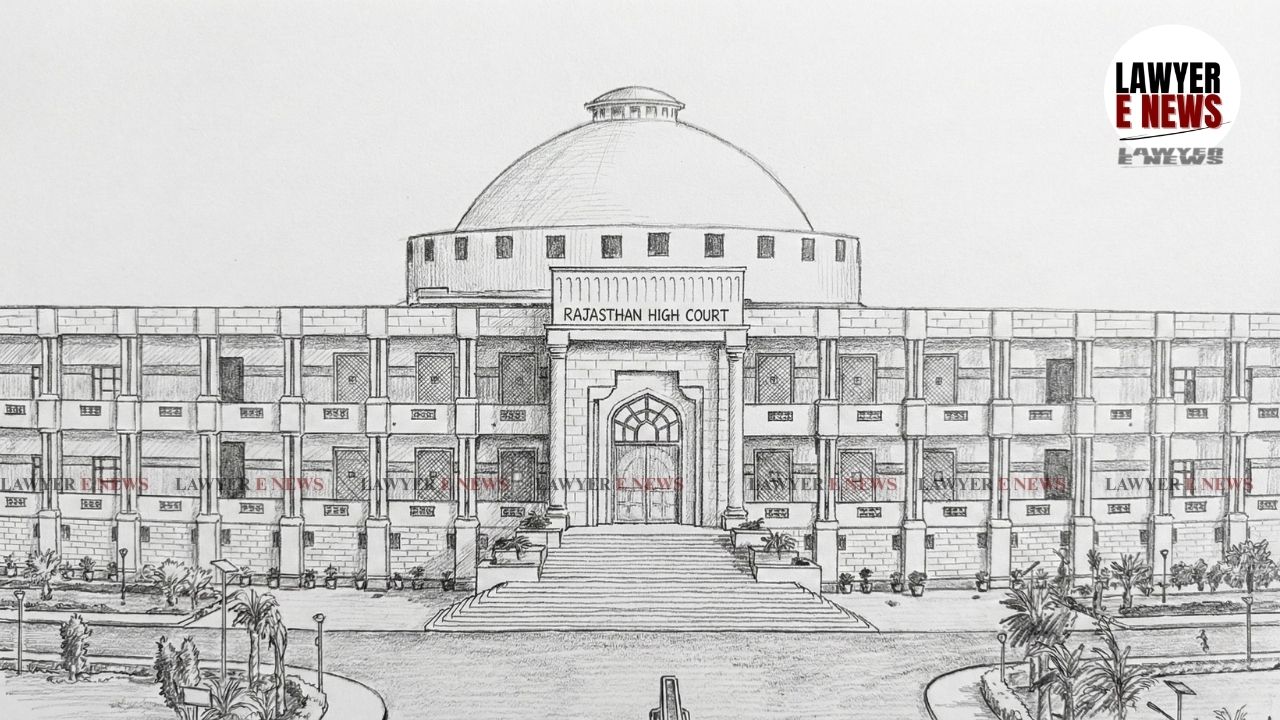
"When jurisdiction is not assigned to adjudicate the matter, then the Tribunal, being a creation of statute, cannot assume its jurisdiction." Rajasthan High Court, in a significant ruling, held that the Rajasthan Civil Services Appellate Tribunal does not possess the statutory jurisdiction to adjudicate matters pertaining to compulsory retirement.
A single-judge bench of Justice Ashok Kumar Jain observed that since the subject is not explicitly enumerated in the governing statute, any order passed by the Tribunal assuming such jurisdiction is a nullity in the eyes of the law.
The respondent, a Sub-Inspector of Police with a tainted service record comprising 43 departmental proceedings, was compulsorily retired by the Inspector General of Police under Rule 53(1) of the Rajasthan Civil Services (Pension) Rules, 1996. He successfully challenged this action before the Rajasthan Civil Services Appellate Tribunal, which set aside his retirement and imposed a penalty of Rs. 2 lakhs on the erring official. Aggrieved by the Tribunal's decision and its assumption of jurisdiction, the State of Rajasthan approached the High Court.
The primary question before the court was whether compulsory retirement qualifies as a service matter under Section 2(f) of the Rajasthan Civil Services Appellate Tribunal Act, 1976, thereby granting the Tribunal jurisdiction. The court was also called upon to determine if subsequent post-facto approval by the State Government validates an order of compulsory retirement initially passed without prior sanction.
The court first examined Section 2(f) of the Rajasthan Civil Services Appellate Tribunal Act, 1976, which exhaustively defines the service matters falling within the Tribunal's domain. The bench noted that the subject of compulsory retirement is conspicuously absent from this statutory list, preventing the Tribunal from entertaining such appeals. The court strongly condemned the Tribunal for overstepping its boundaries without providing adequate justification, noting that none of the enumerated subjects could be stretched to include compulsory retirement. "None of the subjects as mentioned in Section 2(f) is sufficient to assume that compulsory retirement is incidental to the matters provided therein."
Statutory tribunals are strictly bound by their parent legislation and cannot expand their own jurisdictional mandate.
Expanding on the consequences of this overreach, the bench elaborated that a tribunal, being entirely a creature of statute, cannot inherently assume powers that the legislature chose not to confer. Consequently, the High Court held that the Tribunal committed a grave error by adjudicating the respondent's appeal, rendering its entire exercise of power legally void. The court clarified that such judicial overreach results in an outcome that holds no weight in law and must be struck down. "Thus, the Tribunal was not having any jurisdiction to adjudicate upon the appeal preferred by the respondent and any order passed without jurisdiction is a nullity."
Addressing the substantive nature of the State's action, the court relied on established Supreme Court precedents, including Central Industrial Security Force v. HC GD Omprakash. The bench reiterated that compulsory retirement is an administrative tool utilized to improve public system efficiency by weeding out deadwood, and it is not a punitive measure. The court observed that the action involves no civil consequences and is governed by the doctrine of pleasure emanating from Article 310 of the Constitution of India, meaning principles of natural justice are not embodied rules here. "The order of compulsory retirement is in public interest and is based on the subjective satisfaction of the Government and is not liable to be quashed by the Court merely for the reason that uncommunicated adverse remarks were taken into consideration."
A right to file a representation does not equate to a statutory alternative remedy that bars writ jurisdiction.
The court then turned to the State's procedural objection regarding alternative remedies under Section 4A of the 1976 Act. The State had argued that the respondent bypassed the law by not filing a representation under Rule 53(4) of the Pension Rules before approaching the Tribunal. However, the High Court clarified that this provision merely grants a right to represent and does not constitute a formal statutory alternative remedy that must be exhausted. The bench concluded that an aggrieved employee's only valid legal recourse against compulsory retirement is to directly invoke the constitutional courts. "
Rule 53(4) is not an alternative remedy provided against compulsory retirement; therefore, there was no remedy before the respondent except to file a writ petition under Article 226 of the Constitution of India."
"If any approval was not taken at the time of compulsory retirement, then it is a bonafide act and not a malafide act."
Finally, the court discussed the procedural irregularity regarding the lack of prior approval, which the Tribunal had previously deemed malicious. The High Court observed that the Director General of Police had subsequently secured post-facto approval from the State Government for 76 officials, including the respondent, demonstrating complete governmental agreement with the retirement order. The court noted that failing to observe non-binding administrative guidelines regarding prior approval does not automatically render an administrative action malicious or vindictive. "Herein, neither before this Court nor before the Tribunal has any material been placed to show that the respondent was intentionally compulsorily retired... therefore, this is not a case of malice in law."
Ultimately, the High Court allowed the writ petition filed by the State and quashed the Tribunal's order dated April 15, 2021. The ruling firmly establishes that aggrieved employees facing compulsory retirement in Rajasthan must directly approach the High Court under Article 226, as the State's Civil Services Appellate Tribunal lacks the statutory mandate to hear such disputes.
Date of Decision: 27 March 2026