-
by sayum
27 August 2026 7:40 AM







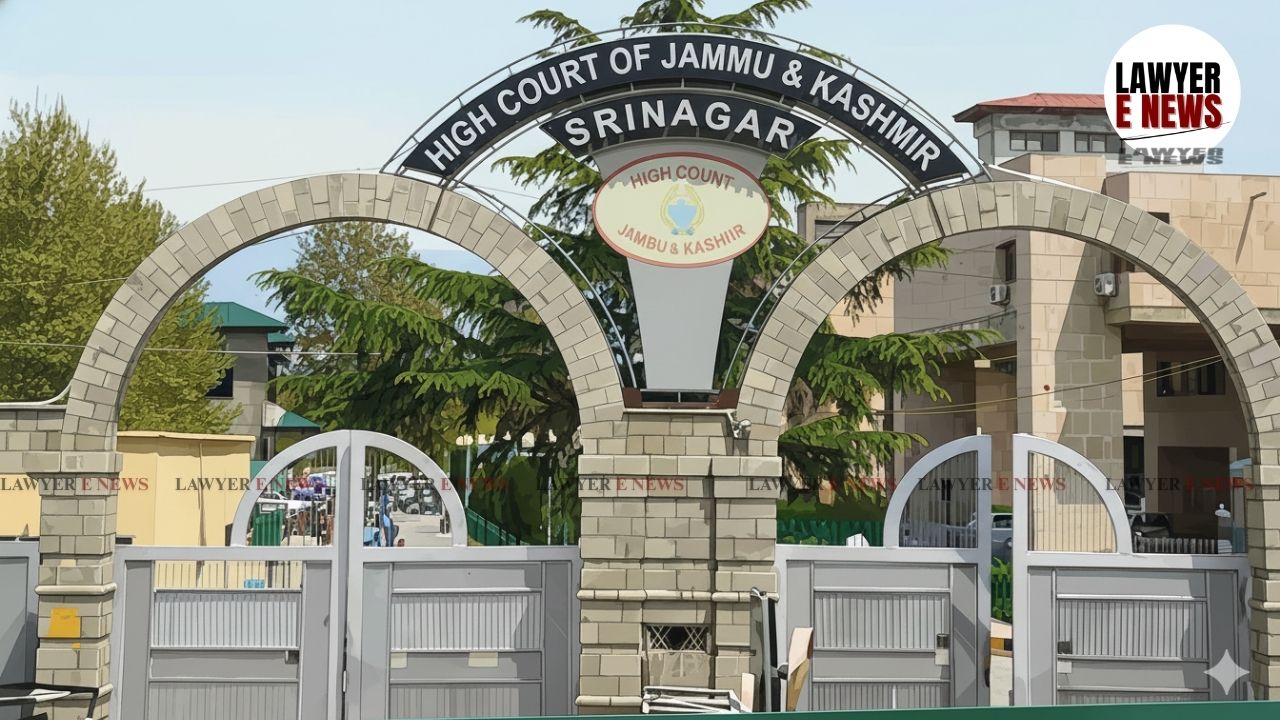
"Aim of investigation and inquiry whether by police or by Magistrate is to ensure that only those persons, who have actually committed the crime are made to face the trial and those, who are not involved in the commission of the crime, are not unnecessarily dragged to face the trial." Jammu & Kashmir and Ladakh High Court, in a significant ruling, held that the investigating agency is duty-bound to verify the defence projected by an accused to ensure a fair investigation under Article 21 of the Constitution of India.
A bench of Justice Sanjay Dhar observed that a "half-baked" investigation that fails to utilize modern forensic technology to ascertain crucial facts cannot form the basis for framing corruption and forgery charges against an accused.
The petitioner, a former Naib Tehsildar, was accused of conniving with a Patwari to tamper with revenue records between 2009 and 2012 to confer undue land benefits upon a co-accused. Finding the initial police investigation regarding the actual physical custody of the records inadequate, the trial court directed further investigation in January 2019. However, based on a subsequent police report containing merely two new witness statements, the trial court framed criminal charges against the petitioner, prompting the present challenge before the High Court.
The primary question before the court was whether a trial court could frame charges based on an incomplete further investigation that failed to verify the specific defence raised by the accused. The court was also called upon to determine whether a Magistrate retains the power to direct further investigation after taking cognizance, and whether such police reports must follow a prescribed statutory format.
Power To Direct Further Investigation Post-Cognizance
The High Court first addressed the petitioner's contention that the trial court lacked jurisdiction to order further investigation at the charge-framing stage. Relying on Supreme Court judgments in Ram Lal Narang v. State (Delhi Administration) and Vinubhai Haribhai Malaviya v. State of Gujarat, the court clarified that the power to direct further investigation is not extinguished merely because cognizance has been taken. The court noted that this power is traceable to Section 156(3) read with Section 173(8) of the Code of Criminal Procedure, 1973 (CrPC) and can be exercised at any stage before the trial actually commences.
Trial Court Showed No Bias
Rejecting the petitioner's argument that the trial court's initial order directing further investigation showed a pre-meditated intent to implicate him, Justice Dhar read the order holistically. The bench observed that the trial court merely pointed out inadequacies in the investigation regarding who actually held immediate custody of the tampered records. The court held that if the trial judge was biased, charges would have been framed straightaway on the mere ground that the petitioner was the overall incharge of the General Record Room.
Duty To Verify Accused's Defence
Turning to the quality of the further investigation, the High Court strongly criticized the investigating agency for ignoring the petitioner's specific defence. The petitioner had claimed the records were under the lock and key of a Junior Assistant and that the tampering occurred prior to his posting. The court noted that instead of verifying this timeline, the police took a shortcut by merely recording witness statements under Section 161 of the CrPC, including that of the very Junior Assistant who might have been interested in saving his own skin to lay blame on others.
"The purpose of undertaking investigation is not somehow to implicate a person but its purpose is to unearth the truth. In that direction, it is duty of the investigating agency to ascertain the veracity of the defence projected by a suspect."
Need For Modern FSL Technology
Justice Dhar emphasized that investigating agencies must utilize scientific methods to unearth the truth rather than relying solely on oral testimonies in forgery cases. The court pointed out that with modern Forensic Science Laboratory (FSL) technology, it is quite possible to determine the approximate age of insertions or tampering in revenue records. Failing to pursue this vital line of inquiry rendered the subsequent police report fundamentally defective.
Improper Format Of Investigation Report
The court also highlighted a procedural illegality in how the investigating agency submitted its findings. Citing the Supreme Court's mandate in Dablu Kujur v. State of Jharkhand, the High Court held that material collected during further investigation must be filed as a supplementary chargesheet in the prescribed format under Section 173(2) of the CrPC, not merely as an informal report. However, the court termed this a curable defect, allowing the agency an opportunity to rectify it.
Article 21 Demands Fair Investigation
Concluding its analysis, the High Court held that framing charges based on such a superficial investigation violated the fundamental rights of the accused under the J&K Prevention of Corruption Act and the Ranbir Penal Code (RPC). The court reiterated that Article 21 of the Constitution demands a fair and just investigation. The bench observed that a trial court must not act mechanically and should insist on adequate material before subjecting a citizen to the rigours of a criminal trial.
The High Court disposed of the petition by quashing the trial court's orders that framed charges against the petitioner. The investigating agency was directed to conduct a fresh, objective further investigation utilizing scientific methods to ascertain the exact period of record tampering, and to file a proper supplementary report under Section 173(2) of the CrPC for the trial court's fresh consideration.
Date of Decision: 02 April 2026