-
by sayum
27 August 2026 3:32 PM







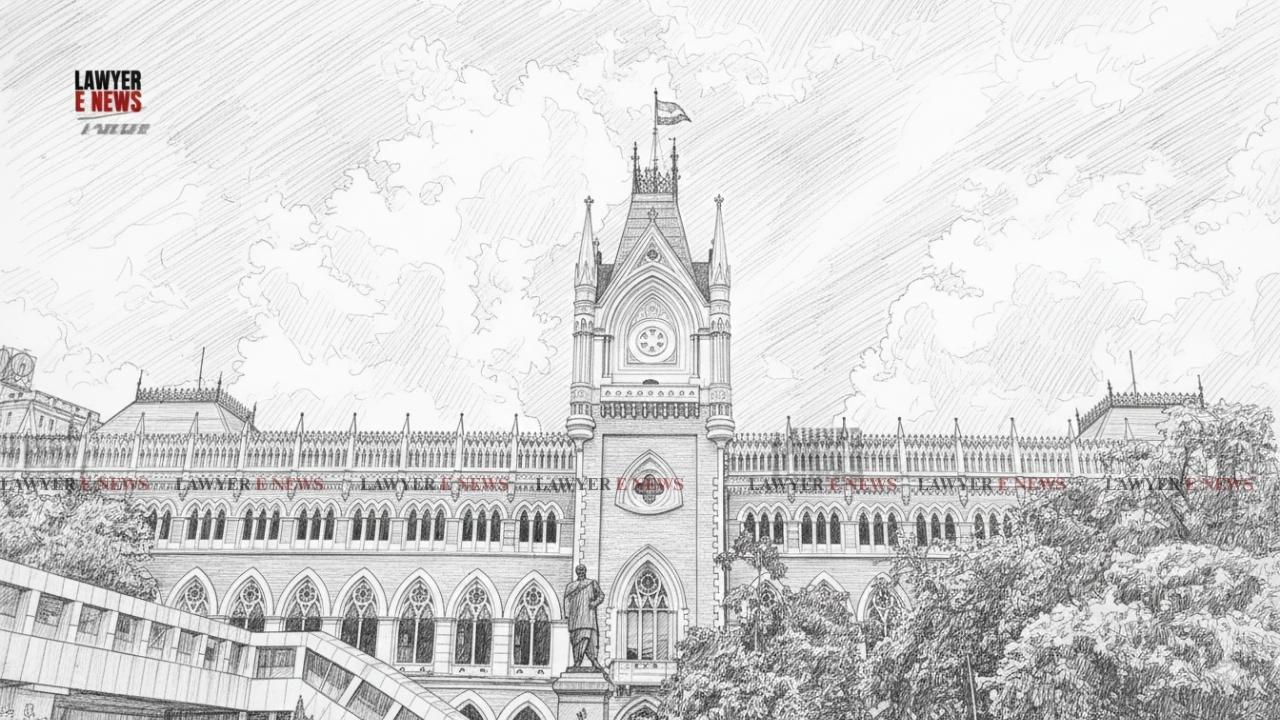
"Sketch map as has been prepared shows the house of Babulal Das on the northern side... the place of occurrence is shown as in the common passage... there is no sign of the house of Ajit. This apparently manifests the improbability and the evidence does not appear to be clinching," Calcutta High Court, in a significant judgment, held that a conviction for voluntarily causing hurt cannot be sustained when the physical evidence, particularly the Investigating Officer’s sketch map, directly contradicts the eye-witnesses' version of the incident.
A single-judge bench of Justice Chaitali Chatterjee Das observed that when the foundational allegation of criminal trespass is not proved, the subsequent narrative of an assault becomes legally fragile and unsustainable.
The case originated from a 2015 incident where the complainant alleged that the appellant, Ajit Biswas, and his wife trespassed onto their land to erect bamboo scaffolding for construction. It was alleged that when the victim, Ramdhan Biswas, protested, the appellant slapped and pushed him, causing him to fall and die instantly. While the Trial Court acquitted the accused of culpable homicide (Section 304 IPC) and criminal trespass (Section 447 IPC), it convicted the appellant under Section 323 IPC for simple hurt.
The primary question before the court was whether the conviction under Section 323 IPC could stand when the accused had been acquitted of the foundational charge of criminal trespass. The court was also called upon to determine the evidentiary value of the Investigating Officer's (IO) sketch map in light of glaring inconsistencies in witness testimonies regarding the place of occurrence.
IO’s Sketch Map Contradicts Claims of Proximity and Trespass
The Court placed heavy reliance on the sketch map prepared by the Investigating Officer (P.W. 8) to test the veracity of the prosecution's narrative. The prosecution claimed the appellant trespassed onto the deceased’s land because their houses were adjacent. However, the Court noted that the sketch map showed the house of a third party, Babulal Das, on the northern side of the victim's house, not the house of the appellant.
The bench observed that the place of occurrence was shown as a common passage between the deceased and his brother, with no sign of the appellant’s house nearby. This physical reality, documented during the investigation, made the prosecution's story regarding the dispute over scaffolding "improbable."
Court Highlights Role Of Sketch Map In Verifying Testimony
The Court emphasized that the physical layout of the crime scene is a crucial tool for verifying ocular evidence. If the witnesses claim an incident happened at a specific spot due to a land dispute between neighbors, but the official sketch map shows they are not neighbors, the very root of the dispute is shaken.
"The sketch map... shows the house of Babulal Das on the northern side of the house of Ramdhan Biswas... The place of occurrence is shown as in the common passage... So there is no sign of house of Ajit."
Inconsistencies Regarding Witness Presence At The Spot
The Court scrutinized the testimonies of P.W. 2 and P.W. 3, who claimed to be eye-witnesses. P.W. 2 claimed he saw the incident from his verandah, yet he admitted his house was a seven-minute walk away from the deceased's residence in a densely populated area. The Court found it unlikely that a witness could see such a specific altercation from that distance in a crowded locality.
Furthermore, P.W. 3 stated that P.W. 2 was present right at the spot of the incident, directly contradicting P.W. 2’s own claim of being on his verandah. The bench noted that these "glaring inconsistencies" regarding their presence and the manner of the incident demolished the credibility of the prosecution's version.
Acquittal Of Trespass Charge Fatal To Prosecution Narrative
A pivotal point in the Court’s reasoning was the Trial Court’s earlier finding that the charge of criminal trespass under Section 447 IPC was not proved. The High Court observed that the entire incident was predicated on the appellant entering the victim's land.
If the Court found that the appellant did not enter the land, the allegation that he pushed the victim while the latter was protesting the intrusion loses its legal basis. The bench held that the Trial Court failed to apply its judicial mind by convicting for hurt while simultaneously concluding that the foundational trespass never happened.
"Since the two vital witnesses... loses their credibility due to glaring inconsistencies regarding their presence at the spot or witnessing the incident, there remain hardly any other sterling witnesses to establish the case."
Interested Witnesses And Inimical Relations
The Court also took note of the bitter history of litigation between the families of the appellant and the deceased. It was observed that P.W. 2 and P.W. 3 were related to the deceased and were "interested witnesses" with a clear motive for false implication. The Court reiterated that while the testimony of an interested witness is not discarded outright, it requires strict corroboration, which was entirely missing in this case.
Concluding that the prosecution miserably failed to prove its case beyond a reasonable doubt, the High Court set aside the conviction. The bench remarked that the Trial Court's observation—that an "intention to hurt" was established despite the acquittal on other charges—was without any legal basis. The appellant was ordered to be set at liberty forthwith.
The High Court allowed the appeal, setting aside the six-month simple imprisonment and fine imposed on the appellant. The ruling reinforces the principle that where ocular evidence is inconsistent with the physical realities of the site as captured in the IO's sketch map, the benefit of the doubt must inevitably go to the accused.
Date of Decision: 13 May 2026