-
by sayum
27 August 2026 3:32 PM







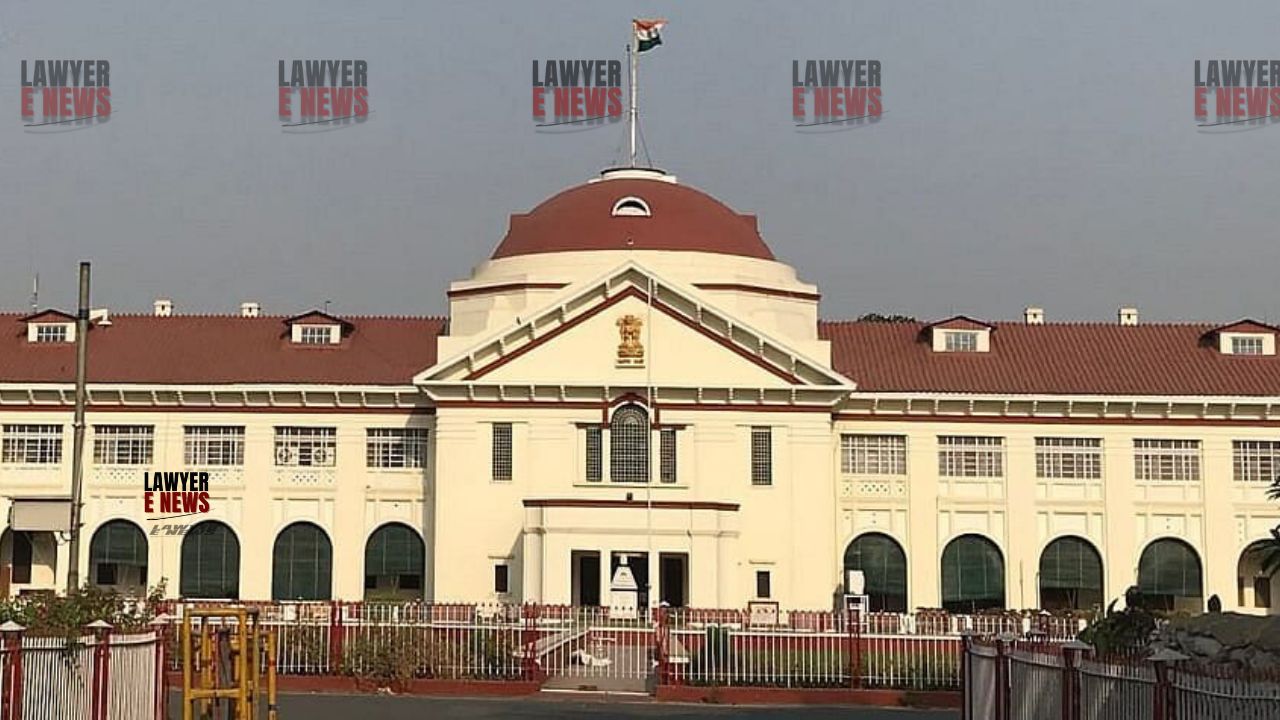
"Having knowingly accepted the AWARD amounts, the acquisition process now stands completed. The petitioners cannot be allowed to have the benefit of the acquisition on the one hand while asking for deferring its acquisition on the other," Patna High Court, in a significant ruling, held that landowners who knowingly accept compensation awards for partial land acquisition cannot subsequently invoke Section 94 of the RFCTLARR Act to demand the acquisition of their entire property.
A bench of Justice Rajiv Roy observed that the doctrine of acquiescence and the principle of 'approbate and reprobate' are squarely attracted once a party receives the fruits of an award, thereby completing the acquisition process. The court noted that such conduct prevents a party from stalling public infrastructure projects like the Patna Metro Rail.
The petitioners, co-owners of an ancestral property known as "Ramgarh Kothi" spanning over 4 acres in Patna, challenged a Collector’s order rejecting their application for the acquisition of their entire estate. The State had notified approximately 1.04 acres for the Rukunpura Metro Station in two phases. While the petitioners argued that the partial acquisition affected their residential structures and internal roads, the State contended that the main house remained untouched and the petitioners had already accepted compensation exceeding ₹69 crores.
The primary question before the court was whether the petitioners could enforce Section 94 of the RFCTLARR Act, 2013, to compel the State to acquire their entire property after having accepted the compensation awards. The court also examined whether the Collector had the jurisdiction to reject such a claim instead of referring it to the competent Authority, especially when the residential nature of the structures was disputed.
The Doctrine of Acquiescence and Finality of Acquisition
The court placed heavy reliance on the conduct of the petitioners, noting that they received ₹42.31 crores for the first phase and ₹26.64 crores for the second phase while the litigation was pending. Justice Roy observed that by accepting these substantial sums, the petitioners facilitated the completion of the acquisition. The bench noted that once the State takes possession and pays compensation, the private holding is divested and the right, title, and interest vest in the State.
"The petitioners, despite their plea to refer the matter to the authority and defer the acquisition, went ahead and accepted the entire compensation amount whereafter the lands were acquired and transferred."
Application of the Principle of Approbate and Reprobate
Citing the Supreme Court’s decision in Union of India v. N. Murugesan, the Court emphasized that a party cannot "blow hot and cold" by accepting the benefits of an instrument while simultaneously questioning its validity. The bench held that the petitioners' consistent conduct in accepting the awards estopped them from seeking a referral under Section 94. The court found that this principle applies with greater vigour when a party enjoys a part of the transaction fully and only later questions another part.
"He who knows that if he objects to an instrument, he will not get the benefit he wants cannot be allowed to do so while enjoying the fruits."
Factual Viability and the Main Residential Building
On the merits of the Section 94 claim, the Court observed that the main residential building of the "Ramgarh Kothi" remained untouched. The bench accepted the State’s argument, supported by aerial photography from 2021, that the structures relied upon by the petitioners were newly constructed after the acquisition proceedings commenced. The Court noted that the petitioners failed to produce any sanctioned maps from the Patna Municipal Corporation to prove the legitimacy of those structures.
Court Finds Section 94 Inapplicable to Unauthorized or New Structures
The bench clarified that while Section 94 mandates a referral when a question arises about whether land forms part of a "house," this protection cannot be invoked by creating structures without approved plans after a public project is announced. Justice Roy noted that the original residential building was structurally sound and retained access to government roads, making the partial acquisition viable without requiring the State to take over the entire four-acre complex.
Public Interest in Large-Scale Infrastructure Projects
The Court highlighted that the Rukunpura Metro Station is a project of immense public importance, partially funded by international agencies. It observed that stalling such a project at an advanced stage would cause a massive financial burden on the exchequer. The bench reiterated that the right to property under Article 300-A of the Constitution is subject to the State's power of eminent domain for public purposes, provided the procedure established by law is followed.
"Any obstruction in the project at this stage will completely derail the construction putting huge financial burden on its exchequer which will by no means serve the public interest."
Final Directions and Orders
While affirming the Collector's order, the Court issued limited directions to ensure the petitioners' grievances regarding valuation and measurement were addressed. The District Land Acquisition Officer (DLAO), Patna, was directed to finalize the valuation of the newer structures within eight weeks. Additionally, the court ordered a re-measurement of Plot No. 86 to verify if the compensation paid matched the actual area acquired. The petitioners were also granted liberty to represent before the Revenue Department to explore the feasibility of the State acquiring the remaining land for other public purposes.
The Patna High Court dismissed the challenge to the partial acquisition, ruling that the acceptance of compensation awards effectively concluded the acquisition process. The judgment underscores that statutory rights under the RFCTLARR Act cannot be used to stall public projects once the owners have acquiesced to the acquisition by receiving the determined value of the land.
Date of Decision: 15 May 2026