-
by sayum
27 August 2026 3:32 PM







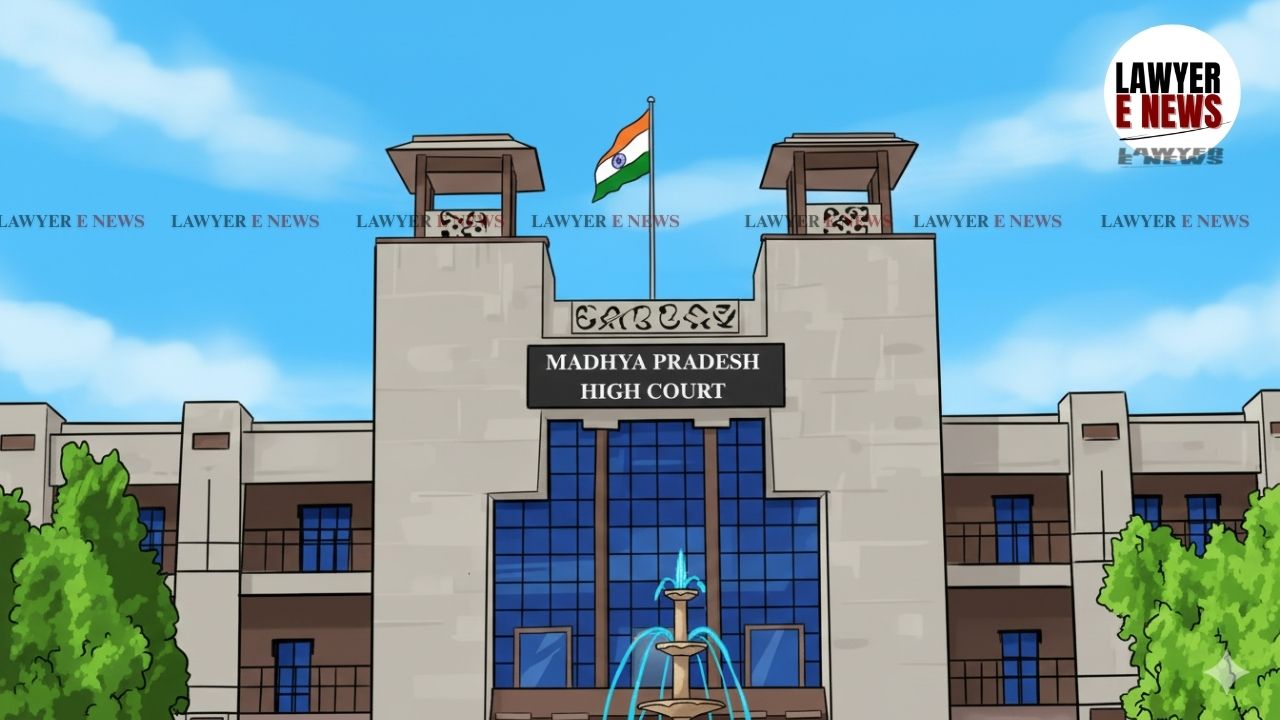
"Applying harmonious construction and the principle that no person shall be left remediless, Section 20(3)(i) must be read to allow filing of an election petition within 30 days of the date of election of the President in the first meeting of the Council." Madhya Pradesh High Court (Gwalior Bench), in a significant ruling, held that an election petition challenging the indirect election of a Municipal President is maintainable if filed within 30 days of the election meeting, even if the result has not been notified in the Official Gazette.
A single bench of Justice Ashish Shroti observed that the legislative inconsistency created by the 2020 amendments to the M.P. Municipalities Act, 1961, cannot be allowed to leave an aggrieved party without a legal remedy. The Court emphasized that no person should be punished for failing to do the impossible, particularly when the law itself creates a procedural vacuum.
The case arose from the 2022 elections of the Municipal Council, Sheopur, where Respondent No. 1, Smt. Renu Garg, was elected as President indirectly by the elected Councillors in their first meeting. The petitioner, Sumer Singh, challenged this election through an election petition under Section 20 of the M.P. Municipalities Act. However, the Election Tribunal dismissed the petition as premature and not maintainable because the result had not been published in the Official Gazette as traditionally required under Section 45.
The primary question before the court was whether an election petition could be maintained in the absence of a Gazette notification, given the legislative conflict between the amended mode of election and the unamended limitation provisions. The court was also called upon to determine whether the non-submission of a Rs. 200/- Treasury receipt at the time of filing warranted a summary dismissal of the petition under Order VII Rule 11 of the CPC.
Legislative Inconsistency Following 2020 Amendments
The Court meticulously analyzed the impact of the M.P. Nagarpalik Vidhi (Sanshodhan) Adhiniyam, 2019, which shifted the election of the President from a direct to an indirect method. The bench noted that while Section 19(1) was amended to reflect this change, corresponding provisions like Section 45 and Section 20(3)(i) remained unamended at the relevant time, creating a "serious discrepancy" and an "unworkable" situation. Under the old regime, Gazette notification was mandatory for directly elected Presidents, but for indirectly elected Presidents, only a certificate under Rule 14 of the 2019 Rules is issued.
Court Explains The Scope Of Harmonious Construction
To resolve this conflict, Justice Ashish Shroti invoked the doctrine of harmonious construction to ensure that the purpose of the Act is served without rendering any provision a "dead letter." The Court observed that the statute must be read as a whole to find the real intention of the legislature. It held that when two provisions appear to be in conflict, the court must make an effort to interpret them so that both may be allowed to operate without making either of them otiose.
"The rule of interpretation requires that while interpreting two inconsistent, or, obviously repugnant provisions of an Act, the courts should make an effort to so interpret the provisions as to harmonise them."
No Person Shall Be Left Remediless Due To Legal Impediments
The Court highlighted that the petitioner could not be penalized for the state's failure to publish a Gazette notification that was no longer practically required for indirect elections. Citing the principle of 'Lex non cogit ad impossibilia' (the law does not compel a man to do that which he cannot possibly perform), the bench stated that a party cannot be rendered remediless due to a legal impediment for which they are not responsible.
"As per the settled position of law, no party shall be left remediless and whatever the grievance the parties had raised before the court of law, has to be examined on its own merits."
Rejection Of Retrospective Application Of 2024 Amendment
While the State argued that the 2024 amendment—which explicitly allows petitions within 30 days of the first meeting—should be applied retrospectively, the Court disagreed. It noted that statutory provisions are generally prospective unless otherwise provided. However, the Court used the 2024 amendment as a tool to confirm the legislative intent, finding it necessary to read the pre-amended Section 20(3)(i) in a way that allows the filing of a petition within 30 days of the election meeting.
Non-Submission Of Treasury Receipt A Mixed Question Of Law And Fact
Regarding the dismissal for want of a Rs. 200/- Treasury receipt under Section 20(3)(ii), the Court held that the Tribunal erred in dismissing the petition at the threshold. Relying on the Division Bench judgment in Renu Shah v. Kant Shirh Dev Singh, the Court clarified that such technical objections should be decided during the final hearing after the collection of evidence, rather than at the stage of Order VII Rule 11 CPC.
"The Tribunal erred in dismissing the EP for want of compliance of Section 20(3)(ii) of the Act at the very initial stage."
Costs Imposed On Respondent For Contradictory Stands
The Court took a stern view of Respondent No. 1’s conduct, noting that she had raised the objection of non-publication in the Gazette while simultaneously functioning as the President. The bench observed that the respondent misused the judicial process by taking contradictory stands to obstruct the election petition. Consequently, the Court imposed a cost of Rs. 1,00,000/- on her, with half payable to the petitioner and the other half to the District Legal Services Authority.
The High Court allowed the civil revision and set aside the Tribunal’s order dated February 1, 2024. It declared the election petition maintainable and directed the Tribunal to conclude the proceedings by November 2026. This ruling ensures that democratic accountability in local bodies is not stalled by legislative drafting errors or procedural technicalities regarding Gazette notifications.
Date of Decision: 13 May 2026