-
by sayum
27 August 2026 3:32 PM







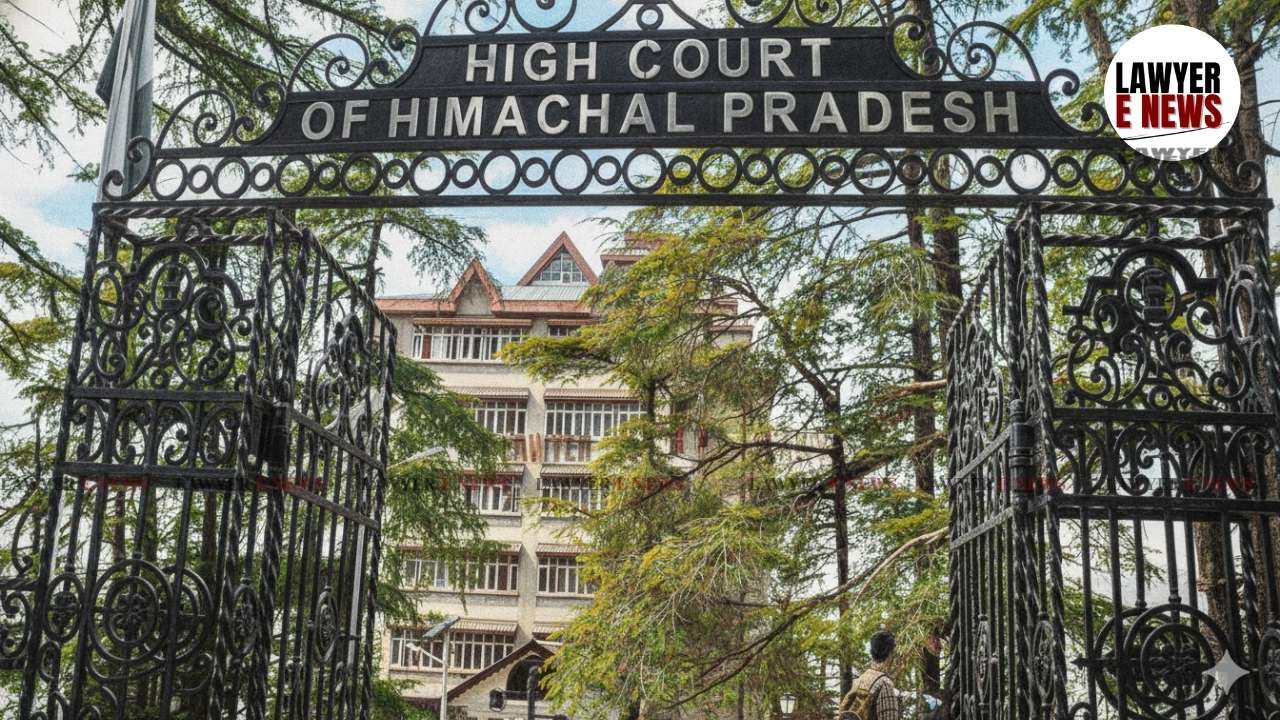
"The absence of the signatures of the accused on seizure memos supports the statements of witnesses that the recovery was made from the bridge and not from the truck," Himachal Pradesh High Court, in a judgment, held that the prosecution is bound by the statements of its own witnesses and cannot escape the consequences if such testimony supports the defense.
A bench of Justice Rakesh Kainthla, while dismissing an appeal against acquittal, observed that the version of events most favourable to the accused must be adopted when two reasonably probable views of the evidence exist.
The case originated from a police operation on February 13, 2005, where a truck was intercepted on secret information regarding the illegal transportation of Khair wood. The police claimed to have recovered Khair logs from the vehicle driven by the accused persons, who failed to produce a valid transport permit. Consequently, a trial was initiated under Sections 41 and 42 of the Indian Forest Act, resulting in an acquittal by the Judicial Magistrate First Class, Jawali.
The primary question before the court was whether the acquittal by the Trial Court was perverse or based on a misreading of evidence. The court was also called upon to determine the legal effect of the prosecution's own witnesses contradicting the official recovery narrative and the significance of the absence of the accused's signatures on seizure memos.
Limited Scope Of Interference In Judgments Of Acquittal
The court began by reiterating the settled legal position regarding appeals against acquittal, citing the Supreme Court’s ruling in Surendra Singh v. State of Uttarakhand. Justice Kainthla noted that interference is warranted only if the judgment suffers from patent perversity or is based on an omission to consider material evidence.
The bench emphasized that a double presumption of innocence applies after an acquittal. It observed that if two reasonable views are possible based on the record, the appellate court must not disturb the findings of the trial court. The court noted that "judicial intervention is only warranted where the Trial Court's view is perverse" or results in a manifest miscarriage of justice.
Prosecution Bound By Testimony Of Its Own Witnesses
The court highlighted a critical flaw in the prosecution's case where two witnesses, Karnail Singh (PW-3) and Hans Raj (PW-4), admitted that the police had actually seized the timber from a stack near a bridge rather than from the truck. These witnesses were not re-examined or declared hostile by the prosecution to clarify this significant discrepancy.
Referring to the precedent in Ramsewak v. State of M.P., the court held that the benefit of such unclarified discrepancies must go to the defense. The bench observed that "they were put forward as witnesses of truth by the prosecution, and the statements made by them would be binding upon the prosecution."
Court Explains Legal Value Of Cross-Examination Admissions
Citing Javed Masood v. State of Rajasthan, the court affirmed that the defense is entitled to rely on evidence provided by prosecution witnesses that supports the accused’s version. The court noted that there is nothing in law that precludes the defense from taking advantage of any statement made during cross-examination that destroys the genesis of the prosecution's story.
The bench held that the testimony of the prosecution’s own witnesses made the claim of recovery from the truck "highly suspect." It reiterated that in criminal jurisprudence, the golden thread is that "the view which is favourable to the accused should be adopted" whenever two versions of the facts are presented.
"If two reasonably probable and evenly balanced views of the evidence are possible, one must necessarily concede the existence of a reasonable doubt."
Significance Of Accused’s Missing Signatures On Seizure Memos
The court found the absence of the signatures of the accused on the seizure memos (Ext.PW-10/A and Ext.PW-10/B) to be a major procedural lapse. ASI Amreek Singh (PW-10) admitted during his testimony that the signatures of the persons producing the articles were usually obtained but could not explain why it was not done in this instance.
The court observed that this omission was not a mere technicality but a substantive factor that supported the defense's argument. Justice Kainthla noted that the "absence of the signatures of the accused on seizure memos supports the statements" of the witnesses who claimed the recovery happened at a different location altogether.
Adverse Inference For Non-Examination Of Independent Witnesses
Rejecting the State's argument that independent witnesses could not be joined due to the "lonely place" and "middle of the night" context, the court pointed out that the police had five hours between receiving the secret information and making the recovery. The bench noted that the police had definite information and were not merely on routine patrolling.
The court held that the police had ample opportunity to join independent persons from the surrounding areas or while on the way to the spot. Consequently, the Trial Court was "justified in drawing an adverse inference against the prosecution" for the failure to involve independent witnesses despite having sufficient time and specific prior information.
The High Court concluded that the Trial Court had taken a reasonable and balanced view of the evidence. It held that the prosecution failed to prove the recovery of Khair wood from the possession of the accused beyond a reasonable doubt. Finding no perversity in the lower court's findings, the bench dismissed the appeal and directed the respondents to furnish fresh bail bonds as per procedural requirements.
Date of Decision: 18 May 2026