-
by sayum
27 August 2026 3:32 PM







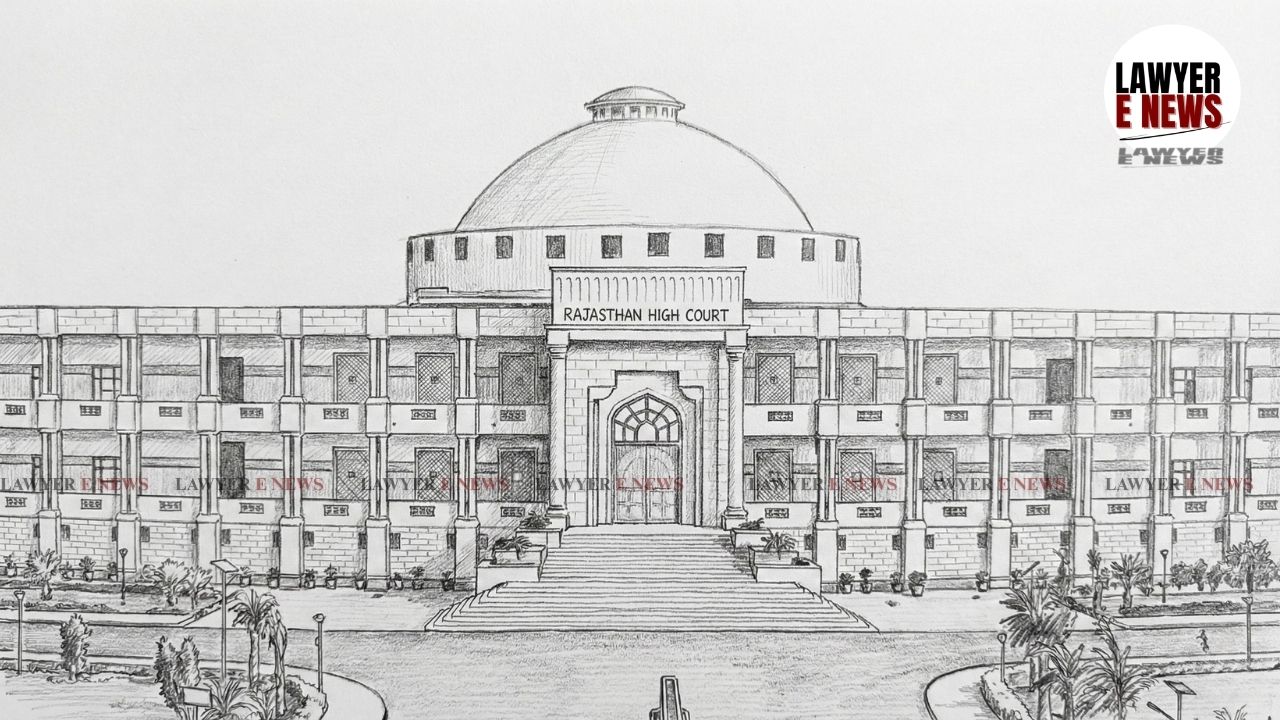
"Court of Law and Justice cannot be a silent spectator to the vanishing of evidence that has the potential to unfurl the truth. If such an important piece of evidence—which sits at the centerline of the story—is allowed to be destroyed or deleted due to regulatory timelines, it would amount to closing the door of justice." Rajasthan High Court, in a significant judgment, has held that the judiciary has a mandatory obligation to ensure the preservation of electronic evidence that could potentially exonerate an accused.
A Single Judge Bench of Justice Farjand Ali observed that when the prosecution fails to produce or allows the destruction of material evidence like CCTV footage and Call Detail Records (CDR) despite timely requests, the trial court is mandated to draw an adverse inference against the State.
The Court emphasized that the "Rule of Best Evidence" is a foundational principle of criminal jurisprudence, especially in cases involving stringent statutes like the NDPS Act. The bench noted that electronic recordings capture events in real-time and possess a degree of objectivity that oral testimony often lacks, making them indispensable for a fair trial under Article 21 of the Constitution of India.
The petitioners were booked under Sections 8/22 of the NDPS Act following an alleged recovery of MDMA by the Lohawat Police. They moved the High Court seeking quashing of the FIR, contending that they were unlawfully detained from a different location and falsely implicated. Simultaneously, they challenged a trial court order that had rejected their application under Section 94 of the BNSS (Section 91 CrPC) for the preservation and production of CCTV footage from a toll plaza and the CDR of the police officials involved.
The primary questions before the court were whether an FIR can be quashed at the threshold based on a disputed defense narrative of false implication. The court was also called upon to determine whether the State is obligated to preserve electronic evidence that might contradict the prosecution’s version and the legal consequences of failing to do so.
High Court Refuses To Quash FIR Based On Disputed Defense Plea
The Court first addressed the prayer for quashing the FIR under Section 528 of the Bharatiya Nagarik Suraksha Sanhita (BNSS), 2023. It observed that at the preliminary stage of quashing, a court cannot enter into an adjudicatory exercise to determine the veracity of a defense narrative. The bench noted that the claims of "planted recovery" and "prior detention" are essentially questions of fact that require a full-dress trial.
Justice Farjand Ali held that the High Court does not possess a "litmus test" to hold a prosecution story as fabricated at the threshold. While the defense version might be true, it cannot be accepted in advance to stifle the prosecution at its inception. Therefore, the Court dismissed the petitions for quashing the FIR, leaving the petitioners at liberty to establish their pleas before the competent trial court.
Electronic Records Constitute 'Best Evidence' In Criminal Trials
Turning to the preservation of evidence, the Court noted that electronic records like CCTV footage and CDR are often the only objective materials available to negate a concocted narrative. It observed that the Rule of Best Evidence mandates that the most direct and reliable evidence accessible to a party must be produced before the Court to prevent fraud or distortion of facts.
The Court highlighted that in the modern context, the doctrine of best evidence has expanded to include electronic records under the Bharatiya Sakshya Adhiniyam (BSA), 2023. Unlike oral testimony, which is subject to the limitations of human perception and memory, CCTV recordings capture events as they actually unfold, providing a more accurate appreciation of the factual matrix.
"The very purpose of investigation and trial is to ascertain as to what is true and what is false and whether the allegations levelled by the prosecution ultimately stand proved in accordance with law or not."
Obligation To Preserve Evidence From Destruction
The Court expressed concern over the "disturbing sequence of events" where the prosecution repeatedly sought adjournments and eventually reported that the requested CCTV data had been deleted. It held that the State is not an ordinary litigant driven by private vendetta but a sovereign authority whose obligation is to ensure that justice is done.
Justice Ali clarified that ordering the preservation of such material does not amount to taking "defense evidence" at a premature stage. Rather, it is a necessary step to protect evidence from being lost due to regulatory retention policies, such as the one-year limit for telecom data. Allowing such evidence to vanish would be antithetical to the principles of fair trial and substantive justice.
Mandatory Adverse Inference Under Section 119 Of The BSA
The bench laid down a categorical mandate regarding the application of Section 114 Illustration (g) of the Evidence Act (now Section 119 of the BSA). It held that if the prosecution fails to produce records that were within its control and were sought by the accused from the inception, the trial court must presume that the evidence was deliberately withheld because it would have been unfavourable to the prosecution.
The Court observed that the failure of the respondents to preserve and produce the most material electronic evidence seriously compromises the fairness of the investigation. Such a lapse "casts a substantial shadow upon the prosecution case," and the benefit of the resulting doubt must necessarily accrue to the accused, particularly in cases involving severe statutory punishments.
"While deciding the case on its merits, the learned trial court shall draw the necessary adverse inference that the electronic evidence which was admittedly within the control of the prosecution and could have been produced, but was withheld or allowed to be deleted, would, if produced have been unfavourable to the prosecution."
The High Court dismissed the petitions for quashing the FIR but allowed the plea for the preservation of evidence. It directed the trial court to take immediate steps to summon the CCTV footage and CDR if they are still available. Crucially, the Court ordered that if the evidence has been destroyed, the Trial Judge must draw an adverse inference against the prosecution at the final stage of the trial, treating the suppression as a violation of the accused's constitutional right to a fair investigation.
Date of Decision: 15 May 2026