
-
by sayum
23 August 2026 2:56 PM







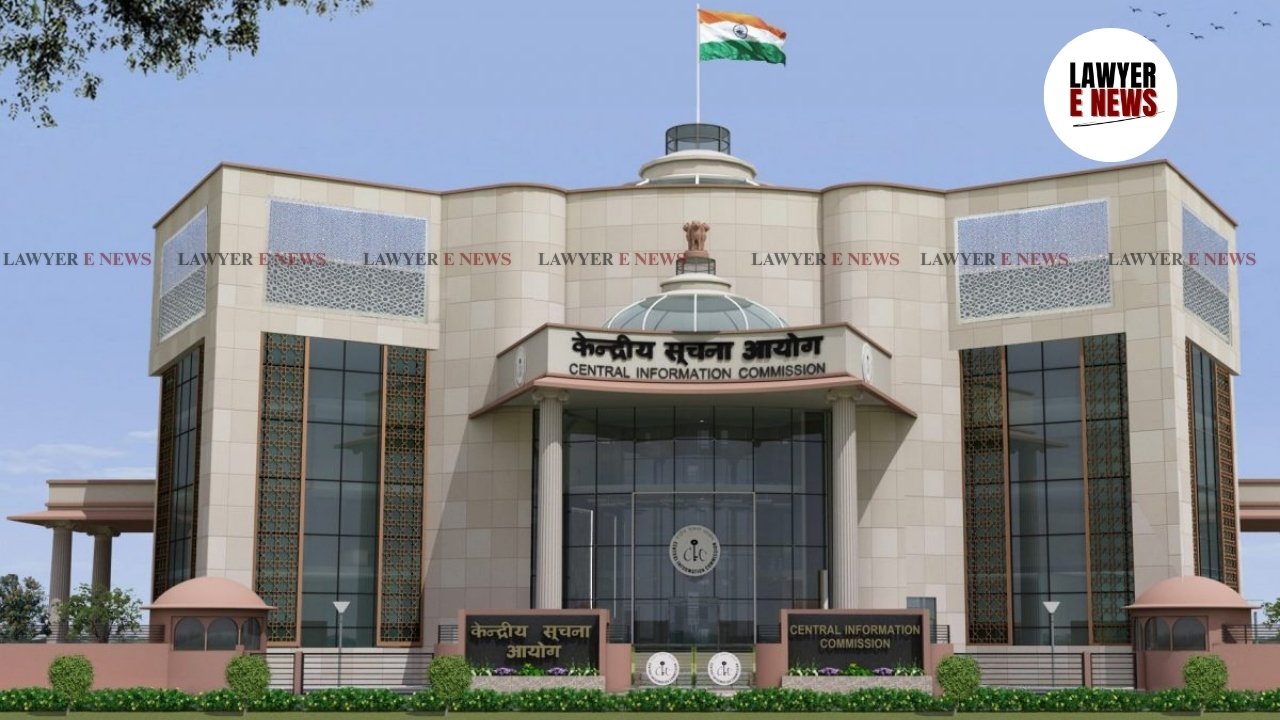
"Definition of 'Public Authority' under Section 2(h) of the RTI Act uses the word 'means' and is therefore exhaustive and restrictive, not illustrative... Mere performance of public functions does not bring a body within the fold of Public Authority," Central Information Commission (CIC), in a significant ruling dated May 18, 2026, has held that the Board of Control for Cricket in India (BCCI) does not constitute a "Public Authority" under Section 2(h) of the Right to Information Act, 2005.
A bench of Information Commissioner Shri P.R. Ramesh observed that the BCCI is a private autonomous body that is neither established by the Constitution nor substantially financed or controlled by the Government. The Commission noted that the discharge of functions of public importance alone cannot substitute the strict statutory criteria required to bring an entity under the RTI framework.
The matter originated from an RTI application filed by Geeta Rani in 2017 seeking information on the authority under which the BCCI represents India and selects national players. The Ministry of Youth Affairs and Sports initially stated it did not hold the information and could not transfer the request as the BCCI had not been declared a Public Authority. After a previous CIC order declaring the BCCI a Public Authority was challenged, the Madras High Court remanded the matter for fresh consideration in light of the Supreme Court's guidelines in BCCI v. Cricket Association of Bihar (2016).
The primary question before the Commission was whether the BCCI satisfies the definition of a “Public Authority” under Section 2(h) of the RTI Act. The Commission was also called upon to determine if regulatory oversight or the performance of public functions by a private society amounts to governmental "control" or "substantial financing" as per the Act.
Definition Of 'Public Authority' Is Exhaustive And Restrictive
The Commission began by clarifying that the definition of "Public Authority" under Section 2(h) of the RTI Act is exhaustive. It noted that the use of the word “means” in the statute indicates that only entities specifically falling within the enumerated categories—those established by the Constitution, statute, or government notification—can be brought within the RTI fold.
The Bench observed that the RTI Act does not include "public function" as a standalone criterion for determining a Public Authority. The Commission emphasized that "mere performance of public functions does not bring a body within the fold of Public Authority" if the specific statutory requirements of ownership, control, or substantial financing are not met.
"The definition is restrictive, not illustrative. Only those entities that satisfy the specific criteria laid down in the provision can be brought within its scope."
Distinction Between 'Establishment' And 'Registration' Under Law
The Commission highlighted a fundamental legal distinction between a body being "established" by a statute and being merely "registered" under one. It noted that the BCCI is a society registered under the Tamil Nadu Societies Registration Act, 1975, and does not owe its existence to a specific creative statute passed by Parliament or a State Legislature.
Relying on the Supreme Court’s ruling in Dalco Engineering Pvt. Ltd. v. Satish Prabhakar Padhye, the Bench noted that registration is merely a mechanism for legal recognition. The Commission held that "a body which is registered under a statute, and is thereby governed by it, does not owe its existence to the statute and is not thereby 'established' by it."
Government Control Must Be 'Deep And Pervasive'
On the issue of governmental control, the Commission ruled that mere regulatory or supervisory oversight does not equate to "control" under Section 2(h)(d)(i) of the RTI Act. It held that for an entity to be a Public Authority, the control must be substantial and pervasive, extending to management, policy, and financial administration.
The Bench observed that the Government has no representation in the BCCI's governance structure and does not appoint its office bearers. It noted that "the Working Committee elected from amongst its members in accordance with its own Rules, controls the entire affairs and management of the BCCI," without any governmental interference in its day-to-day administration.
Tax Exemptions Do Not Amount To Substantial Financing
The Commission addressed the argument that tax exemptions and infrastructure support constitute "substantial financing." Referring to the Thalappalam Services Cooperative Bank case, it held that financing must be real, concrete, and of considerable weight, such that the body would struggle to exist without it.
The Bench found that the BCCI is financially self-sustaining, generating revenues through media rights, sponsorships, and ticket sales. It observed that tax exemptions available to all non-profit entities under the Income Tax Act do not amount to a special governmental dispensation. "Generally applicable statutory exemptions cannot be construed as 'substantial financing' by the Government," the Commission held.
"The degree of financing must be actual, existing, positive and real to a substantial extent, not moderate, ordinary, or tolerable."
Supreme Court Precedents On BCCI’s Legal Status
The Commission analyzed the Supreme Court’s findings in Zee Telefilms Ltd. v. Union of India and BCCI v. Cricket Association of Bihar. It noted that while the Court held the BCCI amenable to writ jurisdiction for discharging public functions, it did not overrule the finding that the BCCI is not "State" under Article 12.
The Bench clarified that the 2016 Bihar judgment was focused on institutional reform and transparency, but it "did not declare the BCCI to be a Public Authority under the RTI Act, but left the issue to the wisdom of the legislature." The Commission also pointed to the National Sports Governance Act, 2025, which limits RTI applicability only to those sports bodies receiving government grants.
"Governance-oriented judicial directions relating to transparency and accountability cannot be construed as a declaration of Public Authority status under the RTI Act."
Obiter Dicta On Market Autonomy And Fairness
While dismissing the appeal, the Commission made notable observations regarding the evolution of the BCCI into a global economic engine. It remarked that the BCCI’s dominance is rooted in market forces and its commercial model, such as the Indian Premier League, rather than state support.
The Bench cautioned that "superimposing a model of oversight premised solely on governmental control may fail to account for these realities." It suggested that fairness in modern institutions is often better achieved through calibrated regulatory mechanisms rather than increased direct governmental supervision.
The Commission concluded that the BCCI does not meet the mandatory prerequisites of Section 2(h) of the RTI Act. It upheld the Ministry's position that the information was not available with the government and that the application could not be transferred to a private body. Consequently, the Second Appeal was dismissed as being devoid of merit.
Date of Decision: 18 May 2026