-
by sayum
27 August 2026 7:40 AM







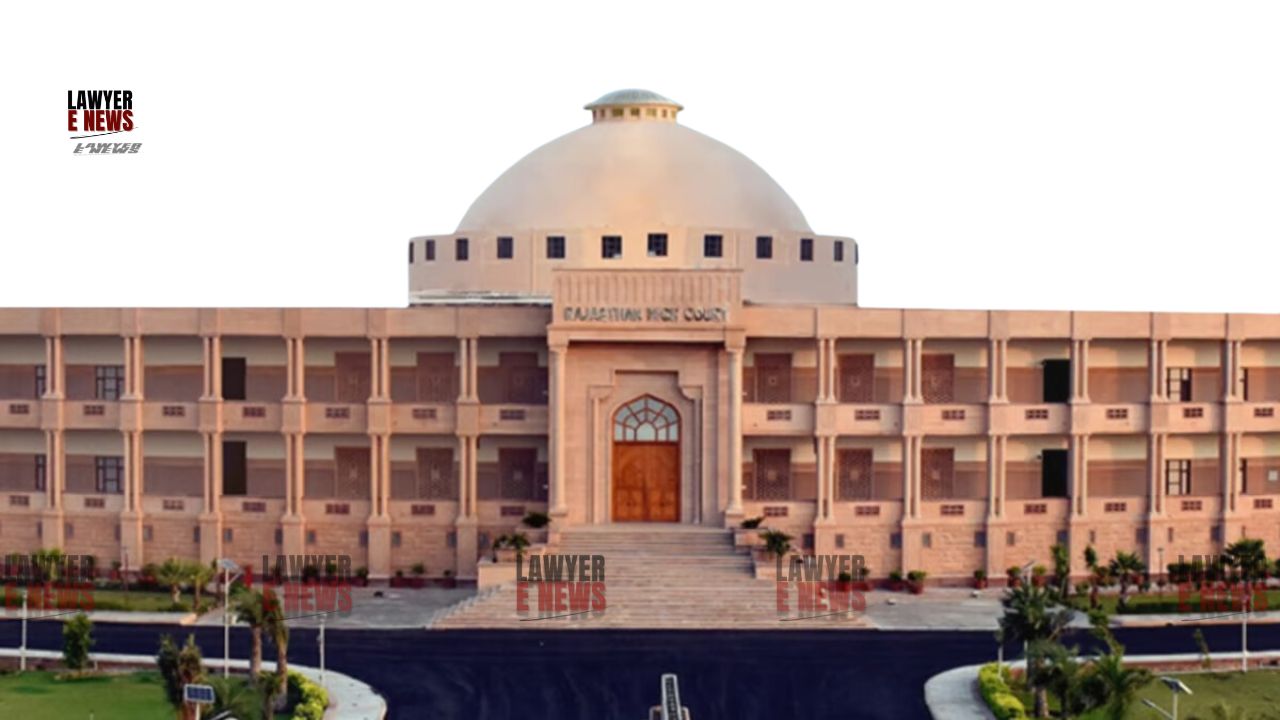
"Permanent alimony is not contingent upon dependency of children alone, but is a distinct and independent right of the spouse arising out of the dissolution of marriage." Rajasthan High Court, in a significant ruling, held that the grant of permanent alimony under Section 25 of the Hindu Marriage Act is an independent statutory right of a spouse and cannot be negated merely because the children of the marriage have attained majority.
A division bench of Justice Arun Monga and Justice Yogendra Kumar Purohit observed that the provision is meant to secure long-term financial stability for the economically disadvantaged spouse, enhancing a wife's alimony from Rs 25 lakhs to Rs 40 lakhs.
The parties were married in 1994 and had been living separately since 2009 due to irreconcilable differences and allegations of cruelty. Following a prolonged separation where the wife raised their two sons single-handedly, the Family Court dissolved the marriage and awarded her Rs 25 lakhs as permanent alimony. The wife appealed to the High Court seeking enhancement to Rs 2 crores, while the husband, a government doctor, filed a cross-appeal seeking a reduction, arguing that their adult sons were capable of maintaining their mother.
The primary question before the court was whether the quantum of permanent alimony awarded to the wife was adequate to ensure her dignified sustenance and future financial security. The court was also called upon to determine whether the majority and independent earning capacity of children absolve a husband of his obligation to pay permanent alimony to his divorced wife.
Scope Of Section 25 Hindu Marriage Act
The bench elaborated on the equitable nature of Section 25 of the Hindu Marriage Act, 1955, emphasising that the provision aims to prevent economic vulnerability following marital breakdown. The court noted that determining alimony requires weighing multiple factors, including the financial capacity of the husband, the reasonable needs of the wife, and the standard of living enjoyed during the marriage.
"The scope of Section 25 of the Hindu Marriage Act is not merely subsistence-oriented but is intended to secure dignified sustenance and long-term financial stability for the spouse who is economically disadvantaged as a consequence of marital breakdown," the bench observed.
Assessment Of Husband's Financial Capacity
Examining the husband's financial position, the court noted his employment as a Specialist Medical Officer drawing a stable government salary of approximately Rs 2 lakhs per month. While rejecting the wife's unsubstantiated claims regarding his additional extra income from private practice, the court found his baseline earning capacity to be substantial and secure. The bench highlighted his ownership of immovable assets, including a self-acquired residential house and a share in ancestral property, as clear indicators of his upper economic bracket.
Wife's Right To Secure Residential Accommodation
The court placed significant reliance on the wife's lack of independent residential accommodation, contrasting it with the husband's multiple properties. It reiterated that a divorced wife's right to secure a reasonable residence is a well-recognised facet of maintenance jurisprudence. The bench observed that the alimony amount must enable her to secure at least a modest dwelling to ensure her long-term financial security.
Alimony Is An Independent Right
Addressing the husband's contention that their adult sons were earning and could support their mother, the court clarified that this argument does not dilute the wife's entitlement. The court stated that while the earning capacity of major children may be a legally relevant factor in assessing quantum, it cannot extinguish the husband's statutory obligation.
"This Court must guard against converting alimony into a measure of enrichment rather than support."
Alimony Is Not A Measure Of Enrichment
While acknowledging the wife's prolonged hardship, the court rejected her demand for Rs 2 crores as disproportionate and unsupported by strict evidence. The court cautioned that the determination of alimony must be realistic and equitable, ensuring it neither unduly burdens the husband nor leaves the wife financially destitute.
Need For A Balanced And Realistic Assessment
Taking into account the 15-year cohabitation, the subsequent 16-year separation, and the established cruelty, the bench found the Family Court's award of Rs 25 lakhs to be inadequate. Factoring in rising inflation, the absence of the wife's residential security, and the husband's progressive earning potential, the court concluded that a higher one-time financial cushion was necessary to meet the ends of justice.
Balancing all factors, the High Court allowed the wife's appeal and enhanced the permanent alimony from Rs 25 lakhs to Rs 40 lakhs, to be paid within six months. The court dismissed the husband's cross-appeal and directed him to continue paying monthly maintenance until the full lump-sum amount is deposited.
Date of Decision: 01 April 2026