-
by sayum
27 August 2026 3:32 PM







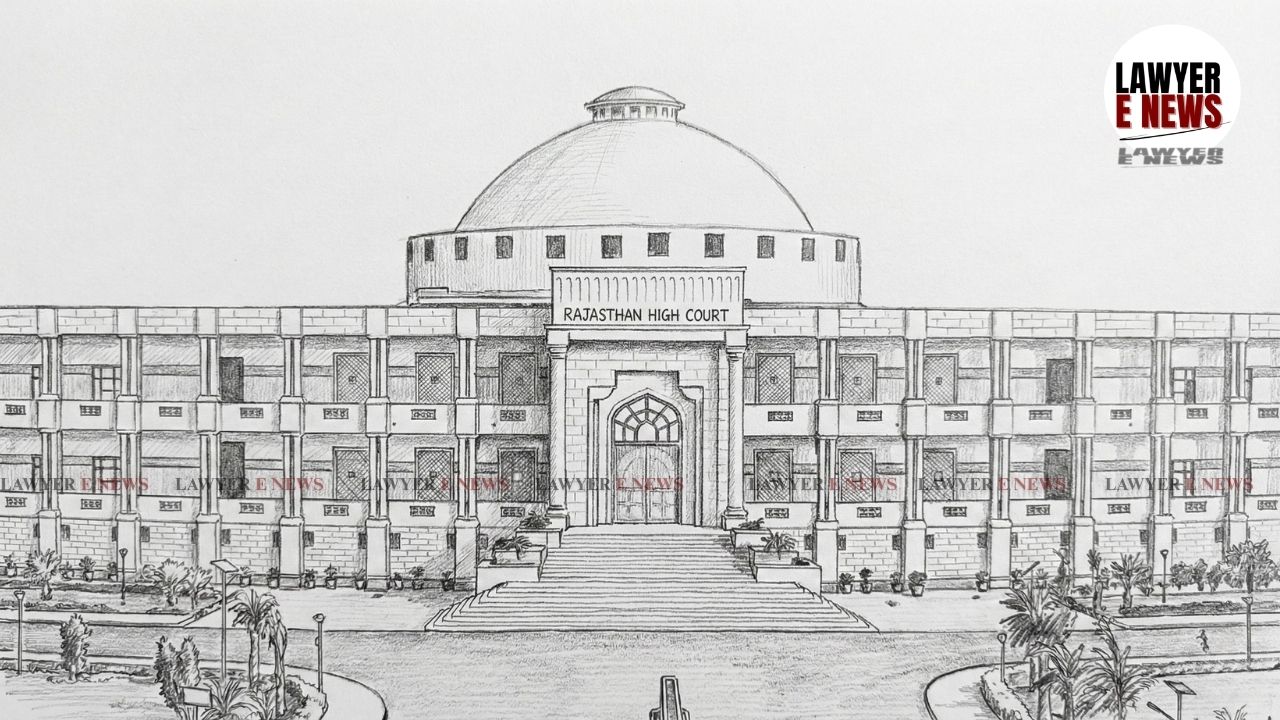
"The benefit of reservation is restricted to the State of origin and cannot be extended into the State to which one has migrated", Rajasthan High Court has delivered a significant ruling reaffirming the State-specific nature of reservation benefits in the context of NEET PG 2025-26 admissions, holding that SC/ST/OBC candidates belonging to other States cannot claim reserved category seats or the relaxed qualifying percentile prescribed for reserved categories in Rajasthan's State Quota counselling.
Justice Sanjeet Purohit, in a detailed judgment dismissing the writ petition filed by the Federation of Private Medical and Dental College of Rajasthan, upheld the minutes of meeting dated 18.02.2026 issued by the NEET PG Medical and Dental Admission/Counselling Board, which directed that reserved category candidates from other States would be treated as General/unreserved category for the purpose of the stray vacancy round of PG medical admissions.
The petitioner Federation challenged a decision taken by the State Counselling Board on 18.02.2026, which reiterated that SC/ST/OBC candidates from States other than Rajasthan would be treated as unreserved/General category for State Quota NEET PG counselling. Following completion of regular counselling rounds — which still left a large number of PG seats vacant — the National Board of Examinations had drastically reduced the qualifying percentile vide notification dated 13.01.2026, bringing the cut-off score for reserved categories to -40 out of 800. The Federation argued that the impugned decision denied out-of-State reserved category candidates the benefit of this relaxed percentile, effectively preventing them from competing for vacant seats and amounting to an unconstitutional 100% domicile-based reservation.
The Court framed two principal issues: first, whether denial of reservation benefits to out-of-State reserved category candidates was arbitrary and constitutionally impermissible; and second, whether the impugned decision effectively created an unconstitutional 100% domicile-based reservation.
Reservation Is Constitutionally State-Specific
The Court undertook an exhaustive examination of Articles 341, 342, and 342A of the Constitution, which vest in the President the power to notify Scheduled Castes, Scheduled Tribes, and Socially and Educationally Backward Classes — crucially, only "in relation to" each specific State or Union Territory. Examining this language, the Court held that the notification of reserved categories is necessarily anchored to a particular State's socio-economic and cultural realities.
"It cannot be assumed, nor is it capable of empirical determination, that backward classes across different States share identical or even comparable social realities. A necessary corollary of this position is that the benefits of reservation are confined to categories notified in relation to a particular State and cannot be extended to members who are recognised as belonging to a reserved category in another State."
The Court relied heavily on the Supreme Court's landmark ruling in Marri Chandra Shekhar Rao v. Seth G.S. Medical College (1990), which had categorically held that treating a Scheduled Caste or Tribe status as portable across States would "be in negation to the very purpose and scheme and language of Articles 341 read with Article 15(4) of the Constitution." The Supreme Court had in that case reasoned that the disadvantages and inhibitions attached to a caste or tribe exist in relation to a specific regional environment, and a candidate migrating to another State cannot be presumed to carry those same disadvantages.
This principle was reinforced by the Supreme Court's subsequent ruling in Bir Singh v. Delhi Jal Board (2018), which the Court quoted at length: "A person notified as a Scheduled Caste in State 'A' cannot claim the same status in another State on the basis that he is declared as a Scheduled Caste in State 'A'."
Clause 4 of Instruction Booklet Is Constitutionally Valid
Clause 4 of Rajasthan's State Instruction Booklet expressly stated: "The norms of reservation of the State Government of Rajasthan will be applicable only for bonafide candidates of the State of Rajasthan. SC/ST/OBC NCL/MBC NCL/EWS candidates of states other than Rajasthan shall be considered as unreserved category candidates."
The Court upheld this clause in its entirety, finding it to be in consonance with the constitutional scheme, the Rajasthan Scheduled Castes, Scheduled Tribes, Backward Classes (Reservation) Act, 2008, and Clause 4.8 of the Postgraduate Medical Education Regulations, 2023. The Court noted that this clause had been consistently applied across all prior rounds of counselling without any challenge from the petitioner Federation.
"No new decision has been taken, much less one contrary to the constitutional scheme or the policy contained in the Instruction Booklet. The contentions that the respondents have changed the rules of the game mid-way are found to be wholly misconceived."
No Case of 100% Domicile-Based Reservation
The Court firmly rejected the petitioner's argument that the impugned decision amounted to an unconstitutional 100% domicile-based reservation. The distinction drawn by the Court was clinically precise: the decision did not render out-of-State reserved category candidates ineligible altogether — they remained entitled to compete for unreserved/General category seats, provided they met the General category qualifying criteria. What was withheld was only the benefit of the relaxed percentile prescribed exclusively for reserved categories.
The Court distinguished the battery of Supreme Court judgments cited by the petitioner — including Dr. Tanvi Behl v. Shrey Goel (2025), Jagadish Saran v. Union of India (1980), and Dr. Pradeep Jain v. Union of India (1984) — on the ground that all those cases dealt with the validity of wholesale domicile-based reservation that excluded candidates entirely from participation. "The controversy in the present case does not relate to the validity of a 100% domicile-based reservation... Rather, the issue herein pertains to the permissibility of restricting the benefits of reservation to candidates belonging to the State of Rajasthan — a measure which aligns with the constitutional framework."
Once Seats Turn Unreserved, Relaxed Percentile Cannot Follow
The Court addressed one of the more nuanced arguments advanced by the petitioner — that once reserved seats are exhausted and converted to unreserved, out-of-State candidates should be allowed to compete for those converted unreserved seats with the benefit of the reserved category relaxed percentile. The Court termed this proposition "wholly untenable and impermissible in law."
Reading the Instruction Booklet's clause on unfilled reserved seats plainly, the Court held that once a seat is treated as unreserved, it must be filled by the criteria applicable to the unreserved category. To permit a candidate to simultaneously claim an unreserved seat while availing the relaxed percentile meant for a different category would, as the Court put it, "conflate distinct eligibility regimes and is clearly impermissible in law, as it would result in an anomalous and legally unsustainable advantage unsupported by the governing framework."
Vacant Seats Cannot Override Merit Standards
The Court acknowledged the national importance of filling PG medical seats and agreed in principle with the proposition that such seats should not remain vacant. However, it drew a firm line: this objective cannot be pursued by compromising minimum merit standards or bypassing the constitutional framework.
Relying on the Supreme Court's rulings in Siddhant Mahajan v. State of Rajasthan (2025) and Ombir Singh v. State of U.P. (1993), the Court held: "Candidates who do not meet the prescribed qualifying criteria cannot be granted admission merely to ensure that seats do not remain vacant." The Court also noted that the Central Government's drastic reduction of qualifying percentile had already substantially addressed the problem of vacant seats, and this relief was available to General category candidates — including out-of-State reserved category candidates competing on the General category basis.
Negative Equality Cannot Be Invoked
The petitioner had pointed to a specific instance where one Dr. Divyanshu Chitravanshi was allegedly admitted against a General category seat using reserved category cut-off marks, and argued that similar benefit must be extended uniformly. The Court dismissed this argument emphatically. It noted that the said admission pertained to an All India Quota seat — an entirely distinct domain — and in any event, a single deviation from the legal framework cannot be cited as a precedent. "Courts are not meant to perpetuate or compound an illegality or irregularity. Even assuming, arguendo, that any deviation has occurred in an individual case, the same cannot be cited as a precedent to claim similar treatment in contravention of the governing legal framework."
Petitioner Estopped by Acquiescence
The Court also invoked the doctrine of estoppel against the petitioner Federation. Clause 4 of the Instruction Booklet had been in place from the very beginning of the 2025-26 NEET PG counselling process and had been uniformly applied across all prior rounds. The Federation had never challenged the clause at any earlier stage. Having acquiesced to the governing framework throughout, the Court held that the petitioner could not be permitted to assail it at the eleventh hour — at the stray vacancy round.
The Rajasthan High Court dismissed the writ petition in its entirety, upholding the decision dated 18.02.2026 as legally sound, constitutionally valid, and fully in consonance with the statutory framework. The Court crystallised its conclusions thus: reservation benefits of one State cannot travel with a candidate to another State; the impugned decision does not amount to 100% domicile reservation since General category seats remain open to out-of-State candidates; relaxed percentile for reserved categories cannot be claimed by candidates competing for unreserved seats; and merit standards in PG medical admissions cannot be sacrificed at the altar of seat utilisation.
Date of Decision: 13th April, 2026