-
by sayum
29 August 2026 7:20 AM







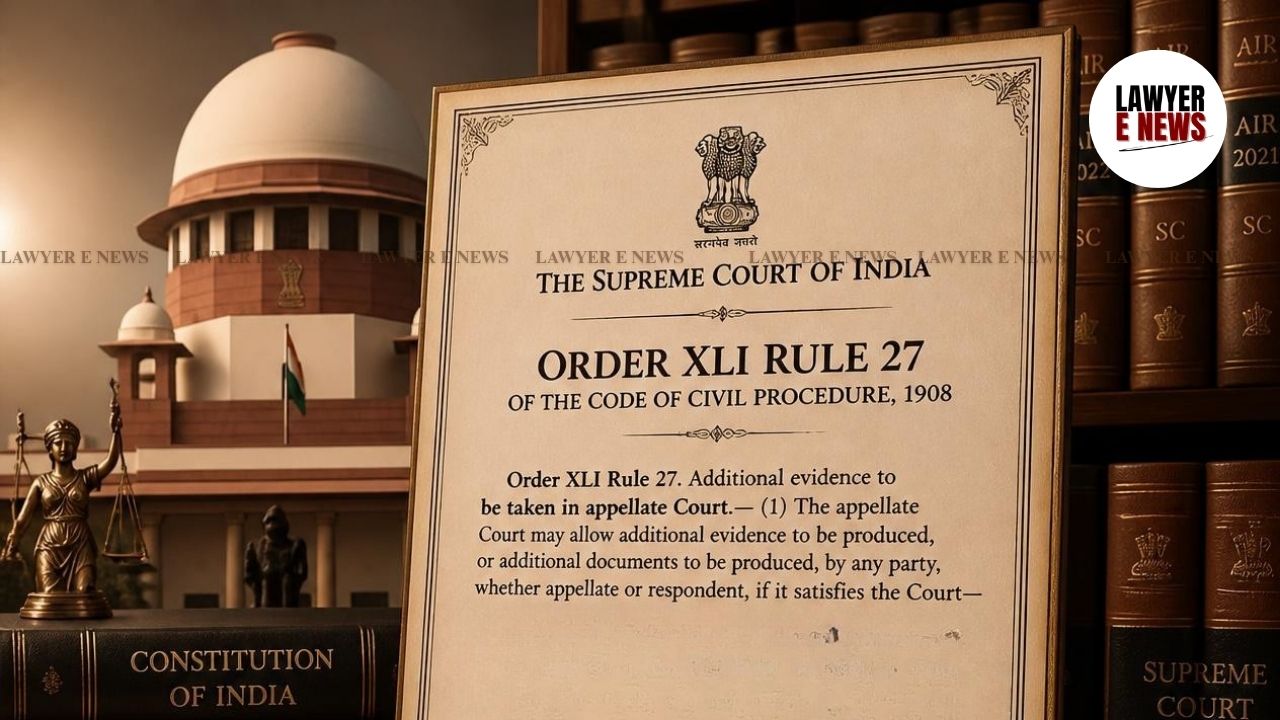
"An Appellate Court has a statutory duty to deal with an Application for Additional Evidence on its merits; the application cannot be ignored while the Court proceeds to pronounce the final judgment." Supreme Court of India, in a significant ruling, held that an Appellate Court commits a grave jurisdictional error if it pronounces a final judgment without explicitly adjudicating upon a pending application for additional evidence filed under Order XLI Rule 27 of the Code of Civil Procedure (CPC).
A bench comprising Justice S.V.N. Bhatti and Justice N.V. Anjaria observed that such a failure constitutes a "procedural failure and a miscarriage of justice," mandating a remand of the matter for fresh consideration.
The dispute originated from a 1999 partition suit filed before the Senior Civil Judge, Devanahalli, which was subsequently decreed in 2006. The matter reached the High Court of Karnataka via a Regular First Appeal (RFA) and cross-objections filed by the appellant. During the appellate proceedings, the appellant filed an application (I.A. No. 1/25) seeking to produce additional evidence, which remained unadjudicated when the High Court dismissed the appeal and the cross-objections in December 2025.
The primary legal issue before the Supreme Court was whether an Appellate Court can proceed to deliver a final judgment in an appeal while a previously filed application for the production of additional evidence under Order XLI Rule 27 of the CPC remains pending and undisposed of. The Court was further called upon to determine if such an omission constitutes a jurisdictional error warranting the setting aside of the appellate decree.
Statutory Mandate of Order XLI Rule 27 CPC
The Supreme Court emphasized that Order XLI Rule 27 of the CPC provides a specific framework for the production of additional evidence in appellate proceedings. The Court noted that while parties are not entitled to produce additional evidence as a matter of right, the Court is vested with the discretion to allow such evidence if it is required to enable the Court to pronounce judgment or for any other "substantial cause."
Appellate Court’s Duty to Adjudicate
The bench clarified that an Appellate Court is under a mandatory statutory duty to hear and decide an application for additional evidence on its own merits before or simultaneously with the final hearing of the appeal. The Court held that the application cannot be ignored or bypassed while the main appeal is being disposed of.
"The Appellate Court must pass a specific order either allowing or rejecting the application. If the production of documents is allowed, the Court is obligated to record its reasons for admission."
The Court observed that dismissing an appeal without addressing a pending application for additional evidence is a jurisdictional flaw. Referring to precedents including Jatinder Singh v. Mehar Singh and G. Shashikala v. G. Kalawati Bai, the Court reiterated that the Appellate Court must evaluate whether the foundational pleadings support the introduction of the proposed evidence and whether the documents are necessary for a "satisfactory" adjudication of the dispute.
Failure to Decide Results in Remand
In the present case, the High Court had heard the matter and reserved it for orders but failed to refer to, consider, or adjudicate upon the appellant's application for additional evidence, which included crucial documents such as prior judicial records, bank loan discharge receipts, and surveyor sketches. The Supreme Court termed this a "direct jurisdictional error" and a "procedural failure."
Consequently, the Court set aside the impugned judgment of the High Court and restored the RFA and cross-objections to the file of the High Court. The matter has been remanded for fresh disposal, with a clear direction that the pending application for additional evidence must be adjudicated in accordance with the law before a final verdict is reached.
Date of Decision: 06 August 2026