-
by sayum
29 August 2026 7:20 AM







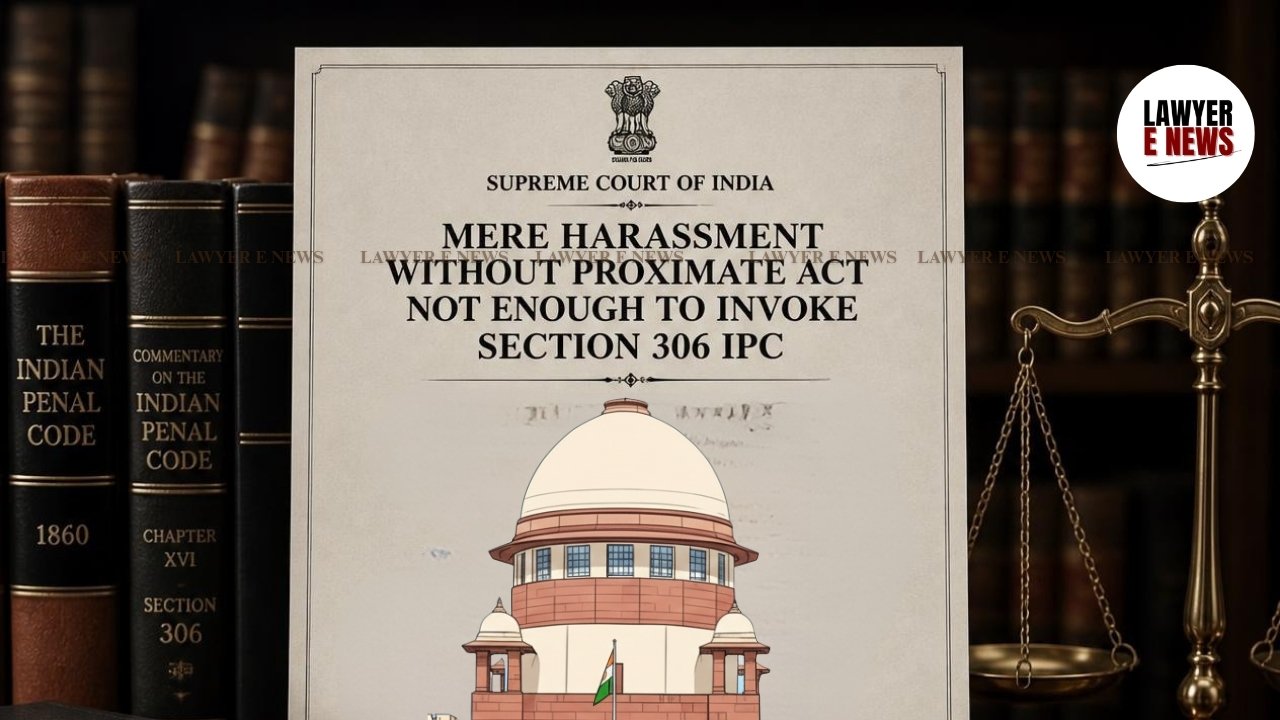
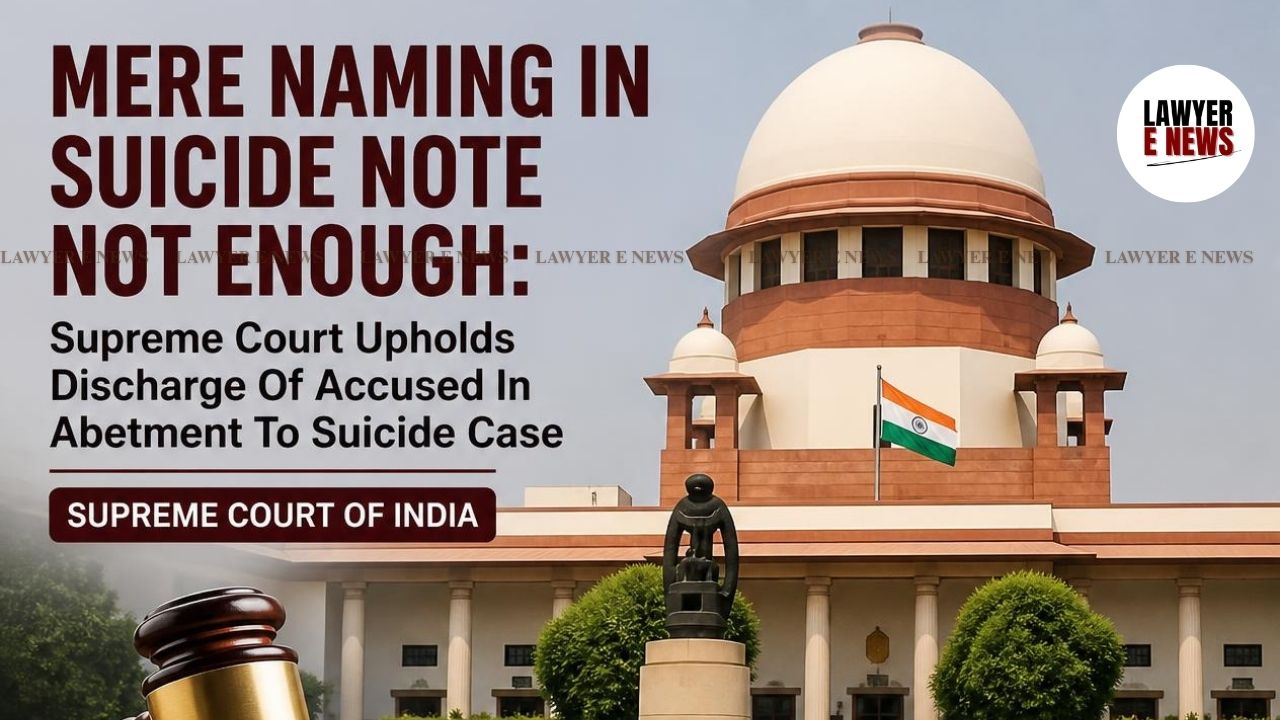
"Be it clearly stated that mere allegation of harassment without any positive action in proximity to the time of occurrence on the part of the accused that led a person to commit suicide, a conviction in terms of Section 306 IPC is not sustainable." Supreme Court of India, in a significant ruling, quashed criminal proceedings against a Forest Department official, holding that a charge of abetment to suicide cannot be sustained in the absence of a proximate act of instigation.
A bench comprising Justice Satish Chandra Sharma and Justice Nongmeikapam Kotiswar Singh observed that while the suicide of a young Forest Range Officer was a tragic outcome, criminal liability under Section 306 of the IPC must be strictly founded upon statutory ingredients, which require proof of a clear mens rea and a direct causal link to the death.
No Proximate Act Of Instigation
The case involved an appeal by Vinod Shivakumar, who faced charges under Section 306, 504, and 506 of the IPC following the suicide of a Forest Range Officer in March 2021. The deceased had left multiple suicide notes alleging mental harassment, professional humiliation, and the denial of leave by her superiors. While the prosecution argued that the appellant’s repeated insults and professional conduct drove the deceased to take her life, the Supreme Court noted that the allegations primarily pertained to administrative actions performed in the course of official duty.
Crucial Test Of Proximity
The bench emphasized that for an offence under Section 306 IPC to be made out, it is essential to establish direct or indirect acts of instigation in close proximity to the time of death. The court observed that the incidents relied upon by the prosecution, such as the registration of an FIR under the SC/ST Act or an alleged miscarriage, were remote in point of time. The judges held that ordinary administrative directions, disciplinary supervision, or even stern behaviour by a superior officer cannot be elevated to the status of abetment unless there is material demonstrating a conscious intention to drive the subordinate to suicide.
Intent Is The Determinative Factor
The court underscored that the "sure test" for determining abetment is whether the alleged perpetrator possessed a deliberate intention to push the victim into a position where they had no reasonable alternative but to end their life. The judgment clarified that mens rea cannot be gleaned merely from the victim's state of mind or the fact that they felt harassed. Without a specific, positive, and proximate act of instigation on the part of the accused, the legal requirements for Section 306 IPC remain unfulfilled, and continuing the prosecution would constitute an abuse of the process of law.
"The material on record does not disclose any overt act of instigation, goading or intentional aid on the part of the Appellant immediately preceding the commission of suicide."
Absence Of Mens Rea In Official Conduct
Regarding the additional charges under Sections 504 and 506 IPC, the court noted that the allegations of intimidation and insult were primarily tied to the appellant's official capacity. The bench highlighted that the appellant did not even possess the independent authority to suspend the deceased, further undermining the prosecution's claims of criminal intimidation. Consequently, the court found that the essential ingredients of these offences were also not attracted. The appeal was accordingly allowed, the impugned orders of the High Court and the Trial Court were set aside, and the appellant was discharged from the case.
The Supreme Court’s decision reaffirms the high threshold required to prosecute public servants for abetment to suicide, protecting them from criminal liability for routine administrative actions. By reiterating that the tragedy of an outcome cannot substitute for the absence of statutory ingredients, the judgment serves as a cautionary precedent for trial courts to ensure that charges are not framed based on mere allegations of professional friction.
Date of Decision: 14 August 2026