-
by sayum
25 August 2026 6:19 AM







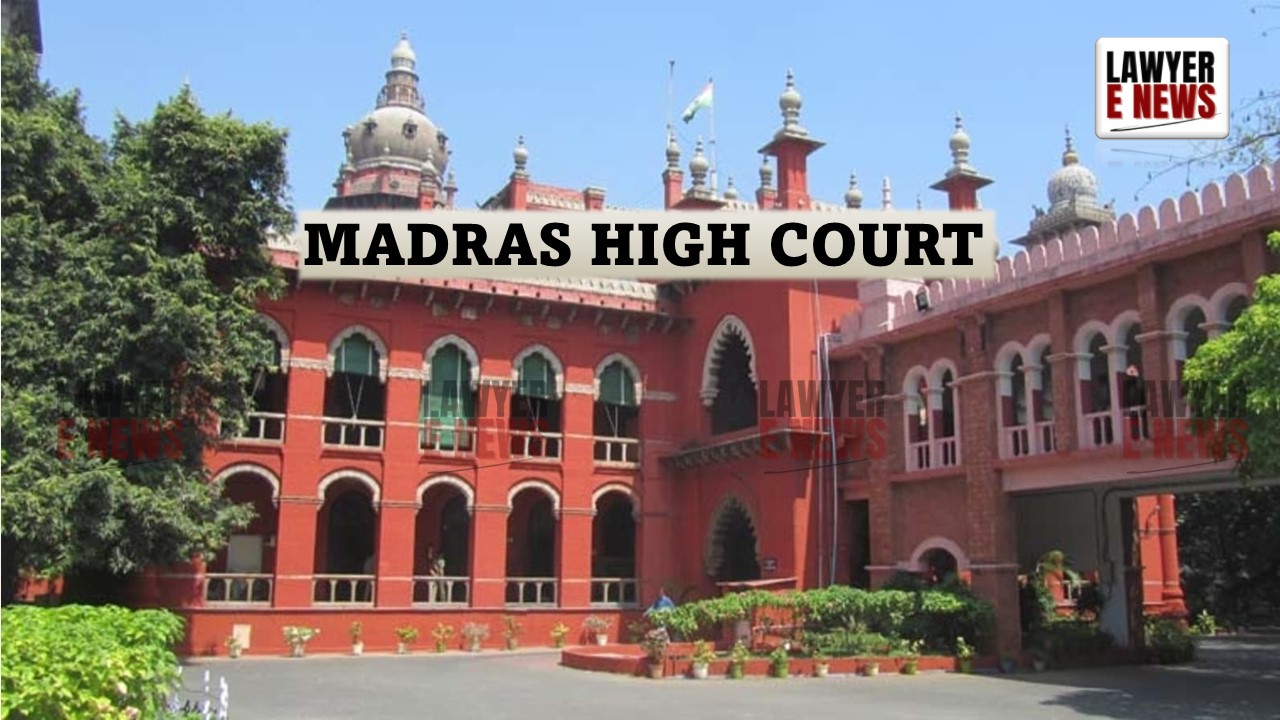
"Market Value Estimate Including Building Cost Cannot Form Basis for Summary Rejection Under Order VII Rule 11", Madras High Court dismissed a Civil Revision Petition filed under Article 227 of the Constitution, affirming the Trial Court’s decision not to reject a plaint at the fag end of trial on the ground of alleged under-valuation of the suit property. Justice S. Sounthar ruled that the evidence produced by the petitioner—particularly the testimony of a Sub-Registrar official—was insufficient to summarily reject the plaint under Order VII Rule 11 of the Civil Procedure Code, 1908, as it raised a disputed question of fact requiring proper adjudication.
The Civil Revision Petition was filed against the order passed by the VI Additional Judge, City Civil Court, Chennai in I.A. No. 7 of 2024 in O.S. No. 500 of 2023. The core legal issue concerned whether a plaint seeking declaration of title and recovery of possession could be rejected at the argument stage of trial on the basis of an under-valuation claim raised by the defendant, supported by oral evidence from a Sub-Registrar’s office official.
Rejection Plea Based on Sale Data After Defence Witness Testimony
The plaintiff (respondent herein) had filed a suit for declaration of title and possession, valuing the suit property at ₹83 lakhs for jurisdictional purposes, paying ad-valorem court fee under Section 25(b) of the Tamil Nadu Court Fees and Suits Valuation Act, 1955.
The defendant, Evangeline Prabhu, filed an application for rejection of the plaint on 23rd April 2024, well after the trial had progressed and after the examination of defence witness DW.4, an Assistant from the Sub-Registrar Office, Mylapore. According to the petitioner, the testimony of DW.4 revealed that a nearby property with a UDS (Undivided Share) of 570 sq.ft. was sold for ₹1.01 crores, and another with 800 sq.ft. UDS and 1800 sq.ft. construction was valued at ₹2 crores. Based on this, the petitioner alleged that the plaintiff had under-valued the suit property and that the plaint should be rejected for non-compliance with correct valuation norms.
However, the Trial Court dismissed the application on 11.11.2025, citing both the belated timing and insufficiency of the valuation evidence provided.
Can a Plausible Dispute on Valuation Justify Rejection of Plaint at Final Stage of Trial?
The petitioner’s main legal contention relied on Order VII Rule 11 of the CPC, which allows rejection of a plaint inter alia where it is undervalued and the plaintiff fails to correct the valuation within time allowed by the court. However, Justice Sounthar clarified that:
“Though application for rejection of plaint can be filed at any stage before disposal of suit, when plea involves disputed facts relating to valuation and requires evidence, plaint cannot be rejected summarily.”
The Court observed that the valuation adopted by the plaintiff could not be conclusively deemed incorrect merely on the basis of DW.4’s testimony. In fact, the valuation described by the Sub-Registrar’s Assistant included both land and building cost and failed to segregate the market value of the land alone. This distinction was crucial, as the cost of construction varies depending on factors like quality and age of the building.
“Based on the valuation mentioned by DW.4, which includes cost of the site as well as cost of building, we cannot come to a definite conclusion that the valuation adopted by the plaintiff is not correct and he under-valued the property.”
The Court noted that it is common knowledge that building valuation is not uniform and cannot be treated as objective market value without further enquiry.
Summary Rejection Not Permissible Where Valuation Is Disputed
Justice Sounthar emphasized that the application was made after the trial had substantially concluded, and the case had reached the argument stage. Although technically such applications can be made at any time before disposal of the suit, their maintainability depends on the nature of the issue involved.
Here, the question of valuation was deemed a “disputed question of fact” which could not be summarily resolved through an Order VII Rule 11 application. Instead, such issues must be tried on evidence after proper framing of issues.
“This Court feels based on the evidence of DW.4 and the sworn statement of the petitioner, we cannot reject the plaint without proper enquiry.”
Court’s Direction and Liberty to Defendant
While upholding the Trial Court's order, the Madras High Court offered a procedural remedy to the petitioner:
“If the petitioner is so advised, it is always open to her to make a request before the Trial Court to frame an issue with regard to the valuation of the plaint.”
Such framing of issues would permit a full-fledged trial on the disputed valuation aspect, allowing the parties to produce documentary and expert evidence rather than relying on a single oral statement.
Accordingly, the Civil Revision Petition was dismissed, and the impugned order was upheld. The connected CMP was also closed, with no order as to costs.
Date of Decision: 02 February 2026