-
by sayum
27 August 2026 3:32 PM







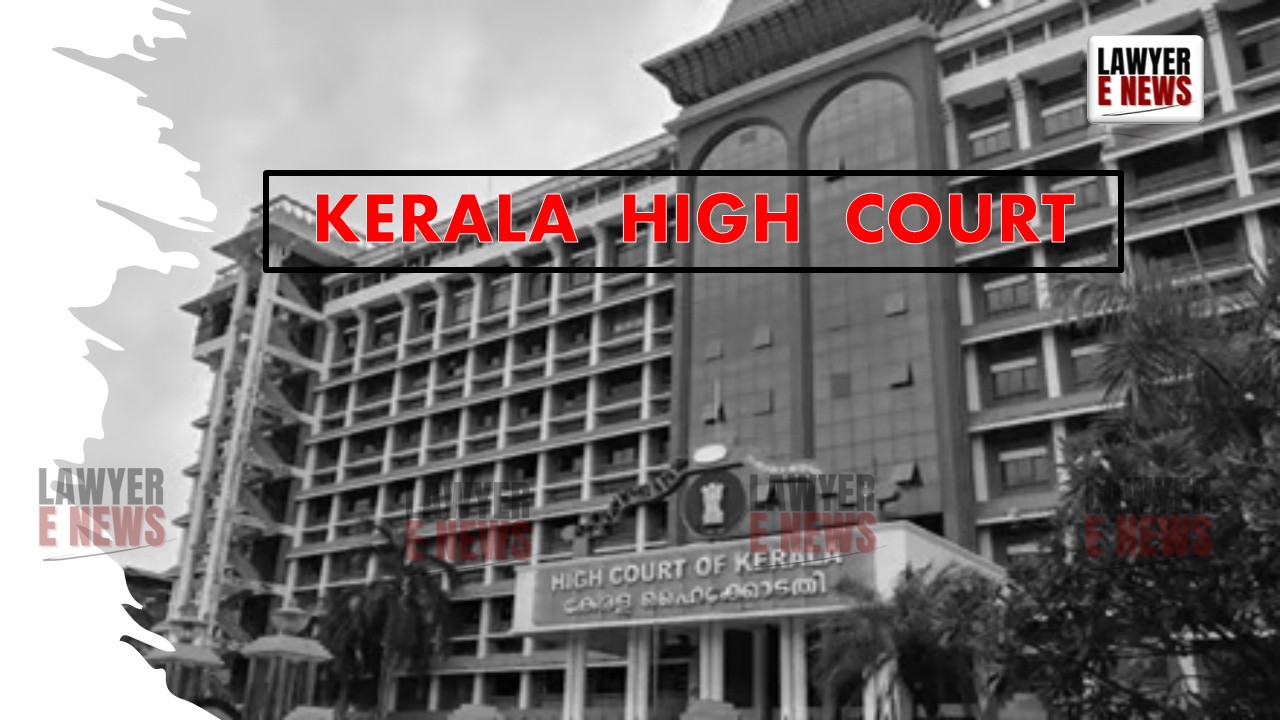
"Legislature has not incorporated in Section 3 (2) (e) of the Act of 1984 a ‘catch all’ clause when it comes to all categories of ‘Public Properties’ and had rather deliberately chosen to provide a closed list of what would constitute a ‘Public Property’ under the said Section," Kerala High Court, in a significant ruling, held that the official vehicle of a judicial officer does not fall within the definition of a "means of public transportation" under the Prevention of Damage to Public Property Act, 1984.
A Single Bench of Justice Syam Kumar V.M. observed that criminal proceedings cannot be sustained against a driver for a road incident involving a public servant's vehicle unless there is proof of intentional criminal force directed against the person or the use of dangerous weapons.
The case arose from an incident in 2018 where a private bus driver allegedly overtook and brushed against the official car of the Judge, Motor Accidents Claims Tribunal (MACT), Alappuzha. The impact shattered a window pane, causing minor injuries to the official driver, leading to charges under Sections 324 and 353 of the IPC and Section 3(2)(e) of the PDPP Act. The petitioner sought to quash the Final Report, arguing that a road accident lacking criminal intent cannot be prosecuted under these stringent provisions.
The primary question before the court was whether the brushing of a vehicle during overtaking attracts the offence of assault or criminal force under Section 353 IPC. The court was also called upon to determine if an official car of a judicial officer constitutes "public transportation" under Section 3(2)(e) of the PDPP Act and if shattered glass fragments qualify as hurt by "dangerous means" under Section 324 IPC.
Section 353 IPC Requires Force Against Person, Not Inanimate Objects
The court meticulously examined the ingredients of Section 353 IPC, which pertains to assault or criminal force to deter a public servant from discharge of duty. Relying on the Supreme Court’s ruling in Umashankar Yadav v. State of Uttar Pradesh, the bench noted that the provision requires the use of physical energy against a person with specific intent.
The bench emphasized that "criminal force" must be exercised against a human being and not merely against a substance or object. Citing the precedent in Devaki Amma v. State of Kerala, the court held that in the absence of any direct or intentional use of force against the driver, the mere contact between the bus and the car cannot be brought within the ambit of Section 353 IPC.
"Criminal force as contemplated under this section means criminal force exercised against a person and not against an inanimate object or substance."
No Criminal Intent Or Mens Rea In Road Accidents
Turning to the facts, the court observed that the First Information Report (FIR) itself described the incident as a bus brushing against the side of the car while passing ahead. The bench found that there was absolutely no allegation to indicate that the petitioner possessed the criminal intent or mens rea required to obstruct or deter a public servant from performing their duties.
The court noted that the very foundation for invoking Section 353 IPC stands vitiated when the essential requirement of assault or criminal force is wholly absent. The incident, characterized by the court as a routine traffic occurrence, lacked the intentionality necessary to sustain a criminal charge of this nature.
Accidental Shattering Of Glass Is Not Hurt By 'Dangerous Means'
Regarding the charge under Section 324 IPC, the court clarified that the provision is only attracted when hurt is caused by dangerous weapons or specific "dangerous means" enumerated in the statute. The prosecution had alleged that the shattering of the car window glass caused injuries to the de facto complainant.
The bench held that such an injury, resulting as a collateral consequence of a road impact, does not satisfy the legal requirements of Section 324 IPC. The court remarked that there was no intentional use of a dangerous weapon by the petitioner, and therefore, the invocation of this section was legally unsustainable and far-fetched.
"The injury was not caused by any intentional use of a dangerous weapon or dangerous means by the petitioner; therefore, the invocation of Section 324 IPC is legally unsustainable."
Official Judicial Vehicles Are Not 'Public Transportation' Under PDPP Act
The most significant portion of the judgment addressed the scope of Section 3(2)(e) of the PDPP Act. While the prosecution argued that any property maintained by the state exchequer is "public property," the court held that Section 3(2)(e) provides a "closed and specifically enumerated list" of properties, such as means of public transportation or telecommunications.
The court observed that an official car attached to a Judge, which is not used for public carriage or carrying passengers for hire, does not fall within this specific category. The bench warned against widening the scope of the Act through an "interpretative exercise" to cover every form of public property in a general sense, noting that the Act was never intended to govern isolated motor accidents.
Legislature Provided A Closed List Under Section 3(2)(e) PDPP Act
The court concluded that the legislature deliberately chose not to incorporate a "catch-all" clause in Section 3(2)(e). By providing a specific list, the legislative intent was to limit the provision's reach to the enumerated properties. Since the official car of a judicial officer does not fit the definition of public transport, the charge was held to be inapplicable.
The bench further noted that the nature of the incident fell more appropriately within the category of a motor accident rather than a deliberate act of mischief aimed at destroying public property. The court reiterated that continuation of such proceedings would amount to an abuse of the process of law.
"It is not open to widen or extend the scope of Section 3 (2) (e) of the Act of 1984 by an interpretative exercise to mean any 'Public Property' in its all pervading and general sense."
The High Court allowed the petition and quashed the Final Report and all further proceedings against the bus driver. The court held that since the trial would invariably result in acquittal due to the absence of essential legal ingredients, the petitioner should not be subjected to the rigors of a criminal trial. The ruling reaffirms that road accidents involving official vehicles cannot be escalated into serious criminal charges without evidence of specific criminal intent and the use of force against the person.
Date of Decision: 09 February 2026