-
by sayum
06 August 2026 10:32 AM







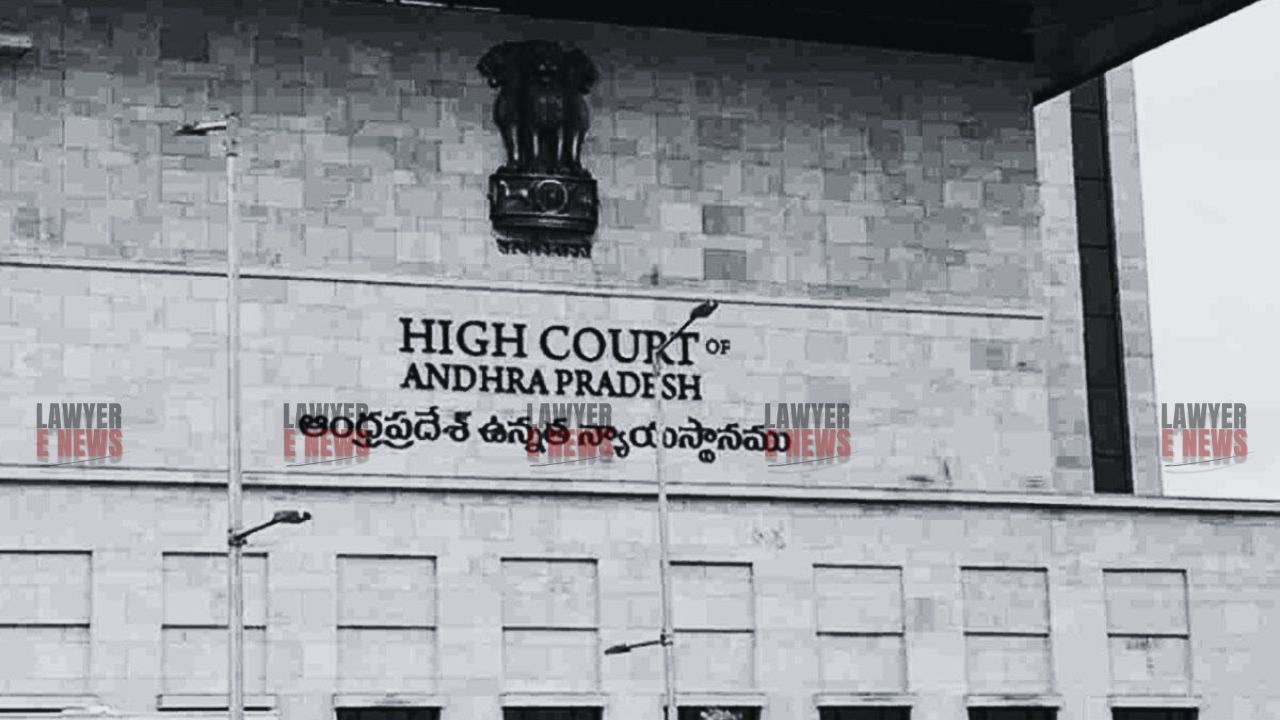
“Mutation Entries Cannot Override Registered Sale Deeds — Disputed Wills Must Be Proved in Civil Court ……Revenue Authorities Cannot Adjudicate Title on Basis of an Unregistered Will — Civil Court Alone Has Jurisdiction Where Title is in Dispute” - In a significant ruling Andhra Pradesh High Court held that revenue authorities lack the jurisdiction to determine title based on an unproven Will, especially when the same is disputed and contradicts registered sale transactions executed decades earlier. The Court declared, “Mutation proceedings are fiscal in nature and do not create or extinguish title nor carry any presumptive value on title”, reiterating the settled legal position that ownership disputes must be adjudicated by civil courts and not through mutation under the ROR Act.
While dismissing a batch of Writ Appeals challenging orders passed by the Revenue Divisional Officer and the Joint Collector that reversed 1985 mutation entries, the Division Bench of Justice Ravi Nath Tilhari and Justice Maheswara Rao Kuncheam struck down the Single Judge’s direction for “forthwith implementation” of the impugned orders and extended status quo on possession for a period of three months. The Court held that direction to forcibly dispossess parties in the midst of an unresolved title dispute was unsustainable, especially when the matter was relegated to the civil forum.
“Revenue Entries Cannot Overturn Sale Deeds Attested by the Original Owner — Once Title is Disputed, Revenue Forum Must Bow Out”
“Where Ownership is Claimed Through a Will, Its Validity Must Be Proved as Per Succession Act and Evidence Act Before a Civil Court”
The case involved agricultural land measuring Ac.27.00 in Krishna District, originally owned by Meka Venkata Ram Mohan Appa Rao, who, as per record, sold the land through registered sale deeds in 1985 to several purchasers. These purchasers — the appellants in the writ appeals — had their names mutated in the revenue records, and pattadar passbooks were issued accordingly.
Decades later, in 2014, the sister of the original owner, Kakumanu Sravanthi Devi, claimed ownership of the same property based on an unregistered Will dated 20.01.2014 allegedly executed in her favour just before her brother’s death. Without initiating civil proceedings, she filed an appeal under Section 5B of the Andhra Pradesh Rights in Land and Pattadar Passbooks Act, 1971, before the Revenue Divisional Officer, seeking cancellation of the long-standing mutations in favour of the registered purchasers.
The RDO allowed the appeal in 2018, and the Joint Collector affirmed this decision in 2020. Attempts were then made to implement these orders and dispossess the appellants, prompting the writ petitions and, ultimately, these appeals.
The Division Bench made it clear:
“Even if based on a Will, any right is being claimed, the same requires determination for which it is for the person relying on the Will to approach the civil court… Such claims cannot be made through proceedings under the ROR Act.”
The Court further noted that the Will in question had never been proved in accordance with Section 63(c) of the Indian Succession Act, 1925 read with Section 68 of the Indian Evidence Act, 1872, and therefore could not serve as a basis to nullify recorded titles established through registered conveyances.
“Proof of Title Cannot Be Assumed — Mutation Based on Unregistered and Disputed Will Cannot Displace Registered Transactions”
The Court strongly deprecated the revenue authorities’ approach in unsettling registered titles through summary proceedings, stating:
“The revenue authorities acted without jurisdiction by cancelling mutations made in 1985 based on registered sale deeds, particularly when the Will was not proved and the title was in serious dispute.”
It further underscored that the original owner had signed as an attesting witness to the sale deeds executed in 1985. If the owner himself had acknowledged the transactions in his lifetime, no mutation based on a belated Will could override those registered and admitted transactions.
The Bench observed:
“Once during his lifetime there was no objection raised nor any challenge made, and based thereon the mutation had been effected, the same could not be reversed posthumously on the strength of an unproven Will.”
“Re-litigation on Mutation Orders Not Permissible — Earlier Petitions Dismissed, Coordinate Benches Cannot Take Conflicting Views”
The High Court also dealt with the issue of re-litigation, pointing out that a previous writ petition and writ appeal filed by one of the same petitioners had already been dismissed in 2020. It held:
“There would be no scope for the writ appellants to again challenge the same order of the Joint Collector in writ proceedings… There cannot be conflicting orders arising from the same mutation order.”
The Bench emphasized the principle of judicial discipline, noting that once a Coordinate Bench had declined to interfere in the same matter, the issue could not be reopened under the guise of fresh writ petitions filed by similarly placed parties.
“Mutation Is Not a Determination of Ownership — It Merely Enables Payment of Revenue”
Referring to binding precedent, the Bench cited the Supreme Court’s ruling in Suraj Bhan v. Financial Commissioner, (2007) 6 SCC 186, where it was held:
“An entry in revenue records does not confer title on a person whose name appears in the record-of-rights. It is settled law that entries in the revenue records have only ‘fiscal purpose’ and no ownership is conferred on the basis of such entries.”
Similarly, the Court cited Ajit Kaur v. Darshan Singh, (2019) 13 SCC 70, reiterating that mutation does not create or extinguish title and carries no presumptive value.
“When Civil Court Must Decide Title, Revenue Authorities Must Stay Their Hand — Mutation Cannot Be Used to Evict Registered Owners”
The Division Bench firmly rejected the Single Judge’s direction to “forthwith implement” the revenue orders, which would have displaced the appellants without any adjudication of their ownership in civil court. The High Court stated:
“Once the learned Single Judge was of the view that the writ petitions deserved dismissal and directed the parties to approach the Civil Court, the direction to implement the orders passed by the Revenue Court could not have been issued.”
Reversing that direction, the Court clarified that no dispossession could take place in the interregnum, especially in a matter involving serious and unresolved disputes of title.
The Court dismissed all Writ Appeals but modified the Single Judge’s order to preserve possession and defer implementation of the revenue orders. It held:
“Disputes involve complicated questions of title… All those questions can be determined only on the civil side by the competent Civil Court.”
It directed that status quo as to possession be maintained for three months, during which the parties are free to pursue civil remedies.
The judgment is a reaffirmation that title to land cannot be determined through the backdoor of revenue entries, particularly when registered sale deeds are in existence and a Will is not judicially proved. It reinforces the limited purpose of revenue records and the primacy of civil courts in title adjudication. As the Court concluded:
“Mutation proceedings are fiscal — not a substitute for a civil suit.”
Date of Decision: 15 October 2025