-
by sayum
29 August 2026 3:15 PM







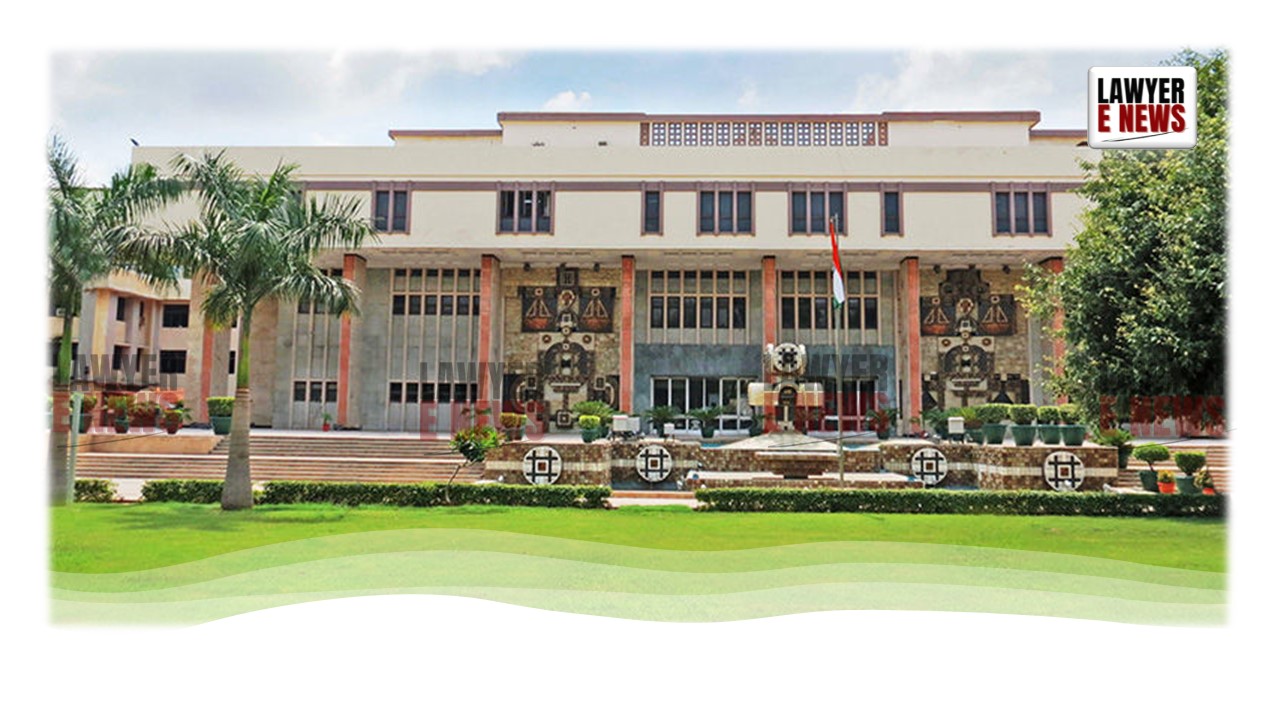
"The maxim delegatus non potest delegare applies where a statutory delegate purports to create a new delegate without statutory sanction. It has no application where the statute itself recognises exercise of power through an authorised authority within the same statutory scheme." Delhi High Court, in a significant service law ruling dated April 1, 2026, held that the Ministry of Home Affairs (MHA) has the requisite statutory jurisdiction to initiate and conclude disciplinary proceedings against IAS officers belonging to the AGMUT Joint Cadre.
A division bench comprising Justice Anil Kshetarpal and Justice Amit Mahajan observed that the "nomination or authorisation of the Ministry of Home Affairs to process and issue disciplinary orders in respect of officers borne on the Joint Cadre does not amount to impermissible subdelegation."
The Union of India filed writ petitions challenging the orders of the Central Administrative Tribunal (CAT), which had quashed disciplinary proceedings against respondent IAS officers posted in Arunachal Pradesh. The Tribunal had held that the MHA lacked the competence to issue charge memorandums, ruling that only the specific State Government where the officer was serving at the time could initiate such actions. The core dispute revolved around whether the Joint Cadre Authority (JCA) could validly nominate the MHA to act as the disciplinary authority for the entire AGMUT cadre.
The primary question before the court was whether the Ministry of Home Affairs, acting as a nominee of the Joint Cadre Authority, was legally competent to initiate disciplinary proceedings against a member of the AGMUT Joint Cadre. The court was also called upon to determine whether such an arrangement amounted to an impermissible sub-delegation of statutory power under the All India Services (Discipline & Appeal) Rules, 1969.
Conjoint Reading of Statutory Rules
Delving into the legislative framework under the All India Services Act, 1951, the court examined the interplay between the 1954 Cadre Rules, the 1972 Joint Cadre Rules, and the 1969 Discipline and Appeal Rules. The bench noted that Rule 2(d) of the 1954 Rules statutorily substitutes the expression "State Government concerned" with the "Joint Cadre Authority" (JCA) in relation to a joint cadre. Consequently, the court found that the disciplinary authority does not vest in a single State acting independently, but in the collective institutional mechanism of the JCA. "In the case of a Joint Cadre, disciplinary authority cannot be understood as vesting exclusively in an individual constituent State acting independently of the Joint Cadre framework, but in the collective Governments of all the constituent States."
Authorisation is Not Sub-Delegation
Addressing the respondents' contention that the JCA's 1989 resolution nominating the MHA was an illegal sub-delegation of power, the court clarified that the statute itself permits such representation. Rule 2(e) of the 1969 Rules expressly includes a Government nominated by the collective States to represent them in a particular matter. The bench held that since the MHA represents the Union Territories within the AGMUT cadre, its designation as the nodal authority was a structured authorisation within the governmental framework, not a transfer of power to an extraneous body. "The present arrangement... does not involve the creation of an extraneous authority but the channelisation of power through an identified organ of the Union Government."
"Administrative channelisation of statutory power, so long as it does not transgress the parent Rules, cannot be equated with assumption of jurisdiction where none exists."
Interpretation of Rule 7
The tribunal had heavily relied on Rule 7 of the 1969 Rules, which states that the "Government of that State" where the officer is serving shall institute proceedings. Rejecting the tribunal's narrow interpretation, the High Court ruled that this expression cannot be read in isolation to defeat the concept of a joint cadre. The bench explained that in a joint cadre setup, the competence of the State Government is collectively channelised through the JCA. Reading Rule 7 in isolation would render the joint cadre framework administratively unworkable. "The expression 'Government of that State' in Rule 7 cannot be construed as denoting a wholly distinct and insulated authority divorced from the definitional framework of the Rules."
Statutory Right of Appeal Unaffected
The court also dismissed the argument that allowing the MHA to act as the original disciplinary authority would render the statutory right of appeal to the Central Government under Rule 16 illusory. The bench observed that service jurisprudence frequently accommodates original and appellate authorities operating within the same broader governmental structure. As long as the designated appellate authority is distinct in rank and competence from the disciplinary authority, the statutory safeguards remain fully preserved and operational. "The mere circumstance that both the disciplinary and appellate authorities function within the broader framework of the Union Government does not, by itself, vitiate the appellate mechanism."
Validity of the 1989 Executive Resolution
Finally, the court held that the 1989 resolution and subsequent 2017 notification operationalising the MHA's role did not create a new source of power, but merely streamlined the existing statutory scheme. The bench noted that executive decisions that operate within statutory rules are valid even if not framed as formal statutory instruments. Procedural irregularities in recording minutes do not nullify an arrangement that conforms to the governing laws of the land. "The validity of the exercise of power must be tested on statutory conformity and not on the format of the administrative record."
Allowing the writ petitions, the Delhi High Court set aside the Central Administrative Tribunal's orders to the extent they held the MHA's actions to be without jurisdiction. The court directed that the disciplinary proceedings against the officers be restored to the stage at which they were interdicted, affirming the Union Government's coordinated disciplinary control over joint cadre officers.
Date of Decision: 01 April 2026