-
by sayum
27 August 2026 3:32 PM







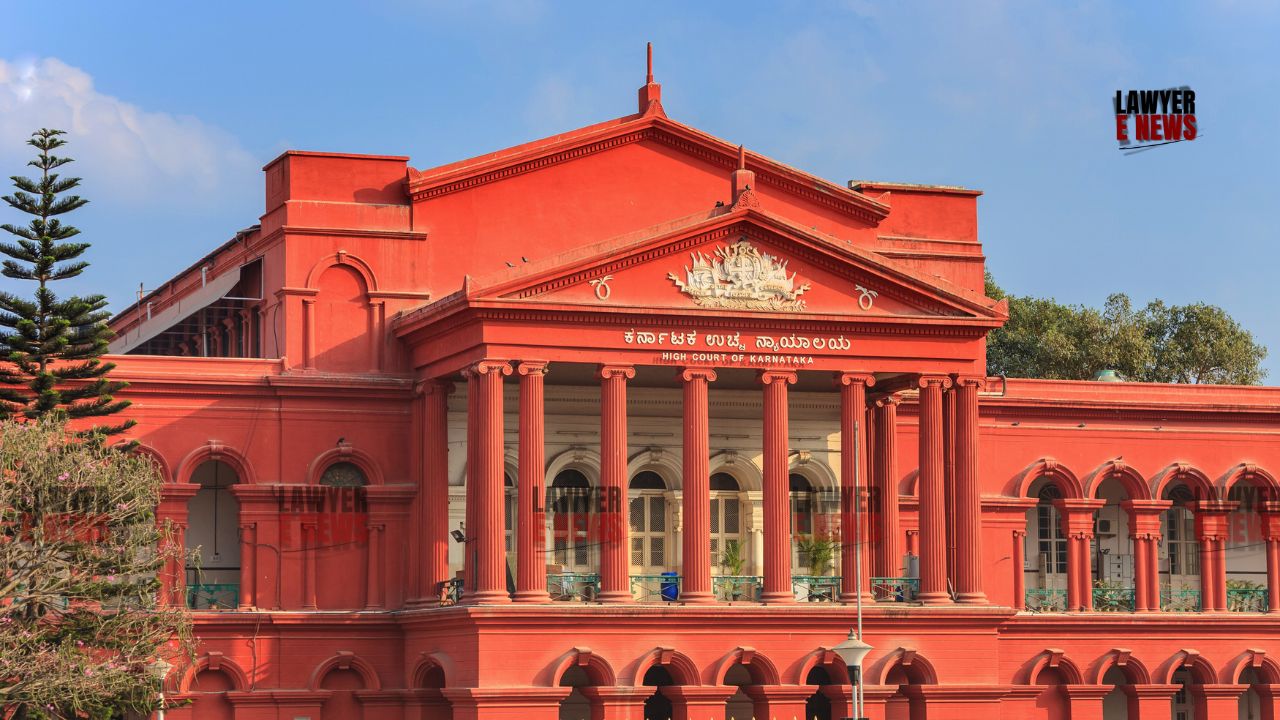
"There is no indefeasible right to continue to enjoy the licence beyond its terms — the licensee's right to renewal is determined by the rules existing at the time of renewal and not at the time of grant", Karnataka High Court (Bengaluru Bench) has allowed the State's appeal and set aside a Single Judge's order that had stayed the operation of the Karnataka Excise (Sale of Indian and Foreign Liquors) (Second Amendment) Rules, 2025, holding that the introduction of e-auction with reservation-based eligibility for liquor licences and the forfeiture of lapsed licences are well within the State's rule-making power under the Excise Act, and that liquor licence holders have no vested right of renewal that can be asserted against a policy change.
A Division Bench of Chief Justice Vibhu Bakhru and Justice C.M. Poonacha, in a comprehensive judgment traversing the constitutional status of liquor trade, the nature of delegated legislation and the presumption of constitutional validity, held that subordinate legislation cannot be lightly stayed and that the writ petitioners had failed to surmount the presumption of constitutionality that attaches to every piece of delegated legislation.
The Division Bench was called upon to determine whether the impugned Rules exceeded the rule-making power under Section 71 of the Excise Act; whether the deemed forfeiture of lapsed licences was beyond the State's competence; whether the adoption of reservation norms by reference in the Rules constituted impermissible sub-delegation; whether licence holders had vested rights of renewal; and whether singling out three categories of licences for the new regime violated Article 14.
On the Misapplication of the B. Govindraj Hegde Precedent
The Single Judge had primarily relied upon the Division Bench's earlier decision in State of Karnataka v. B. Govindraj Hegde (WA 3374/2016). The Division Bench distinguished that decision at the outset. In Govindraj Hegde, the challenge had been to a relaxation of the minimum room-capacity requirement for hotel licences for reserved-category applicants — a relaxation of a restriction imposed in the public interest, which the Court found impermissible. Crucially, that very judgment had expressly held that reserving a quota of licences for reserved categories would be permissible. The impugned Rules introduced e-auction with reservation of a quota — precisely what Govindraj Hegde had said was permissible. "The challenge to the proviso to Rule 5 of the Rules, which enables the Government to specify general reservations for licences to be auctioned, cannot be sustained on the strength of the said decision," the Division Bench held.
On the Nature of the Liquor Licence — A State Privilege, Not a Citizen's Right
The Court undertook an authoritative survey of the constitutional position on liquor trade, beginning with the Supreme Court's seminal decision in Cooverjee B. Bharucha v. Excise Commissioner (1954), which established that no citizen has a fundamental right under Article 19(1)(g) to carry on trade in intoxicants. Drawing upon Nashirwar v. State of M.P., State of Orissa v. Harinarayan Jaiswal and Har Shankar v. Excise & Taxation Commissioner, the Court reaffirmed that the manufacture, distribution and sale of intoxicants is an exclusive privilege of the State, which it may part with on such conditions as it chooses, raise revenue from, or refuse altogether. "Since rights in regard to intoxicants belong to the State, it is open to the Government to part with those rights for a consideration — citizens cannot have any fundamental right to trade or carry on business in the properties or rights belonging to the Government," the Court quoted.
On the Forfeiture of Lapsed Licences
The Court made an important doctrinal clarification. A plain reading of the proviso to Rule 5-A showed that it did not in fact provide for forfeiture of a subsisting licence — it curtailed only the right of renewal of lapsed licences. Since the Excise Act itself contains no provision for renewal of licences, the right of renewal was entirely a creation of the Rules. The Court applied the elementary principle that what the Rules could create, the Rules could also curtail. "Plainly, if the Rules can provide for the renewal of the licence, they could also provide for curtailing the said right. We are unable to accept that whilst the Rules could provide for renewal of licences, it could not limit the same," the Bench held. Section 71(2)(e) of the Excise Act expressly empowered the State Government to make rules regulating the periods for which licences may be granted — curtailing the renewal window was squarely within this power.
On Vested Rights — There Are None
The Division Bench dismissed the vested rights argument with considerable force, holding that the respondents' entire contention was built on a misunderstanding of what constitutes a vested right. Relying on Bibi Sayeeda v. State of Bihar, MGB Gramin Bank v. Chakrawarti Singh and Kuldeep Singh v. Govt. of NCT of Delhi, the Court held that a vested right must be fixed, accrued, settled and absolute — a mere expectancy of future benefits or a contingent interest founded on the anticipated continuance of existing laws does not constitute a vested right.
Since the licence was granted for a fixed annual term, there was no indefeasible right to continue beyond that term. "The licensee's right to renewal is determined by the rules existing at the time of renewal and not at the time of grant. There is no right to insist that the rules pertaining to renewal, as on the date of grant of licence, shall continue to be operative and vest an indefeasible right to renewal in perpetuity," the Court held. Even applications filed before the amendment of the Rules do not confer a vested right to be considered under the pre-amendment Rules, since the applicable policy is the one prevailing on the date of consideration, not the date of application.
On Sub-Delegation and Reservation Norms
The respondents contended that the proviso to Rule 5, which enabled the adoption of reservation norms "fixed by the Government," was an impermissible sub-delegation under the principle of delegatus non potest delegare. The Division Bench rejected this squarely. The Excise Act delegated rule-making power to the State Government. The proviso to Rule 5 incorporated the State Government's own reservation policy — meaning the delegatee and the alleged sub-delegatee were one and the same entity. The Court relied upon the Supreme Court's decision in Arun Tewari v. Zila Mansavi Shikshak Sangh, which held that when the rule-making authority gives to itself the power to prescribe criteria in specific circumstances, the question of excessive delegation simply does not arise. "Principle of sub-delegation may not apply where the delegator and the delegate are the same," the Court held. The Advocate General also undertook on instructions that the reservation norms would be specifically incorporated in the Rules to obviate any further objection.
On Article 14 — Singling Out Three Licence Categories
The Court rejected the discrimination argument with equal clarity. Rule 3 of the Excise Rules sets out multiple categories of licences for different establishments with different characteristics. The State is fully entitled to determine the terms and conditions on which its privilege is parted with and to create multiple licence categories with varying terms. "There is no principle of law which confines the State to enter into only one type of contract and restrict its freedom to enter into contracts with varying terms. Issuance of various types of licences with varying terms and conditions does not offend the equal protection clause," the Court held.
On the Presumption of Constitutional Validity
The Court concluded with a strong reminder about the proper approach to staying subordinate legislation — a reminder that applies universally to any challenge to delegated legislation. Citing Nand Kishore v. State of Punjab, Bombay Dyeing & Mfg. Co. Ltd. v. Bombay Environment Action Group and Sharma Transport v. Government of A.P., the Court held that the tests of arbitrary action applicable to executive action do not automatically apply to delegated legislation — a much higher threshold of manifest arbitrariness must be established. If two views are possible, one favouring validity and one against, the former must always be preferred. "We are unable to, prima facie, accept that the writ petitioners have surmounted the presumption of constitutionality. The impugned order disregards settled principles and is therefore liable to be set aside," the Bench concluded, allowing the appeal and vacating the stay in its entirety.
Date of Decision: 15.04.2026