-
by sayum
27 August 2026 3:32 PM







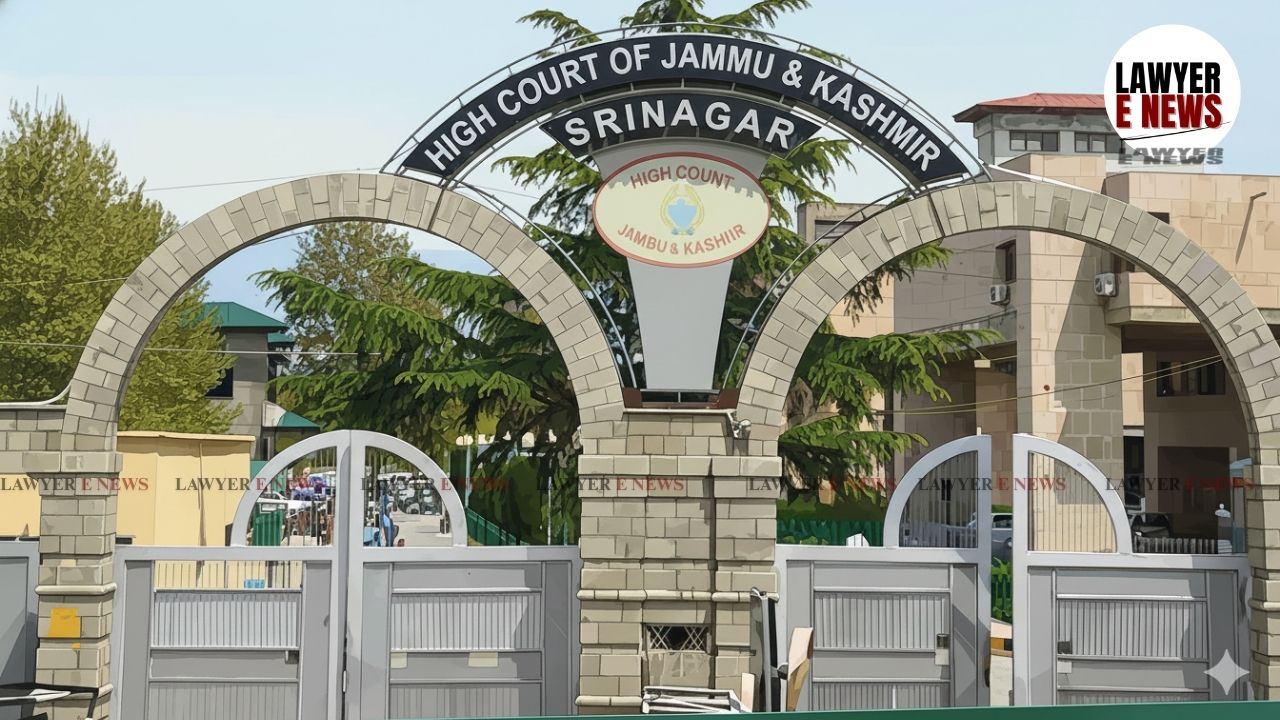
"To deny benefit of Section 14 in given set of circumstances would be to punish the appellant for this Court's own docket load in deciding case even on preliminary objection of maintainability", High Court of Jammu & Kashmir and Ladakh at Jammu has set aside a Commercial Court order dismissing a recovery suit as time-barred, holding that a litigant who bona fide pursued a writ petition for nine years — only to withdraw it with liberty to seek civil remedy — is entitled to exclusion of that entire period under Section 14 of the Limitation Act, 1963, and cannot be penalised for the delays caused by the court's own pendency.
A Division Bench of Justice Rajnesh Oswal and Justice Rahul Bharti sharply criticised the trial court's "hyper-technical approach" in denying the benefit of Section 14, observing that it amounted to "missing the woods for trees" and frustrated the ends of justice.
The appellant, M/s HSL Enterprises, executed site-enabling works for a 30 MLD Sewage Treatment Plant at Bhagwati Nagar, Jammu at the instance of respondent No. 1, M/s Thermax Ltd. A part payment was released but a balance of Rs. 96 lakhs remained outstanding. In 2013, the appellant filed a writ petition before the High Court. The respondent contested maintainability, asserting the dispute arose from a private contract not amenable to writ jurisdiction. The writ court initially allowed the petition on 31.10.2013, but the Division Bench set aside that order in February 2015 and remitted the matter. After years of pendency, the writ petition was dismissed for non-prosecution on 27.10.2021, restored on 13.04.2022, and finally withdrawn on 30.05.2022 with liberty to pursue civil remedy. The appellant filed the civil suit promptly on 09.07.2022 along with an application under Section 14 of the Limitation Act seeking exclusion of the time spent in the writ proceedings. The Commercial Court rejected the application, finding lack of bona fides and due diligence, and dismissed the suit as time-barred. The present appeal was filed against that order.
The central question was whether the appellant satisfied the conditions for invoking Section 14 of the Limitation Act — particularly whether the writ proceedings were prosecuted with due diligence and good faith, and whether the ultimate failure of those proceedings due to jurisdictional objections constituted a "defect of jurisdiction or other cause of a like nature" within the meaning of the provision. A procedural question also arose on whether exclusion of time under Section 14 must be pleaded in the plaint itself, as distinct from a separate application for condonation of delay.
On the Procedural Necessity of Pleading Section 14 in the Plaint
The Division Bench opened its judgment by clarifying an important procedural point that practitioners often conflate. The Court observed that exclusion of time under Section 14 of the Limitation Act is not the same as condonation of delay under Section 5 — it is not sought by a separate application, but must ideally be pleaded in the plaint itself through detailed averments. "There is no provision for 'condonation of delay' by an application in filing of a civil suit. Rather, the period spent bona fide in pursuing a remedy before a legal forum lacking jurisdiction is meant to be statutorily excluded when computing limitation period for which a plaint is supposed to bear averments in detail," the Court held.
On the Trial Court's Finding of Lack of Bona Fides
The High Court found the trial court's conclusion of lack of diligence to be entirely unsustainable on the facts. The trial court had penalised the appellant specifically for the 2021 dismissal for non-prosecution. The Division Bench rejected this reasoning categorically, holding that once the Writ Court had formally restored the proceedings on 13.04.2022, the trial court had no business going behind that restoration order to treat the prior non-prosecution as evidence of lack of diligence. "Once a matter is restored, the trial court cannot 'go behind' that order to comment on prior non-prosecution as evidence of lack of diligence," the Court held emphatically.
The Court further noted that the appellant could not be faulted for continuing to pursue the writ proceedings after 2016, when maintainability objections were raised, because those objections were never decided expeditiously by the writ court. "Had the respondent No. 1's 2016 raised maintainability objection been decided expeditiously by the writ Court, the appellant would have sought and availed available/alternative remedy at that very stage," the Court observed, making the crucial point that the nine years of pendency were attributable not to the litigant's inaction but to the court's own docket burden.
On Punishing the Litigant for Judicial Delay
The Division Bench made a pointed observation that strikes at the heart of the justice delivery challenge. A litigant cannot be held responsible for the pace of adjudication — that lies entirely beyond their domain and control. To deny Section 14 benefit in such circumstances, the Court held, "would be to punish the appellant for this Court's own docket load in deciding case even on preliminary objection of maintainability."
On the Scope of Section 14 — 'Other Cause of a Like Nature'
Drawing from the Supreme Court's landmark exposition in Madhavrao Narayanrao Patwardhan v. Ramakrishna Govind Bhanu, 1959 SCR 564, the Court applied the five conditions for invoking Section 14 — both proceedings being civil proceedings by the same party, prosecution with due diligence and good faith, failure due to defect of jurisdiction or like cause, identity of subject matter, and both proceedings being before a court. The Court found all five conditions satisfied on the facts.
Relying further upon Roshanlal Kuthalia v. R.B. Mohan Singh Oberoi, (1975) 4 SCC 628, the Court affirmed that the expression "other cause of a like nature" in Section 14 must receive a liberal interpretation and covers "any circumstance legal or factual which inhibits entertainment or consideration by the Court of the dispute on the merits." The appellant's bona fide, albeit ultimately misdirected, recourse to writ jurisdiction fell squarely within this expansive formulation.
The Court also placed reliance on the Supreme Court's recent decision in Purni Devi v. Babu Ram, 2024 INSC 259, where it was held that a plaintiff who pursues proceedings bonafidely and diligently before what it believed to be the appropriate forum is entitled to exclusion of that period when computing limitation before a court of competent jurisdiction.
"Upon a careful examination of the impugned order, we find that the trial court has paddled a hyper-technical approach failing to appreciate the matter in its true perspective and, thus, missing the woods for trees. Such a constructive understanding and interpretation of Section 14 of the Limitation Act, 1963 frustrates and fails ends of justice," the Division Bench concluded, setting aside the impugned order and remitting the suit for disposal on merits.
Date of Decision: 10.04.2026