
-
by sayum
25 August 2026 6:19 AM







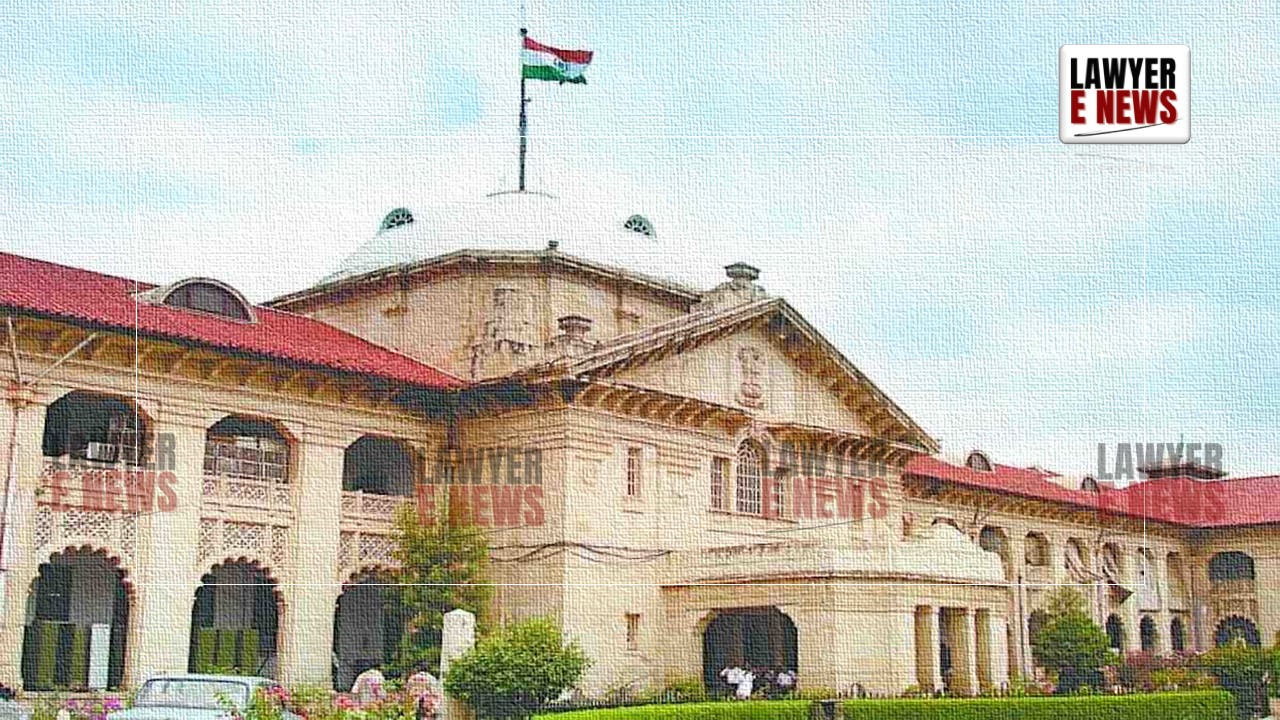
“Where defendant enters as licensee and stays after termination, suit for mandatory injunction is maintainable — No protection under Section 41(h) of the Specific Relief Act” – Allahabad High Court
In a judgment with significant implications for property disputes arising amidst matrimonial litigation, the High Court of Judicature at Allahabad dismissed two first appeals filed by Smt. Sonu Sirohi, affirming that her occupation of a residential flat owned by her husband was illegal after revocation of license, and that a suit for mandatory injunction was properly decreed in favour of the husband and the subsequent purchaser.
Justice Prakash Padia upheld the judgment and decree dated 11.12.2018 passed by the Civil Judge (Senior Division), Gautam Budh Nagar, which had directed eviction of the appellant and awarded mesne profits of ₹60,000 per month from May 2011 till the date of possession. The trial court had also declared Plaintiff No. 2, Poonam Agarwal, as the lawful owner by virtue of a valid sale deed dated 25.03.2011.
“Defendant Was Only a Licensee — Mandatory Injunction Maintainable Even Without Possession Suit”
One of the primary contentions raised by the appellant was that the suit for mandatory injunction was barred under Section 41(h) of the Specific Relief Act, which bars injunctive relief when equally efficacious remedies are available, such as a possession suit. However, the High Court rejected this argument, holding that the suit was perfectly maintainable, stating:
“Where a defendant enters possession as a licensee and stays after the license is terminated, a suit for mandatory injunction is legally maintainable — this is settled law since Sant Lal Jain v. Avtar Singh, AIR 1985 SC 857.”
Citing the Supreme Court’s recent reaffirmation in Bharat Bhushan Gupta v. Pratap Narain Verma, (2022) 8 SCC 333, the Court emphasized that the form of relief (mandatory injunction) does not invalidate a licensor’s suit where possession was permissive and later revoked.
“The object of the suit is possession, and the relief sought is possession which the plaintiff may be found to be entitled,” the Court reaffirmed.
“No Proof of Stridhan Contribution — Mere Allegations Not Enough to Claim Co-Ownership”
Smt. Sonu Sirohi had argued that the disputed flat, originally allotted to her husband Pushpendra Singh Sirohi, was partly purchased using her stridhan and personal jewellery, and thus she was a co-owner. However, the Court found no merit in this contention.
The Court noted: “There is no documentary proof whatsoever of contribution by the appellant — and her affidavit, filed in evidence, was never tested in cross-examination despite repeated opportunities.”
Justice Padia observed that under well-settled law, an affidavit not tested by cross-examination loses evidentiary value. The Court emphasized that the burden to prove joint ownership lay squarely on the appellant, which she failed to discharge.
“The lease deed and title documents stand solely in the name of the husband — no inference of joint ownership can be drawn in absence of material evidence,” the Court concluded.
Citing Nedunuri Kameswaramma v. Sampati Subba Rao, AIR 1963 SC 884, the Court also dismissed the argument that lack of a separate issue on stridhan had prejudiced the appellant, holding that where both sides led evidence on ownership, the absence of a framed issue does not vitiate findings.
“Lis Pendens Does Not Bar Valid Transfer Where Sale Is Bona Fide and with Due Permissions”
The appellant had challenged the sale deed executed on 25.03.2011 by her husband in favour of Poonam Agarwal, on the ground that it was executed during pendency of matrimonial and domestic violence proceedings, and hence hit by Section 52 of the Transfer of Property Act (lis pendens).
This contention too was firmly rejected.
The Court held: “Mere pendency of domestic litigation does not render the sale void — the transferee acted in good faith, after securing No Objection Certificates from NOIDA and the builder, and executed indemnity bonds in full awareness of pending disputes.”
The Court clarified that the provisions of Section 52 TPA do not bar transfers per se during pendency of litigation, but merely subordinate the transferee’s rights to the outcome of the suit — and in this case, the title of the husband was upheld, and no right in the appellant had ever been judicially declared.
Further, the Court accepted that the transferee had conducted due diligence, had acted in good faith, and that the transfer was lawful and complete in terms of the applicable procedures under NOIDA rules and builder policies.
“Domestic Violence Act Does Not Create Ownership or Bar Sale — Only Protects Right in Shared Household”
Relying on proceedings under the Protection of Women from Domestic Violence Act, 2005, the appellant had also claimed that the disputed flat was a shared household, and therefore she could not be evicted without violating her right to residence.
The Court rejected this claim on facts and law.
Justice Padia observed: “Evidence shows that another flat was also available to the appellant and her children — thus, the disputed flat cannot be deemed to be the exclusive shared household.”
The Court reiterated that right of residence under Sections 17 and 19 of the Domestic Violence Act is restricted to one shared household, and where alternate accommodation exists, an order under the Act cannot bar lawful ownership rights or prevent alienation by the true owner.
“Rental Income Is Not Charity — Damages of ₹60,000/Month Justified Based on Prior Rent and Use”
The Court also upheld the trial court’s award of mesne profits at ₹60,000 per month, noting that the flat had previously been let out at the same rate and that the appellant’s claim of financial hardship did not affect the owner’s legal entitlement to damages.
Quoting from the trial court’s findings, the High Court noted: “The flat had been let to a tenant (Rohit Sharma) for ₹60,000 per month in 2009 — in absence of any contrary evidence from the appellant, this was the appropriate benchmark.”
Justice Padia added: “The rightful owner cannot be denied reasonable compensation merely because the occupant has a maintenance order — mesne profits flow from illegal occupation, not from personal capacity to pay.”
*“No Perverse Finding — No Interference Needed”: High Court Refuses to Reopen Trial Court’s Factual Findings
In conclusion, the High Court found no perversity or legal error in the trial court’s decision, affirming the principle laid down in Nirmala Devi v. Gurgaon SC & VT Agriculture Thrift & Credit Society Ltd., (2021) 8 SCC 785:
“Findings of fact recorded by trial court, especially regarding ownership and possession, should not be disturbed in appeal unless perverse or illegal — none shown here.”
Both First Appeals were accordingly dismissed, and the judgment and decree dated 11.12.2018 was upheld in full.
Date of Decision: February 4, 2026