-
by sayum
04 August 2026 1:39 PM







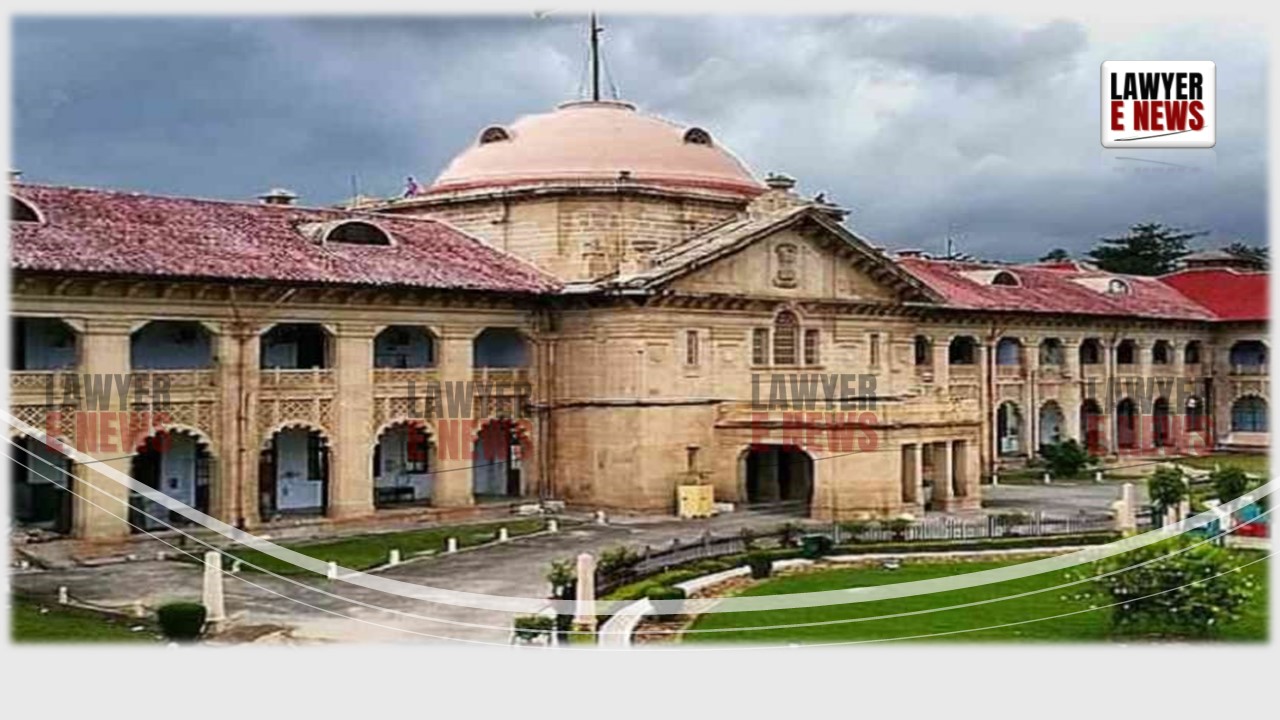
“A mere denial of title, raised belatedly, cannot become a tool to derail an eviction suit pending for decades”— In a significant judgment Allahabad High Court (Lucknow Bench) upheld the jurisdiction of the Small Causes Court in an eviction suit despite objections regarding disputed ownership title.
Rejecting the revision petition against an order dated 26.07.2011 passed in an eviction suit pending since 2001, the High Court observed that mere assertion of title by a tenant does not oust the jurisdiction of a Small Causes Court under Section 23 of the Provincial Small Cause Courts Act, 1887. The Court firmly held that jurisdiction cannot be defeated by conveniently raising title disputes late in proceedings.
“The application under Section 23 PSCC was apparently malafide, inasmuch as more than ten years had lapsed when it was moved… The defendant never disputed the title of Smt. Sampata, even in prior proceedings.” — Justice Saurabh Lavania
The matter arose out of a long-standing eviction and arrears of rent suit originally filed in 1995 as SCC Suit No. 3 of 2001/1995 by Smt. Sampata Devi, the landlady of a residential premises in Balrampur, against her tenant Jugeshwar Prasad, seeking eviction and arrears of rent. The property was let out at a monthly rent of ₹750. After default from June 1995, a notice under Section 106 of the Transfer of Property Act was served but ignored, leading to the suit.
Over time, Smt. Sampata Devi passed away. Her brother-in-law Hanuman Prasad was substituted as plaintiff based on a registered Will dated 30.11.1979, while the tenant’s son, Santosh Chandra Gupta, claimed another unregistered Will dated 03.11.1996, asserting the property belonged to their ancestral estate.
Subsequently, in 2011—after over a decade of litigation—the tenant moved an application under Section 23 of the PSCC Act, arguing that complicated questions of title warranted transfer of the suit to a regular civil court. The application was rejected by the trial court and became the subject of the present revision.
Title Denial Does Not Confer Jurisdiction
Justice Saurabh Lavania, dismissing the revision, cited a settled principle that “jurisdiction of Small Causes Court is not lost merely because a defendant raises an issue of title.”
“Even assuming a plea of title, it is not obligatory on the part of the Small Causes Court to return the plaint. A mere denial or assertion of title does not suffice.” — Allahabad High Court
The Court noted that the tenant, in earlier litigation—Regular Suit No. 106 of 1979—had admitted the landlord’s title, and had himself witnessed the very Will now relied upon by Hanuman Prasad. Moreover, the tenant’s own son relied upon Sampata Devi’s Will to claim succession. These facts, the Court observed, destroyed any semblance of bona fides in the title challenge: “The conduct of defendant-revisionist clearly shows that the issue regarding title has been raised at a belated stage only to stall the proceedings of eviction.”
The Court emphasized that Section 23 is discretionary, and can be invoked only if the court finds that a genuine, complex question of title needs adjudication for granting relief. In the instant case, no such circumstance existed. As the Court put it: “This Court does not find that the decision rendered by the SCC Court suffers from any patent error of jurisdiction or perversity.”
Refusing to interfere under its revisional jurisdiction under Section 25 of the PSCC Act, the Court dismissed the civil revision with clarity: “The revision lacks merit and is accordingly dismissed. The SCC Court is directed to proceed and decide the suit expeditiously, preferably within six months.”
The High Court’s ruling is a stern reminder that procedural devices like Section 23 cannot be misused to indefinitely delay eviction suits, particularly when a tenant has previously acknowledged the landlord’s title. The ruling reiterates the special jurisdiction and autonomy of Small Causes Courts, protecting them from being obstructed by tactical and belated title disputes.
“If there was any misgiving in the mind of the defendant, he could have instituted a suit of title or declaration or partition. However, the same was never done.”
Date of Decision: 14 May 2025