
-
by sayum
26 August 2026 4:44 AM







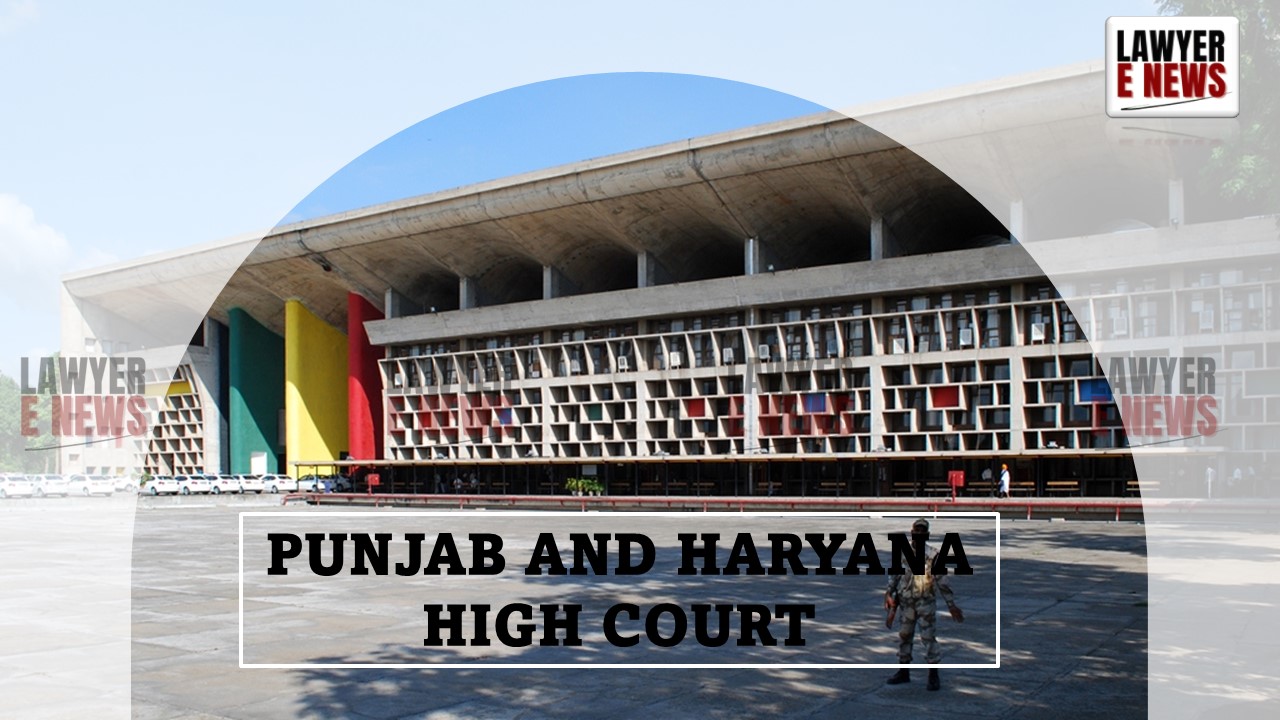
“Accused Identified for First Time in Court After Claim of Darkness and Unconsciousness—Evidence of Identification Found Wholly Unreliable”, In a significant reaffirmation of principles governing identification evidence and the presumption of innocence, the Punjab and Haryana High Court on 2nd December 2025 dismissed a criminal appeal filed by the State of Punjab, challenging the acquittal of two accused under Section 307 IPC.
A Division Bench comprising Justice N.S. Shekhawat and Justice Sukhvinder Kaur upheld the trial court's judgment dated 27.11.2003, acquitting the accused of attempt to murder on the ground that identity of the assailants was not proved beyond reasonable doubt, and that the prosecution failed to meet the legal standard required for conviction.
Rejecting the prosecution's theory of identification, the Court observed, “The identification for the first time in the Court is a very weak kind of evidence and especially in the present case it is of no consequence when during his police statement the injured had stated that those four persons were standing in the dark.”
“Test Identification Parade Was Not Conducted — First-Time Dock Identification Found Untrustworthy”
The case pertained to an alleged incident on 06.10.2000, in which the complainant Sukhwinder Singh, after dinner at a roadside eatery, was allegedly stabbed in the back by unknown assailants in a dark street near Jain School, Faridkot. While the prosecution named Harjit Singh and Paramjit Singh as the accused, the Court found the evidence linking them to the crime highly questionable.
The prosecution’s case rested heavily on the testimony of the injured, PW4 Sukhwinder Singh, and an alleged eye-witness PW5 Kartar Singh. However, the Court found serious contradictions and inconsistencies in their depositions.
Justice Sukhvinder Kaur, delivering the judgment, noted: “From his statement it is quite obvious that the accused persons were not earlier known to him. Admittedly, their test identification parade had not been done. Thus he identified the accused persons for the first time in the Court.”
Citing the Supreme Court’s decision in Kanan and others vs. State of Kerala, AIR 1979 SC 1127, the Court held: “When a witness identifies the accused, who is not known to him in the Court for the first time, his evidence is absolutely useless unless there has been a previous test identification parade.”
“Injury Caused from Behind—Victim Claimed to Have Become Unconscious—Identification of Accused Deemed Impossible”
The Court further highlighted that the assault allegedly occurred in darkness, the injury was inflicted from behind, and the injured became unconscious immediately after the stabbing, making his claim of recognition highly improbable.
“It was dark at the time and the injury was given by the assailants from his backside. It is also pertinent to note that as per PW4 he became unconscious after receiving the injury, so there was hardly any occasion for PW4 to identify the assailants,” the Court observed.
As for PW5 Kartar Singh, the Court found his presence at the spot highly doubtful. Not only did PW4 not name or refer to him during the investigation or trial, but PW5 was also a close relative of the injured, described as his co-brother, and his name surfaced only later, raising the possibility of an introduced witness.
The Court remarked: “PW5 admitted in his statement that PW4 Sukhwinder Singh is his wife's sister's husband. So the possibility of PW5 being an introduced witness cannot be ruled out.”
“Recovery of Shoe from Public Thoroughfare on Third Day Found Implausible”
Turning to the recovery evidence, the prosecution had claimed that one shoe of an accused was recovered from the scene on the third day, and the other from the accused’s house. The Court questioned the reliability of such evidence, observing:
“Admittedly, place of occurrence was a busy place and it was a thoroughfare. So, it is highly improbable that one shoe was recovered from the alleged place of the occurrence on the third day.”
“Motive Absent — Though Not Essential, It Would Have Strengthened the Case”
Though the State argued that motive was not necessary in a case of direct evidence, the High Court found that in the absence of reliable eyewitnesses or identification, absence of motive further weakened the prosecution case.
The Bench observed: “Though, it is not essential to prove motive in each and every case, yet keeping in view the facts and circumstances of the present case, proving of the motive… certainly would have strengthened the case of the prosecution.”
“Appeal Against Acquittal Lies on a Different Pedestal—No Perversity in Trial Court Judgment”
Reiterating the settled principle that an appeal against acquittal is not to be treated at par with an appeal against conviction, the Court quoted the Supreme Court’s ruling in Sadhu Saran Singh vs. State of U.P., 2016 (2) RCR (Criminal) 319, stating: “In an appeal against acquittal, where the presumption of innocence in favour of the accused is reinforced, the Appellate Court would interfere only when there was perversity of fact and law.”
Finding no such perversity or illegality in the trial court’s reasoning, the High Court declined to interfere.
The judgment is a compelling reiteration of fundamental principles of criminal jurisprudence — the prosecution must prove its case beyond reasonable doubt, dock identification without a prior TIP is inherently weak, and conviction cannot rest on speculative or inconsistent testimony.
The High Court ultimately held: “In light of the above… evidence on record is indeed insufficient to convict the accused of the offences as charged with and they have been rightly acquitted by learned trial Court.”
Accordingly, the State’s appeal was dismissed, and the acquittal of Harjit Singh and Paramjit Singh was upheld.
Date of Decision: 2 December 2025