-
by sayum
25 August 2026 11:12 PM







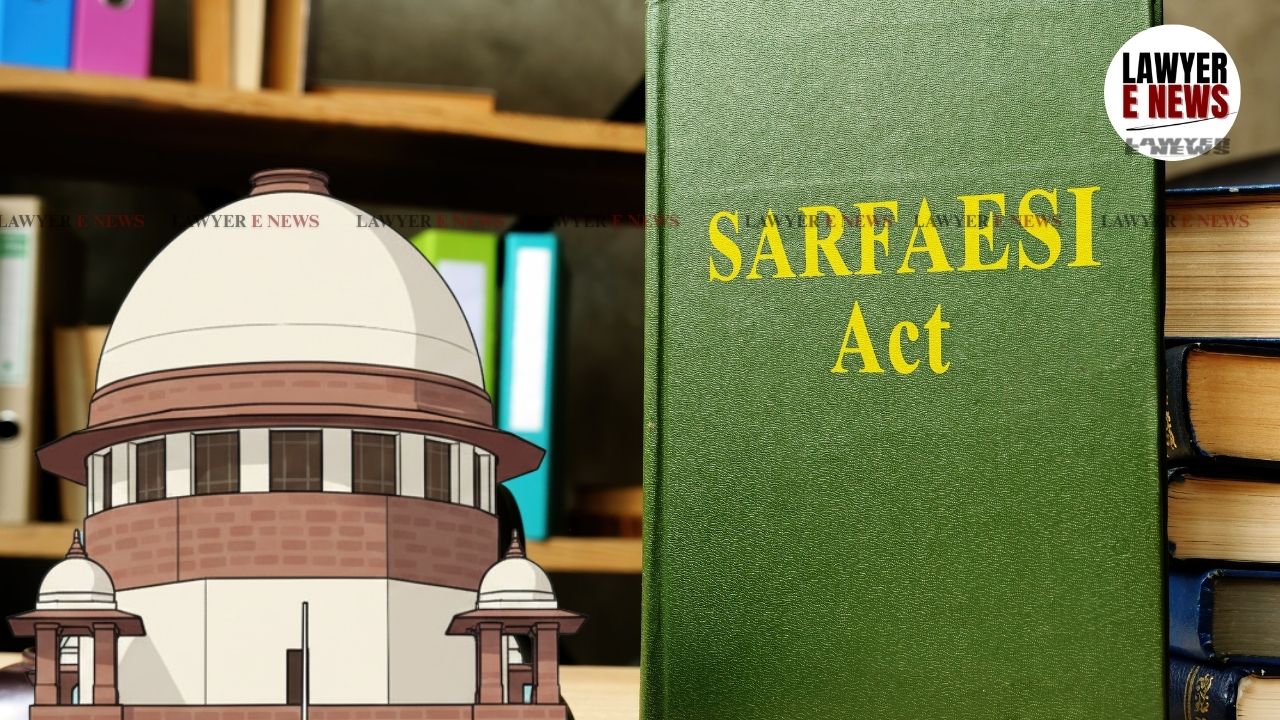
“SARFAESI Act Cannot Override Article 371A”: Supreme Court Upholds High Court Order, Declares NEDFi's Recovery Action Without Mortgage in Nagaland as Without Jurisdiction. On 16 December 2025, the Supreme Court of India in North Eastern Development Finance Corporation Ltd. (NEDFi) v. M/s L. Doulo Builders and Suppliers Co. Pvt. Ltd. (Civil Appeal No. 6492 of 2024) delivered a landmark ruling, holding that NEDFi's invocation of the SARFAESI Act to seize assets in Nagaland was without jurisdiction, as there was no valid security interest created in its favour.
Justice Dipankar Datta, writing for the Bench, categorically stated:
“We reiterate, no security interest in respect of any property (secured asset) was created in favour of the Corporation within the meaning of the SARFAESI Act and, therefore, the Corporation is not a secured creditor”.
“Provisions of SARFAESI Cannot Apply in Nagaland Without State Assembly’s Approval”: Court Emphasizes Primacy of Article 371A
At the heart of the case was Article 371A of the Constitution, which provides that no Act of Parliament in respect of ownership and transfer of land shall apply to Nagaland unless the State Assembly so resolves.
The Court ruled that:
“The SARFAESI Act, though it gives overriding effect under Section 35, cannot and does not override any provision of the Constitution, to wit, Article 371A thereof”.
Referring to a government notification, the Bench noted that the SARFAESI Act was formally extended to Nagaland only on 10 December 2021, well after the impugned recovery actions were undertaken in 2011 and 2019.
“Loan Without Mortgage Is Not Enforceable Under SARFAESI”: Court Rejects Recovery via Village Council's Guarantee
The Court found that the loan extended to the borrower company in 2001 lacked any mortgage or legally valid security agreement under the SARFAESI framework. Instead, the Model Village Council had entered into a guarantee agreement under the Nagaland Village and Area Councils Act, 1978, which merely enabled the Council to act as surety and recover the loan amount by seizing the borrower’s assets through auction.
“It is abundantly clear that the Division Bench of the High Court was clearly right in interdicting the actions of the Corporation… The action of the Corporation was without jurisdiction”.
The Court held that mere guarantee or transfer of property to the Village Council did not create any "security interest" enforceable under the SARFAESI Act.
“Security Interest Must Be Expressly Created, Not Implied”: No Right Accrued to NEDFi Over Borrower’s Assets
In rejecting NEDFi’s argument, the Court emphasized:
“Security interest means right, title or interest of any kind… upon property created in favour of any secured creditor” – and no such interest was created in this case.
Justice Datta explained that under normal banking practices, mortgage or hypothecation must be expressly documented. Here, the borrower’s property was mortgaged to the Village Council, not to NEDFi.
Thus, NEDFi could not invoke SARFAESI to seize assets, as it was not a "secured creditor" under the Act.
“High Court Was Right to Entertain Writ Despite Alternative Remedy” – When Jurisdiction is Lacking, Writ is Maintainable
NEDFi argued that the borrower should have challenged the recovery actions before the Debts Recovery Tribunal under Section 17 of the SARFAESI Act. The Supreme Court disagreed, upholding the Gauhati High Court’s view that:
“Where there is no security agreement, and the creditor is not a ‘secured creditor’, the SARFAESI Act cannot be invoked and hence, there is no question of remedy under Section 17”.
The High Court had rightly quashed the SARFAESI notices and ordered restoration of possession.
“Retrospective Use of SARFAESI Not Permitted Without Security Agreement”: Earlier Judgments Cited But Distinguished
NEDFi relied on M.D. Frozen Foods v. Hero Fincorp and UCO Bank v. Deepak Debbarma to argue that SARFAESI can be used for past debts. However, the Court clarified:
“What follows is that there has to be creation of a security interest… No such interest was created in this case”.
The judgment reinforces that retrospective application of SARFAESI is only valid if a security agreement existed.
Appeal Dismissed, NEDFi May Recover Debt by Lawful Means, Not via SARFAESI
The Supreme Court concluded that NEDFi’s actions in seizing the borrower’s cold storage unit and related assets were wholly illegal, as the SARFAESI Act did not apply in Nagaland at the time, and no valid mortgage existed.
“The appeal stands dismissed, leaving it open to the Corporation to pursue/seek remedies against the Company or the Council in accordance with law”.
With this, the Court upheld the Gauhati High Court’s 2020 order, reinforcing constitutional protections under Article 371A and ensuring that financial institutions cannot bypass local land laws by indirect means.
Date of Decision: 16 December 2025