-
by sayum
25 August 2026 11:12 PM







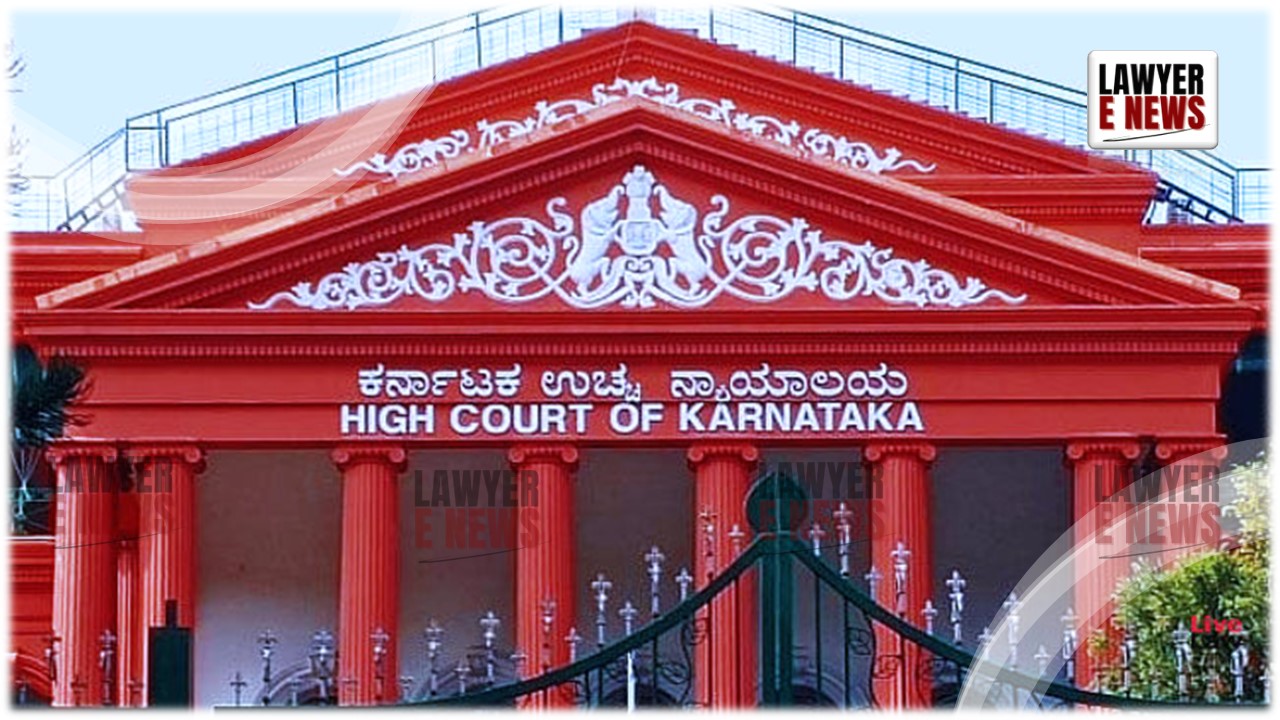
“Even if Agreement is Lawful, Court Not Bound to Enforce It if Discretion Under Section 20 Shows Inequity”, In a latest Judgement Karnataka High firmly rejecting a decree of specific performance granted by a lower court and reiterating that the discretionary powers vested under Sections 16(c) and 20 of the Specific Relief Act, 1963, must be exercised with strict adherence to equitable principles. Justice Hanchate Sanjeevkumar set aside the trial court's decree in O.S. No. 974/2008 and instead allowed only the alternative relief of refund of the advance amount of Rs. 2,50,000 with interest.
The judgment is significant for reinforcing the fundamental principle that in suits for specific performance, mere proof of an agreement is not sufficient — the plaintiff must prove genuine readiness and willingness throughout, and courts must evaluate whether granting such equitable relief would result in unfair advantage or hardship.
A Sale Agreement or A Secured Loan? A Transaction Veiled in Doubt
The origin of the dispute lay in an alleged agreement of sale dated 26.09.2006, under which the plaintiff claimed that late Sanjeevappa (husband of defendant No.1) agreed to sell a property within Bengaluru city for Rs.6,00,000 and received Rs.2,50,000 as advance. After Sanjeevappa’s death, the plaintiff issued a legal notice to his legal heirs seeking execution of the sale deed. The trial court, on the strength of the written agreement and a reply notice (Ex.P-3) allegedly signed by Sanjeevappa, decreed specific performance.
However, the defendants consistently maintained that no such sale was intended. They claimed that the document was concocted to secure a hand loan and not meant to be a genuine sale agreement.
Execution of Sale Agreement Highly Doubtful Given “Gross Under-Valuation”
Justice Sanjeevkumar critically examined the nature of the agreement and expressed grave doubts about the transaction's authenticity. The suit property — a 1,050 sq. ft site with an 1,800 sq. ft building — was located within Bengaluru city limits. Notably, the certified Sub-Registrar guideline value for the year 2005 was Rs.23,92,518.75.
In light of this, the Court held: “On all its preponderance of probabilities, there could not have been chances of execution of agreement of sale for such lesser amount of Rs.6,00,000/-… Ex.P.1-agreement of sale might have been for the purpose of security towards the loan of Rs.2,50,000/-.”
Allowing additional evidence under Order XLI Rule 27 CPC, the Court admitted the certified copy of the guideline value, emphasizing that:
“This is the Gazette Notification and certified public document relevant for just decision of the case.”
Thus, the trial court’s finding on execution was found unsustainable.
Section 16(c): Readiness and Willingness Is Not a Mere Legal Incantation
The High Court gave substantial weight to the plaintiff’s failure to establish continuous readiness and willingness, as required under Section 16(c) of the Specific Relief Act. Justice Sanjeevkumar remarked:
“It is not mere by proving agreement of sale that the plaintiff is entitled for decree, but the intention on the part of executing agreement of sale is also to be considered.”
Despite the legal notice asserting willingness, the plaintiff provided no proof of actual financial capacity to pay the balance sale amount of Rs.3.5 lakhs. The Court relied heavily on the authoritative Supreme Court decisions in U.N. Krishnamurthy v. A.M. Krishnamurthy, P. Daivasigamani v. S. Sambandan, J.P. Builders v. A. Ramdas Rao, and others.
Reiterating the binding principles, the Court quoted: “The plaintiff must establish his readiness and willingness from the date of the contract till the date of the hearing — not by mere assertion, but by conduct, financial capacity, and actions in furtherance of performance.”
Failure to do so, the Court held, was fatal to the claim for specific performance.
Section 20: Decree for Specific Performance Is Not Automatic — It Is Discretionary and Equitable
The Court further invoked Section 20 of the Specific Relief Act (Pre-amendment) to emphasize that even if a sale agreement is technically proved, the grant of specific performance remains a discretionary relief.
Referring to a line of Supreme Court judgments, including Jayakantham v. Abaykumar, K. Narendra v. Riviera Apartments, and Sardar Singh v. Krishna Devi, the Court observed: “Even if the execution of the agreement of sale is proved, the court has discretion either to grant or to refuse specific performance… The court should meticulously consider all facts and circumstances of the case and not be swayed merely because it is lawful to do so.”
Particularly, the Court found that the low sale consideration — against the market reality — indicated that granting specific performance would confer an “unfair advantage” to the plaintiff and result in inequitable hardship to the defendants.
Trial Court Failed to Apply Judicial Discretion; High Court Corrects the Course
Justice Sanjeevkumar took strong exception to the trial court’s mechanical approach, stating:
“The trial Court is not correct in swaying away upon the proof of execution of sale deed. The intention behind execution and surrounding circumstances are crucial.”
The trial court’s failure to scrutinize the hardship caused by the undervalued contract, and the absence of adequate readiness and willingness on the plaintiff’s part, warranted appellate interference.
Alternative Relief of Refund of Advance Money with Interest Decreed
While dismissing the specific performance claim, the High Court granted the alternative relief sought by the plaintiff — refund of the Rs.2,50,000 advance, along with 6% per annum interest from the date of the agreement.
Justice Sanjeevkumar directed: “The defendants are directed to refund an amount of Rs.2,50,000/- with interest at the rate of 6% per annum from the date of execution of agreement of sale dated 26.09.2006 within a period of five months.”
A Landmark in Reinforcing Judicial Discretion and Equitable Principles
This judgment reinforces the principle that equitable relief such as specific performance demands high standards of conduct and proof. Courts are not compelled to enforce a contract merely because it exists on paper. The intention behind the transaction, the fairness of its terms, and the plaintiff's conduct remain paramount.
The Karnataka High Court’s judgment is a strong affirmation of the idea that civil courts must not become forums for enforcement of unjust enrichment or speculative gains under the guise of technical legality.
Date of Decision: 14 November 2025