-
by sayum
11 August 2026 2:00 PM







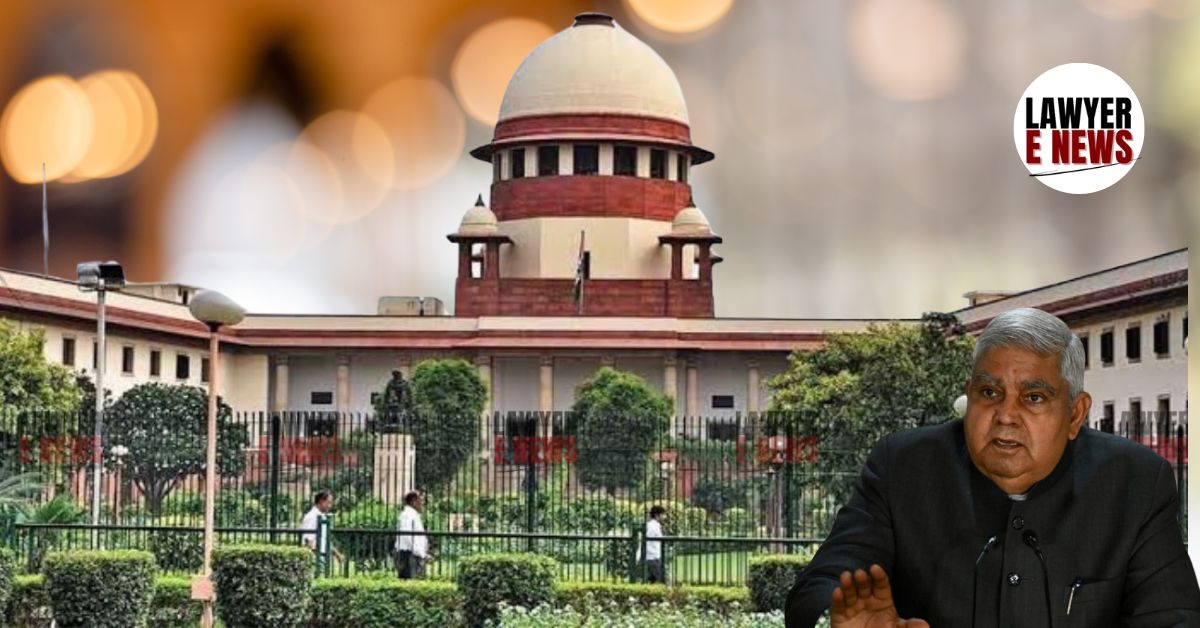
In a sharp and high-profile critique of the Indian judiciary, Vice President Jagdeep Dhankhar has raised strong objections to the Supreme Court's expansive use of Article 142 of the Constitution, describing it as a "nuclear missile against democratic forces, available to the judiciary 24x7."
The remarks were made in the wake of a recent Supreme Court judgment that directed the President of India to act within three months on state bills reserved by Governors for consideration, a decision that has sparked debate across legal and political spheres.
The Supreme Court had earlier ruled that the prolonged inaction of Tamil Nadu Governor RN Ravi in withholding assent to 10 state legislative bills was "illegal" and "arbitrary." The bench, while invoking its powers under Article 142, imposed a three-month deadline for the President to decide on the pending bills.
This unprecedented direction from the judiciary prompted the Vice President to question the constitutional basis of such judicial intervention into executive functions.
While addressing an event, Dhankhar said: “We have judges who will legislate, who will perform executive functions, who will act as a super Parliament, and absolutely have no accountability because the law of the land does not apply to them.”
He underscored the importance of maintaining institutional boundaries and expressed concern that the judiciary was encroaching into legislative and executive territories, thereby blurring the doctrine of separation of powers enshrined in the Constitution.
Article 142 of the Constitution empowers the Supreme Court to pass any order necessary for doing “complete justice” in any matter. The Vice President, however, likened its use to an unchecked weapon, stating:
“Article 142 is a nuclear missile against democratic forces, available to the judiciary 24x7.”
His analogy sought to highlight the immense power and lack of accountability that, in his view, accompanies judicial interventions of this nature.
Dhankhar also touched upon a related issue—judicial accountability. He pointed out that while the President and Governors enjoy constitutional immunity, no such formal immunity is granted to judges. Yet, he argued, the judiciary wields authority without proportional checks:
“There is no constitutional provision that immunizes judges from investigation, unlike the President and Governors.”
The Vice President’s statements have revived a long-standing debate on the limits of judicial activism. While many legal experts support the judiciary’s role in safeguarding democracy when other arms of the government falter, others argue that such proactivity risks undermining the balance of power.The Supreme Court’s recent use of Article 142, especially in matters involving the functioning of state legislatures and the role of the President, has intensified scrutiny of the judiciary’s discretionary powers.
The remarks by Vice President Dhankhar reflect growing tensions between the organs of the State and raise fundamental constitutional questions about judicial boundaries, democratic accountability, and the scope of Article 142. As the debate continues, legal scholars and policymakers alike are watching closely how these tensions evolve and how institutional roles are reaffirmed or redefined in the years to come.