-
by sayum
19 August 2026 1:58 PM








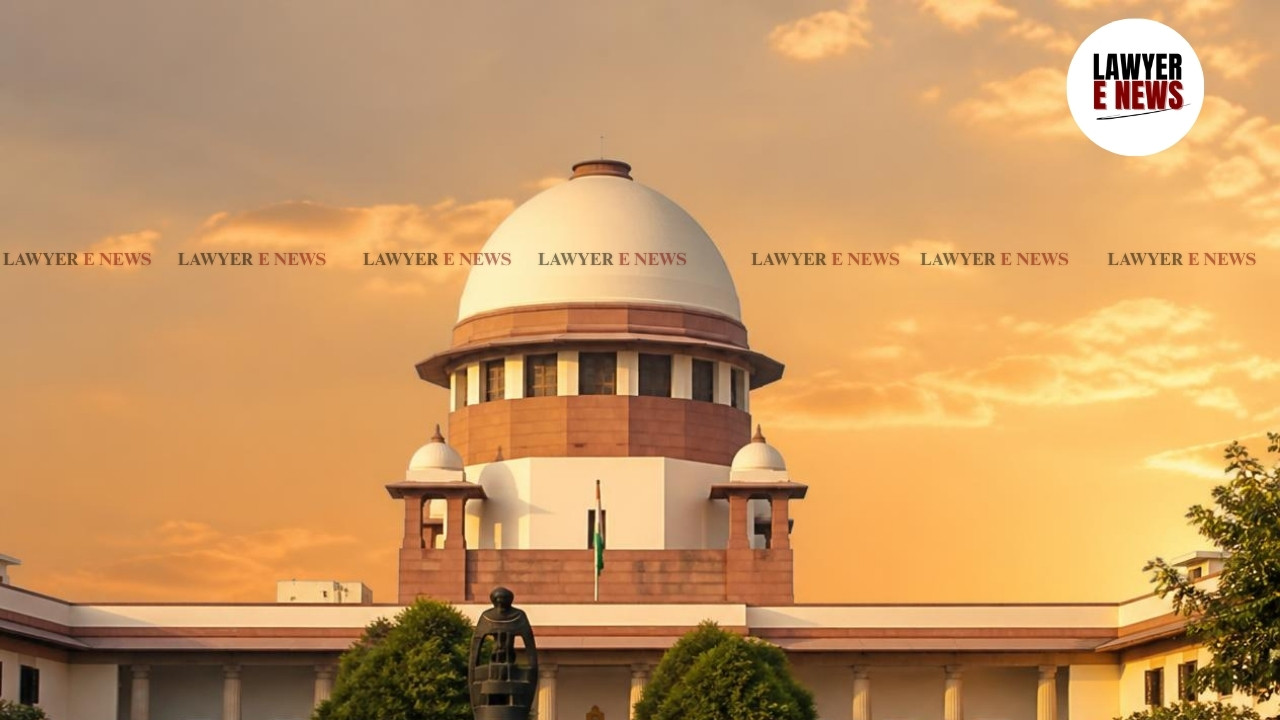
"Article 311 applies only to civil servants or those who otherwise hold a ‘civil post’ under the Union or the State. ICAR functions as an autonomous Society... its recruitment and conditions of service are governed by its own rules and bye-laws. Thus, Article 311 is not attracted at all," Supreme Court, in a significant judgment dated April 28, 2026, has clarified that employees of the Indian Council of Agricultural Research (ICAR) do not hold "civil posts" and therefore cannot claim the constitutional protections afforded under Article 311.
A bench of Justice Prashant Kumar Mishra and Justice Vipul M. Pancholi observed that where an appointment order expressly reserves the power to curtail a tenure "until further orders," the employee has no enforceable right to complete the full term.
The Court further emphasized that the scope of judicial review in administrative matters is strictly confined to the legality of the decision-making process rather than the merits of the decision itself. The bench noted that an administrative order reverting an official to their original post due to "unsatisfactory" performance does not, by itself, constitute a stigmatic or punitive action requiring a full-scale disciplinary enquiry.
The appellant, Sadachari Singh Tomar, was a Senior Scientist at the Central Institute of Agricultural Engineering (CIAE) before being appointed as Assistant Director General (ADG-ARIS) at ICAR in 1998. His appointment was for a period of five years or "until further orders, whichever is earlier." However, in 2001, ICAR curtailed his tenure and reverted him to his previous post of Senior Scientist following Annual Assessment Reports (AARs) that characterized his performance as "unsatisfactory" and "below average."
The appellant alleged that this action was retaliatory, claiming he had acted as a whistleblower regarding financial irregularities worth hundreds of crores within ICAR. He challenged the curtailment before the Central Administrative Tribunal (CAT) and subsequently the Delhi High Court, both of which dismissed his pleas. He then approached the Supreme Court, contending that his reversion was punitive and violated Article 311(2) of the Constitution of India.
The primary question before the court was whether ICAR employees are entitled to the protection of Article 311 of the Constitution regarding dismissal or reduction in rank. The court was also called upon to determine whether the curtailment of a fixed-tenure appointment on the grounds of "unsatisfactory performance" constitutes a stigmatic order. Additionally, the bench examined whether allegations of mala fides can be inferred solely from the sequence of administrative events.
ICAR Employees Not Covered By Article 311 Protections
The Supreme Court began by rejecting the appellant's claim for protection under Article 311 of the Constitution. The bench noted that Article 311 applies exclusively to civil servants or those holding a "civil post" under the Union or a State. Since ICAR functions as an autonomous society reporting to the Department of Agricultural Research and Education, its service conditions are governed by its own internal rules and bye-laws.
The bench held that the submission regarding Article 311 was "totally unsustainable" because the appellant was an employee of an autonomous society and not a member of a civil service of the Union. Consequently, the procedural requirements of Article 311(2) regarding enquiries before reduction in rank were not applicable to the dispute at hand.
No Enforceable Right To Tenure Where Power To Curtail Is Reserved
Addressing the merits of the tenure curtailment, the Court affirmed the CAT’s finding that the appellant had no "enforceable right" to complete the full five-year term. The bench pointed out that at the time of appointment, the authority had expressly reserved the power to curtail the tenure at any point by issuing "further orders."
The Court observed that this was not a case of an authority cutting short a minimum tenure prescribed by statute or a binding judicial direction. Instead, the appointment was conditional from the outset. The judges noted that while this administrative power is not absolute, it is subject only to narrow judicial review to ensure the action was not arbitrary, irrational, or tainted by mala fides.
Scope Of Judicial Review Is Limited To Process, Not Merits
The Court relied on the precedent set in Deputy General Manager (Appellate Authority) and Ors. vs. Ajai Kumar Srivastava, reiterating that constitutional courts evaluate the decision-making process rather than the fairness of the conclusion itself. The bench stated that the court cannot substitute its own decision for that of the competent authorities or examine the correctness of a decision as a matter of fact.
"The power of judicial review is an evaluation of the decision-making process and not the merits of the decision itself. It is to ensure fairness in treatment and not to ensure fairness of conclusion."
Reversion Based On Performance Is Not Stigmatic Or Punitive
The appellant argued that being reverted to a post "two ranks below" ADG-ARIS was punitive in effect and that describing his performance as "unsatisfactory" was stigmatic. The Court disagreed, noting that reversion or repatriation is ordinarily an incidence of service and does not amount to punishment per se.
Referring to the standard described in Pavanendra Narayan Verma vs. Sanjay Gandhi P.G.I. of Medical Sciences, the Court held that for an order to be "stigmatic," the language used must impute something over and above mere unsuitability for the job. The bench found that terms like "unsatisfactory work and conduct" fall within the class of non-stigmatic assessments of unsuitability.
"The language used in the order... is almost exactly those which have been quoted in Dipti Prakash Banerjee’s case as clearly falling within the class of non-stigmatic orders... the impugned Order is not ex facie stigmatic."
Allegations Of Mala Fides Must Be Supported By Clear Material
Regarding the appellant's claim that the ICAR’s actions were retaliatory due to his whistleblower activities, the Court held that allegations of colourability or mala fides cannot be inferred merely from the sequence of events. Citing State of U.P. and Ors. vs. Gobardhan Lal, the bench emphasized that a challenge to a transfer or reversion should normally be eschewed unless there are strong and convincing reasons.
The Court observed that the appellant was afforded a reasonable opportunity to represent against his adverse AARs, and those representations were considered and rejected by the competent authority. The bench concluded that it could not sit in appeal over the administrative assessment of the appellant's performance, which was not found to be totally without basis or perverse.
The Supreme Court concluded that there was no merit in the appeals as the curtailment was a routine exercise of administrative assessment. The bench also noted that the appellant had eventually been promoted to Principal Scientist with retrospective effect during the pendency of the litigation and had since superannuated with his retiral benefits released. Finding no illegality in the impugned orders of the High Court and CAT, the Supreme Court dismissed the appeals.
Date of Decision: April 28, 2026