Mere Allegations of Harassment Do Not Constitute Abetment of Suicide: Punjab & Haryana High Court Grants Bail to Wife in Matrimonial Suicide Case 'Convenience Of Wife Not A Thumb Rule, But Custody Of Minor Child Is A Weighing Aspect': Punjab & Haryana HC Transfers Divorce Case To Rohtak MACT | A Minor Cannot Be Treated as a Non-Earner: Punjab & Haryana High Court Consensual Love Affair Not Cheating Under IPC Section 417: Madras High Court Acquits Man Despite Paternity Confirmation Review Jurisdiction is an Ant-Hole in a Pigeon-Hol: Madras High Court Dismisses Review Plea Against Order Upholding Arbitral Award on Liquidated Damages Bank Can Freeze Guarantor’s Salary Account to Recover Loan Dues: Kerala High Court Clarifies CPC Exemption Does Not Apply to Banker’s Right Revenue Entry Calling Property ‘Ancestral’ Does Not Create Title: Gujarat High Court Upholds Registered Will in Second Appeal Licensee Cannot Resist Resumption Of Railway Land: Gauhati High Court Upholds Eviction For Amrit Bharat Station Scheme Mere Non-Payment of Business Dues Is Not Cheating: Calcutta High Court Protects Traders from Criminal Prosecution in Purely Civil Dispute Prosecution’s Failure to Prove Age of Prosecutrix Beyond Reasonable Doubt Fatal to POCSO Conviction: Rajasthan High Court Judicial Review Is Not A Substitute For Examiner’s Judgment: Delhi High Court Rejects DJSE Candidate’s Plea Over Alteration of Marks Part-Payments Extend Limitation - Each Payment Revives Limitation: Delhi High Court No Title, No Right, No Equity: Bombay High Court Demolishes Claim Over Footpath Stall, Imposes ₹5 Lakh Costs for Abuse of Process Cooperative Society Is A “Veritable Party” To Arbitration Clause In Flat Agreements, Temple Trust Entitled To Arbitrate As Non-Signatory: Bombay High Court State Government Cannot Review Its Own Revisional Orders Under Section 41(3): Allahabad High Court Affirms Legal Bar on Successive Reviews When Several Issues Arise, Courts Must Answer Each With Reasons: Supreme Court Automatic Retention Trumps Lessee Tag: Calcutta High Court Declares Saregama India ‘Raiyat’, Directs Reconsideration of Land Conversion Application Recovery of Valid Ticket Raises Presumption of Bona Fide Travel – Burden Shifts to Railways: Delhi High Court Restores Railway Accident Claim Failure to Frame Issue on Limitation Vitiates Award of Compensation Under Telegraph Act: Gauhati High Court Sets Aside Order, Remands Matter Compassionate Appointment Is Not a Heritable Right: Gujarat High Court Rejects 9-Year Delayed Claim, Orders Re-Issuance of ₹4 Lakh Compensation Court Cannot Rewrite Contracts to Suit Contractor’s Convenience: Kerala High Court Upholds Termination of Road Work Under Risk and Cost Clause Post-Bail Conduct Is Irrelevant in Appeal Against Grant of Bail: Supreme Court Clarifies Crucial Distinction Between Appeal and Cancellation Granting Anticipatory Bail to a Long-Absconding Accused Makes a Mockery of the Judicial Process: Supreme Court Cracks Down on Pre-Arrest Bail in Murder Case Recognition as an Intangible Asset Does Not Confer Ownership: Supreme Court Draws a Sharp Line Between Accounting Entries and Property Rights IBC Cannot Be the Guiding Principle for Restructuring the Ownership and Control of Spectrum: Supreme Court Reasserts Public Trust Over Natural Resources Courts Cannot Convict First and Search for Law Later: Supreme Court Faults Prosecution for Ignoring Statutory Foundation in Cement Case When the Law Itself Stood Withdrawn, How Could Its Violation Survive?: Supreme Court Quashes 1994 Cement Conviction Under E.C. Act Ten Years Means Ten Years – Not a Day Less: Supreme Court Refuses to Dilute Statutory Experience Requirement for SET Exemption SET in Malayalam Cannot Qualify You to Teach Economics: Supreme Court Upholds Subject-Specific Eligibility for HSST Appointments Outsourcing Cannot Become A Tool To Defeat Regularization: Supreme Court On Perennial Nature Of Government Work Once Similarly Placed Workers Were Regularized, Denial to Others Is Discrimination: Supreme Court Directs Regularization of Income Tax Daily-Wage Workers Right To Form Association Is Protected — But Not A Right To Run It Free From Regulation: Supreme Court Recalibrates Article 19 In Sports Governance S. Nithya Cannot Be Transplanted Into Cricket: Supreme Court Shields District Cricket Bodies From Judicially Imposed Structural Overhaul Will | Propounder Must Dispel Every Suspicious Circumstance — Failure Is Fatal: : Punjab & Haryana High Court Electronic Evidence Authenticity Jeopardized by Unexplained Delay and Procedural Omissions: MP High Court Rejects Belated 65B Application Not Answering to the Questions of the IO Would Not Ipso Facto Mean There Is Non-Cooperation: Supreme Court Grants Anticipatory Bail Undertaking to Satisfy Award Is Not Waiver of Appeal: Supreme Court Restores Insurer’s Statutory Right

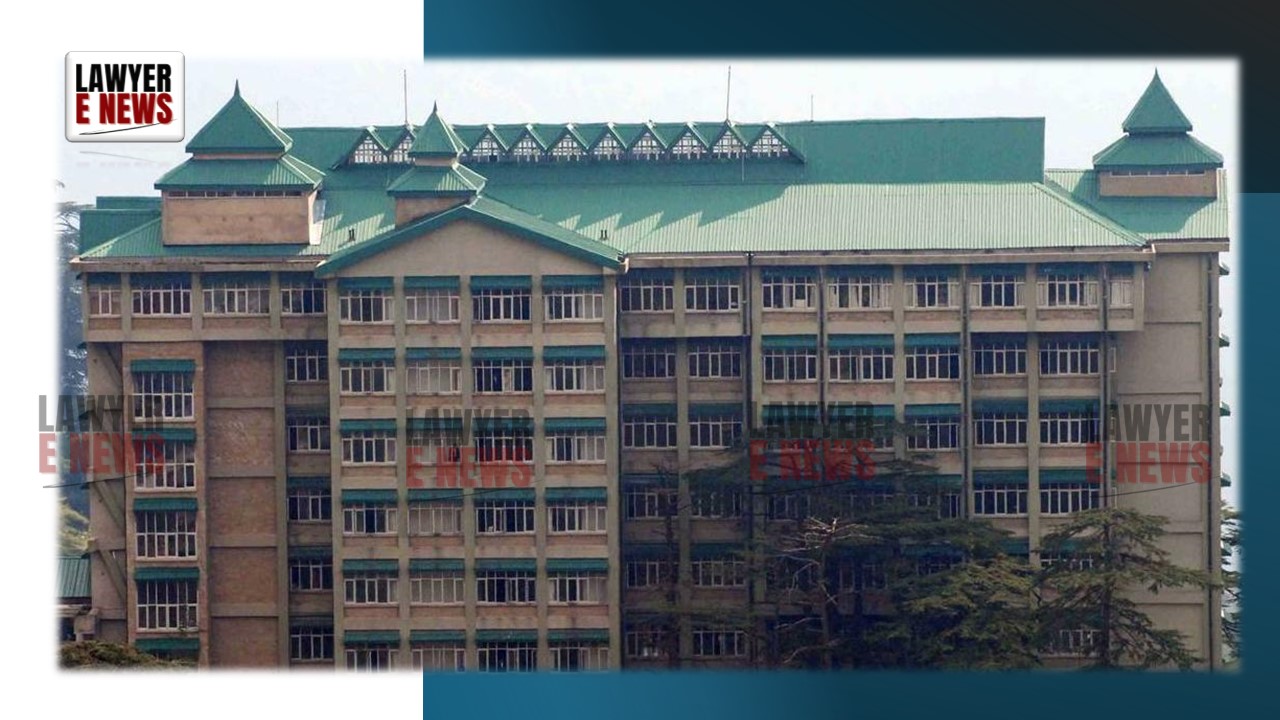
High Court of Himachal Pradesh Dismisses Bail Plea in ₹200 Crore Scholarship Scam: Rajdeep Singh Case

14 November 2024 1:16 PM

By: Deepak Kumar


High Court of Himachal Pradesh, Shimla, rejected the bail application of Rajdeep Singh in CrMP(M) No. 1853 of 2024. Presiding Justice Virender Singh found that Singh did not meet the conditions for bail under Section 45 of the Prevention of Money Laundering Act (PMLA), 2002, due to the severity of the allegations and ongoing investigation complexities. Singh, accused of involvement in a ₹200 crore scholarship scam targeting funds meant for SC, ST, and OBC students, remains in custody.

Rajdeep Singh, along with other co-accused, allegedly participated in a fraudulent scheme misappropriating scholarship funds under the Post Matric Scheme (PMS), intended to support the education of students from disadvantaged backgrounds. The Enforcement Directorate (ED) initiated its investigation based on findings from the Central Bureau of Investigation (CBI), which had uncovered large-scale misappropriations involving individuals from private educational institutions, state educational officials, and banks.

Forged student enrollments in distance education programs.
Bogus scholarship claims submitted to the Directorate of Higher Education, Himachal Pradesh, using fake affiliation letters.
Creation of shell entities and accounts through which funds were misappropriated.
Singh’s defense argued that the ED failed to follow proper arrest procedures under Section 19 of PMLA by not providing a copy of the “reasons to believe” document. However, as Singh had not challenged his arrest, the court declined to address this issue substantively, reiterating that procedural compliance was met in prior proceedings.
The twin conditions for bail under Section 45 of PMLA were central to the court's decision. These conditions require:
Reasonable grounds for believing that the accused is not guilty of the offense.
Assurance that the accused will not commit another offense if released.
Justice Singh concluded that these conditions were not satisfied in Singh’s case, emphasizing the serious nature of the allegations and the potential risk of witness tampering or further obstruction in the ongoing investigation.
The ED presented detailed accusations, supported by CBI charges, illustrating how Singh and his co-accused allegedly orchestrated the scam:
Formation of Shell Entities: Singh and co-accused created entities such as ASAMS Education Group and Skill Development Society, which were used as fronts to claim scholarships for non-existent students.
Forgery and Document Manipulation: False student enrollment records and fabricated fee structures were submitted. Singh allegedly claimed scholarships for students supposedly enrolled in unaccredited courses, including defunct programs from Karnataka State Open University.
Misrepresentation of NIELIT Affiliation: The accused fraudulently associated their entities with NIELIT (National Institute of Electronics and Information Technology), further misleading authorities into approving scholarship claims for unregistered courses.
Justice Singh concluded that granting bail would impede the investigation due to the high-profile nature and extent of the fraud. He emphasized the ongoing nature of the inquiry, the need for additional evidence, and concerns regarding the potential influence on witnesses by Singh.
“In view of the above discussion, in the considered opinion of this Court, the applicant is not able to make out a case for grant of bail, at this stage,” Justice Virender Singh stated, underscoring that the order should not reflect upon the case's merits, as it solely concerns the bail plea.
Rajdeep Singh’s bail plea was dismissed due to the weight of evidence against him, the ongoing investigative requirements, and the court’s obligation to uphold stringent bail standards under the PMLA for cases involving significant economic offenses.

Date of Decision: November 8, 2024

 

Latest Legal News