-
by sayum
27 August 2026 7:40 AM







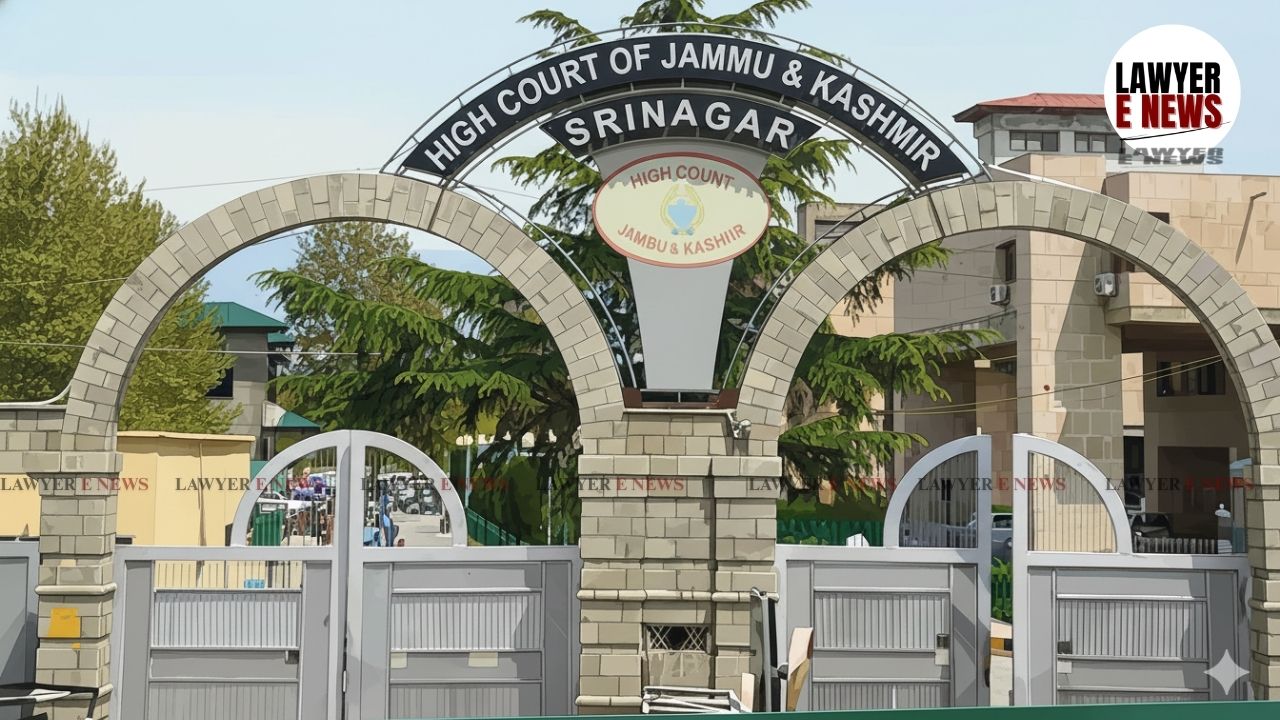
"Test is whether the material placed on record, if taken at its face value, discloses the existence of a prima facie case or at least raises a grave suspicion against the accused." High Court of Jammu & Kashmir and Ladakh, in a significant ruling, held that charges can be framed against an accused based on "grave suspicion" without requiring a meticulous evaluation of evidence at the threshold.
A bench of Justice Sanjay Parihar observed that the judicial threshold at the stage of framing charges is intentionally kept low to prevent the stifling of legitimate prosecutions, while dismissing revision petitions filed by officials of the Consumer Affairs and Public Distribution (CAPD) Department accused in a fake kerosene oil allotment racket.
The petitioners, serving as employees in the CAPD Department, were implicated in a widespread racket involving the fabrication and circulation of fake kerosene oil allotment orders. The Principal Sessions Judge, Jammu, discharged them for certain forgery offences but framed charges for cheating, criminal conspiracy, and violations of the Essential Commodities Act. Aggrieved by the framing of charges, the petitioners moved the High Court, arguing that they were improperly implicated primarily on the basis of statements made by co-accused persons to the police.
The primary question before the court was whether grave suspicion based on circumstantial material is sufficient to frame criminal charges against an accused. The court was also called upon to determine whether a co-accused can be implicated solely based on statements recorded under Section 161 of the CrPC, and whether a second FIR is legally permissible when it unearths a larger conspiracy distinct from a prior, specific FIR.
Low Threshold For Framing Of Charge
The court commenced its analysis by outlining the circumscribed scope of revisional jurisdiction against an order framing a charge. Relying on the Supreme Court's decisions in State of Bihar v. Ramesh Singh and Union of India v. Prafulla Kumar Samal, the bench emphasized that a trial court is not expected to meticulously evaluate evidence as if conducting a full-fledged trial. The court noted that the purpose of this stage is merely to sift the material to determine if the allegations are groundless or if they raise a strong presumption of guilt.
Defence Material Cannot Be Considered Initially
Addressing the petitioners' reliance on a departmental circular to claim innocence, the High Court held that such defences cannot be deeply examined prior to trial. Citing State of Orissa v. Debendra Nath Padhi and Amit Kapoor v. Ramesh Chander, the bench clarified that courts must refrain from examining the sufficiency or reliability of evidence at this juncture. The bench remarked that the threshold is intentionally low, ensuring that legitimate prosecutions are not aborted at their very inception.
Evidentiary Value Of Section 161 Statements
The petitioners heavily contested their implication based on statements of co-accused recorded under Section 161 of the CrPC. The court concurred with the general legal proposition, citing Kashmira Singh v. State of Madhya Pradesh, that a confession of a co-accused is not substantive evidence and a person cannot be implicated solely on such police statements. The bench noted that statements in the nature of confessions to police are rendered inadmissible under Sections 25 and 26 of the Indian Evidence Act.
Prosecution Case Goes Beyond Confessions
Despite acknowledging the limitations of Section 161 statements, the court found that the prosecution's case in this specific matter did not rest exclusively upon them. The bench highlighted that the charge-sheet contained substantial additional material, including the seizure of multiple forged allotment orders, forensic evidence, and witness testimonies showing that the departmental officials actively verified fake orders as genuine. Citing Sajjan Kumar v. CBI and Niranjan Singh Karam Singh Punjabi v. Jitendra Bhimraj Bijjaya, the court stated that admissibility and probative value of evidence are matters strictly reserved for trial.
Conspiracy Does Not Require Direct Evidence
Dealing with the argument that there was no direct evidence linking the petitioners to the actual preparation of the forged documents, the High Court observed that direct evidence is not a sine qua non for framing a charge. The court noted that the repeated typing of fake orders and the subsequent release of kerosene oil pointed to a systematic racket. Relying on State (NCT of Delhi) v. Navjot Sandhu, the bench reiterated that a conspiracy is seldom proved by direct evidence and must typically be inferred from the surrounding circumstances.
"The two FIRs, though connected, operate in distinct spheres of criminality... falls within the permissible category where subsequent investigation reveals a wider conspiracy, justifying independent registration."
Permissibility Of A Second FIR
The court then addressed the defence's contention that the present FIR (No. 31/2006) was barred as a second FIR under the doctrine laid down in T.T. Antony v. State of Kerala. The bench rejected this argument, applying the "test of sameness" to distinguish the two police investigations. The court observed that while the first FIR pertained to a singular, specific incident of black-marketing, the second FIR dealt with a much larger, overarching conspiracy involving the mass preparation and circulation of forged allotment orders.
Independent Criminal Spheres
Drawing from the Supreme Court's jurisprudence in Babubhai v. State of Gujarat, the bench differentiated between the "same transaction" and a "distinct conspiracy". The court firmly established that when subsequent investigation reveals a wider, systematic racket that operates in a distinct sphere of criminality, the registration of a second, independent FIR is wholly permissible and does not violate established criminal procedures.
Ultimately, the High Court concluded that the trial court had exercised proper judicial discretion by discharging the petitioners for certain offences while rightly proceeding against them for others based on grave suspicion. The court dismissed the revision petitions, vacated all interim directions, and directed the trial court to proceed with the trial in accordance with the law.
Date of Decision: 01 April 2026