-
by sayum
27 August 2026 7:40 AM








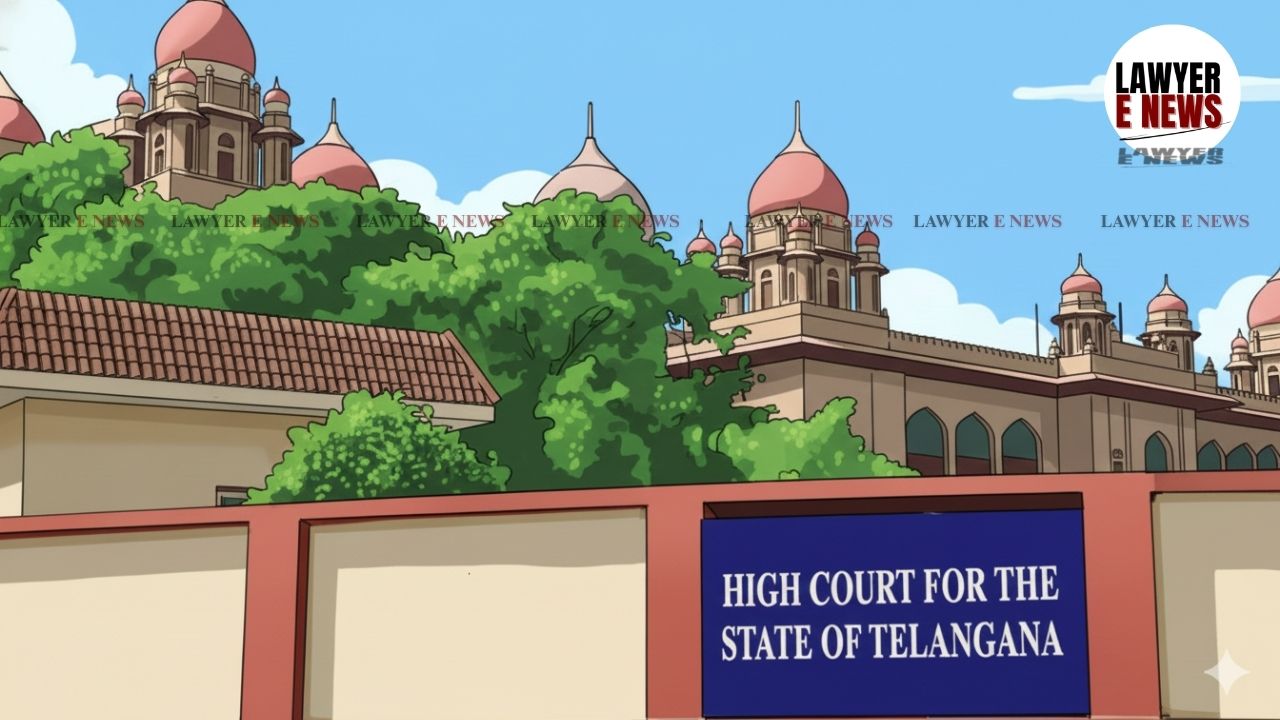
"Any association that excludes a statutorily recognized class of allottees is not only contrary to the principles of equality and inclusivity but is also unsustainable in law." Telangana High Court, in a significant ruling , held that a gated residential community developed under a social housing policy cannot be governed by an association that deliberately excludes Economically Weaker Section (EWS) and Low Income Group (LIG) allottees.
A Division Bench comprising Chief Justice Aparesh Kumar Singh and Justice G.M. Mohiuddin observed that the formation of an association restricted solely to villa owners subverts the statutory scheme of social inclusion by creating a discriminatory, two-tier community.
The dispute centered on the governance and maintenance of 'Pristine Estates', a gated community developed with 105 independent villas and 12 LIG/EWS units as mandated by government regulations. A section of villa owners registered the appellant society under the Telangana Mutually Aided Co-operative Societies (TMACS) Act, framing bye-laws that expressly excluded the LIG/EWS allottees and imposed an exorbitant membership fee. The promoters successfully challenged this registration before a Single Judge, who set it aside, prompting the appellant society to prefer the present writ appeal.
The primary question before the court was whether the registration of an exclusive society for villa owners under the TMACS Act was legally sustainable given the non-inclusion of LIG/EWS stakeholders. The court was also called upon to determine whether a single residential project with a mandatory social housing component could be subjected to multiple associations.
Fabricated Verification Report Vitiates Registration
The court first examined the procedural legality of the appellant society's registration, noting glaring discrepancies in the verification report prepared by the authorities. The bench observed that the report falsely stated only 22 flats were sold, whereas 87 villas and all 12 LIG/EWS units had already been registered and assessed for property tax. Relying on the Supreme Court's decision in Naseem Bano v. State of U.P., the court held that the failure of the authorities to explain this discrepancy rendered the foundation of the registration suspect.
Registrar Failed To Invite Objections
The court heavily criticized the registering authority for failing to issue notices to the LIG/EWS allottees or the majority of the villa owners prior to granting registration. The judges emphasized that under the TMACS Act, the process of registration is not a mere formality but requires due application of mind. The requirement to invite objections from stakeholders is a substantive safeguard to ensure transparency and inclusivity in the formation of a society meant to represent an entire community.
Exclusion Defeats Social Housing Policy
Delving into the statutory framework, the court underscored that the project was governed by G.O.Ms.No.528, which mandates the inclusion of a social housing mix. The court noted that the appellant society's bye-laws expressly confined membership to "Villa Owners" and unequivocally excluded the LIG/EWS allottees. The bench observed that the subsequent imposition of an exorbitant membership fee of Rs 5,00,000 further aggravated the discriminatory character of the society and violated the principle of free admission.
Integration, Not Segregation, Is The Objective
The court fiercely rejected the concept of an exclusive governing body for a select class of residents within a unified project. The bench observed that allowing such an arrangement would render the conditions of social housing illusory and nugatory. Emphasizing the collective nature of the development, the court noted that the common amenities and facilities are collective property, and no unit holder can claim exclusive rights over them.
"The formation of an association restricted solely to 'villa owners' results in the creation of a stratified, two-tier community, wherein LIG/EWS allottees stand effectively excluded. Such an arrangement runs contrary to the underlying objective of the social housing policy, which seeks integration and not segregation."
Single Unified Association Mandatory For One Project
Relying on the precedent set in M/s. Saket Engineering Pvt. Ltd. v. State of Telangana, the court categorically ruled against the creation of multiple associations within a single residential layout. The bench noted that the Real Estate (Regulation and Development) Act, 2016 (RERA) intends to ensure a unified body representing the collective interests of all allottees. The court observed that allowing multiple associations would inevitably lead to disharmony, conflicting claims, and administrative chaos.
RERA Observations Do Not Validate Illegal Association
The appellant society had relied on an order passed by the Telangana State Real Estate Regulatory Authority (TS RERA), which noted the promoters' failure to facilitate an association. However, the High Court clarified that this order did not confer legality upon an exclusionary society. The bench observed that an association suffering from procedural infirmities and exclusionary bye-laws cannot derive legitimacy merely on account of the promoters' omission to discharge their statutory obligations.
Court Moulds Relief To Ensure Democratic Representation
Holding that the scope of judicial review under Article 226 extends to ensuring that statutory mandates are effectuated, the court issued comprehensive directions for forming a new, legally compliant association. The bench directed the District Co-operative Officer to actively oversee the process to secure a single, unified association representing the entire project. The court mandated that the new bye-laws must explicitly reflect the social housing policy and grant membership to all villa owners and EWS/LIG allottees without any discrimination whatsoever.
The High Court dismissed the writ appeal and upheld the Single Judge's decision cancelling the registration of the exclusionary appellant society. Emphasizing the need for a harmonious community structure, the court directed the authorities and promoters to facilitate the immediate formation of a single, unified, and inclusive association representing all unit holders within the Pristine Estates project.
Date of Decision: 02 April 2026