-
by sayum
28 July 2026 9:28 AM







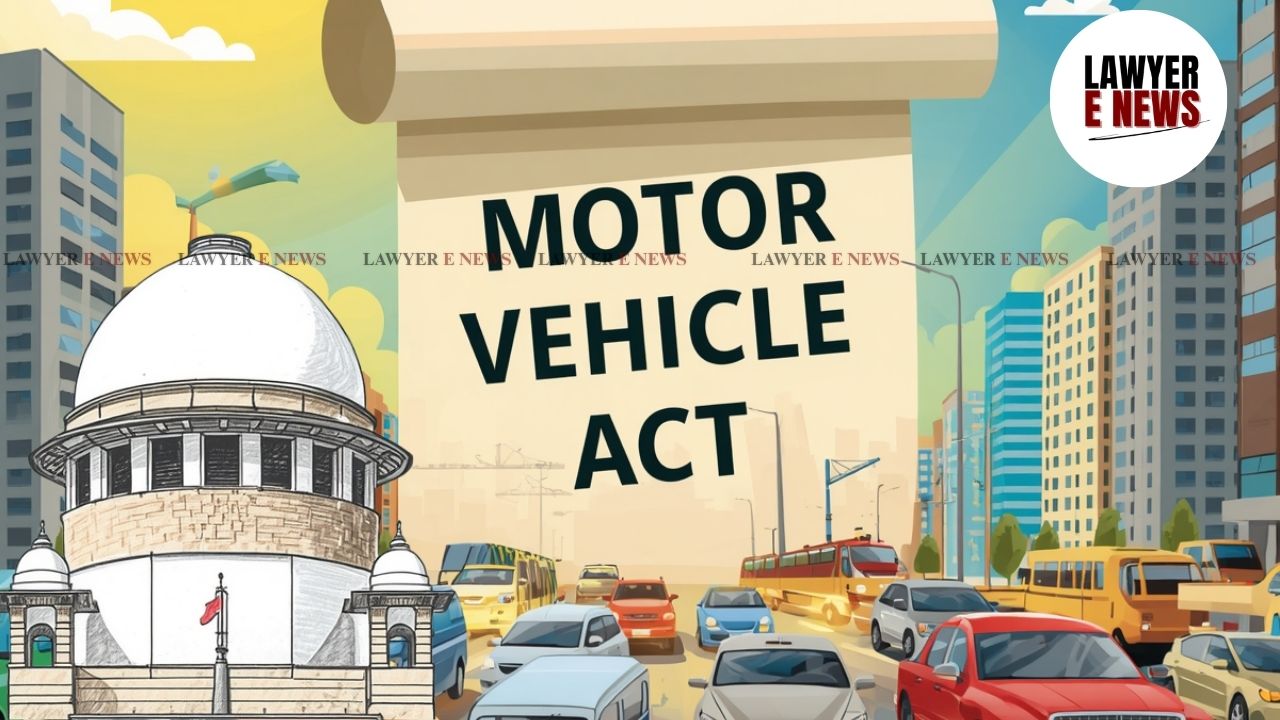
"In other words, the motor vehicle itself does not play an active role in the accident. It is not part of the proximate cause of the accident. For that reason, a claim under Section 166 specifically may not be appropriate, " Supreme Court, in a significant ruling dated June 11, 2026, held that the falling of a roadside tree branch onto a stationary vehicle does not qualify as an accident "arising out of the use of a motor vehicle" under the Motor Vehicles Act, 1988 (MVA).
A bench of Justices Sanjay Karol and Nongmeikapam Kotiswar Singh observed that for a claim to be maintainable under Section 166 of the MVA, the vehicle must play an active role or be a proximate cause of the accident.
The case originated from an incident on June 23, 2007, when Respondent No. 1 was travelling in an autorickshaw in Bengaluru. Due to heavy rain, the vehicle was parked under a tree, where a detached branch fell on the auto, causing the passenger to suffer total paraplegia. The Motor Accidents Claim Tribunal initially dismissed the claim as an "Act of God," but the High Court later awarded Rs. 17.10 lakhs, apportioning 25% liability to the Bruhat Bangalore Mahanagara Palike (BBMP).
The primary question before the court was whether the appellant corporation could be held liable under the MVA for injuries caused by a falling tree branch. The court was also called upon to determine if such an incident constitutes an accident "arising out of the use of a motor vehicle" as contemplated under Section 165 and 166 of the Act.
Court Examines Doctrine of 'Act of God' and Strict Liability
The Court began by tracing the origins of the ‘Act of God’ (Vis Major) doctrine, referencing English precedents like Nichols v. Marsland and Rylands v. Fletcher. It noted that an Act of God involves direct, violent, and sudden acts of nature that could not have been foreseen or resisted by human care. The bench emphasized that while heavy rain is foreseeable, the specific falling of a branch during such a storm often falls within this category.
Limits on Duty of Municipal Corporations to Maintain Vigil
Addressing the negligence of municipal authorities, the Court referred to Rajkot Municipal Corpn. v. Manjulben Jayantilal Nakum. It observed that while the BBMP has a statutory duty to look after city trees and undertake periodic maintenance, it is unrealistic to expect a "constant vigil" over every tree or shrub. The bench noted that a prudent authority cannot be expected to slash all branches of old trees merely because they might give way.
"It would be unrealistic to expect that authorities of the Corporation can maintain a constant vigil over each tree/shrub."
Interpretation of 'Arising Out of Use' Under Motor Vehicles Act
The bench analyzed the phrase "arising out of the use of motor vehicles" appearing in Section 165(1) of the MVA. While acknowledging the liberal interpretation given in Shivaji Dayanu Patil v. Vatschala Uttam More, where "use" includes periods when a vehicle is stationary or broken down, the Court clarified that there must still be a causal relationship between the vehicle's use and the injury.
Proximate Cause vs. Remote Relationship in Accidents
The Court distinguished between injuries "caused by" and those "arising out of" the use of a vehicle. Citing Australian jurisprudence, the bench noted that "arising out of" requires a less proximate relationship than "caused by." However, it held that in the present case, the autorickshaw was merely the site of the incident and did not play an active role in the accident itself.
"The motor vehicle itself does not play an active role in the accident. It is not part of the proximate cause of the accident. For that reason, a claim under Section 166 specifically may not be appropriate."
Invoking Article 142 to Enhance Compensation on Humanitarian Grounds
Despite finding that the claim was technically inappropriate under the MVA, the Court refused to leave the respondent without relief. Noting that the victim suffered "life-altering grievous injuries" resulting in total paraplegia and bladder incontinence, the bench held that leaving him without sustaintance would not "appeal to the conscience of justice."
Court Exercises Extraordinary Powers for Substantial Justice
Invoking its extraordinary powers under Article 142 of the Constitution of India, the Supreme Court decided to enhance the total compensation to Rs. 25,00,000/-. The bench maintained the High Court's apportionment of liability (25% to BBMP, 50% to the Insurer, and 25% to the Horticulture Department) to ensure the respondent received immediate and adequate financial support for his permanent disability.
The Supreme Court settled the question of law by ruling that falling tree branches are not proximate results of vehicle use under the MVA. However, acting as the "final Court of the country," it enhanced the compensation to Rs. 25 lakhs on humanitarian grounds. The appeal was disposed of with directions to deposit the amount directly into the respondent's bank account within four weeks.
Date of Decision: June 11, 2026