-
by sayum
25 August 2026 6:19 AM







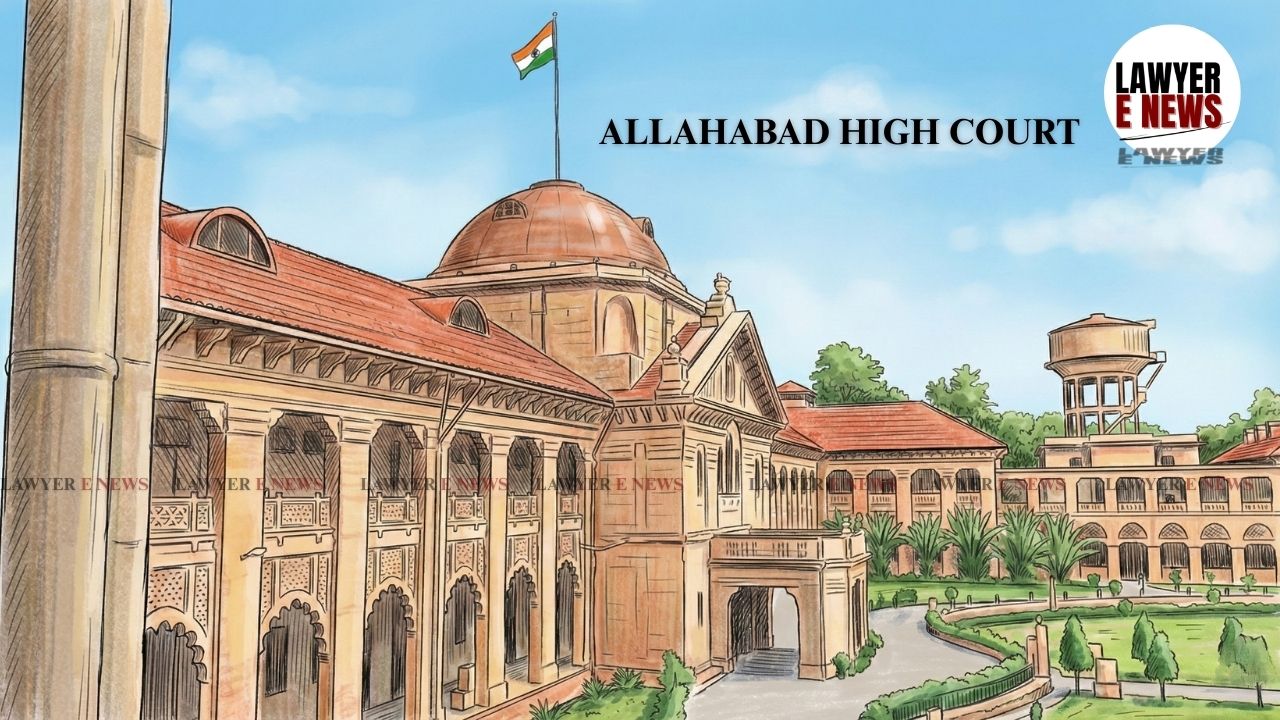
“High Court cannot indirectly invalidate an order under appeal by entertaining writ against a consequential act”, Allahabad High Court firmly reiterating the limited legal status of an election certificate issued by the Assistant Registrar under the Societies Registration Act, 1860. Dismissing an intra-court appeal, the Bench refused to interfere with the Single Judge’s decision that declined relief against the issuance of such a certificate following recounting of votes in a society election.
The High Court held that “issuance of an election certificate by the Assistant Registrar does not have any independent statutory or legal sanctity under the Act”, adding that “the power to function as an office bearer flows not from such certificate but from the registration of the list of office bearers under Section 4(1)”.
Dispute over President's Post After Recounting of Votes in Kayasth Pathshala Election
The appellant, Dr. Sushil Kumar Sinha, had contested elections for the post of President of Kayasth Pathshala, a registered society in Prayagraj. Following elections held on December 25, 2023, and counting on December 26, 2023, he was declared elected and issued a certificate by the Returning Officer.
However, a challenge was raised by the rival candidate, respondent No. 4 (Chaudhary Raghvendra Nath Singh), alleging irregularities. The Assistant Registrar, under Section 25(1) of the Act, referred the matter to the Prescribed Authority (SDM), who on March 22, 2025, ordered a recount. After recounting revealed the respondent had won, the Assistant Registrar issued a fresh certificate dated March 28, 2025, cancelling the appellant’s earlier certificate and declaring the respondent elected.
Aggrieved, Dr. Sinha challenged only the certificate dated March 28, 2025, before the writ court without assailing the foundational order of the Prescribed Authority dated March 22, 2025, which was already under appeal before the Commissioner under Section 25(1)(d). The Single Judge dismissed the writ petition, and this dismissal was challenged in the present special appeal.
Court Emphasizes: Writ Petition Cannot Be Used To Indirectly Challenge A Statutory Order Under Appeal
The High Court refused to entertain what it termed an “indirect challenge” to the Prescribed Authority’s order, observing:
“Admittedly, the order dated 22.03.2025 passed by the Prescribed Authority is not the subject matter of the writ petition and a statutory appeal...is still pending. Therefore, neither the writ Court nor this Appellate Court can record a finding which may, directly or indirectly, result in either setting aside or upholding the order.” [Para 21]
The Court was categorical that any grievance with the consequences of the Prescribed Authority's directions — such as declaration of result after recount — could only be raised in the pending statutory appeal and not via a writ confined to the consequential election certificate.
No Legal Authority in Election Certificate; Functional Authority Derives from Section 4(1) Registration
One of the central issues was whether the Assistant Registrar had any authority to issue a new election certificate and cancel the previous one.
The Court noted that while the recount was ordered by the Prescribed Authority, the Assistant Registrar acted merely in execution of that order. Therefore, the certificate dated March 28, 2025 was merely a consequential document and not a source of legal authority.
Quoting its earlier decision in the connected Special Appeal No. 388 of 2025, the Bench reiterated:
“Nothing has been pointed out that the Act/Rules requires issuance of any such election certificate and, therefore, in our opinion, the same by itself, does not have any legal status.” [Para 26]
It further clarified that:
“The power is derived based on the registration of the office bearers under Section 4(1) of the Act and even the said order is appealable under Section 4(1A) of the Act.” [Para 25]
As the list of office bearers after recount had already been registered under Section 4(1) on April 2, 2025, and no challenge had been made to that registration or attestation, the Court found that no relief could be granted to the appellant.
Assistant Registrar’s Role is Ministerial, Not Adjudicatory
The appellant had argued that the Assistant Registrar assumed adjudicatory powers by cancelling the earlier certificate and declaring a new winner. The Court rejected this contention, finding:
“The Assistant Registrar was bound to obey the directions issued by the Prescribed Authority…to get the recount done and declare its result… Questioning the nature of the said direction or its consequence could only possibly be entertained in proceedings…against the order dated 22.03.2025 itself and not in the writ petition.” [Para 20]
Therefore, the Court concluded, the Assistant Registrar merely implemented what the Prescribed Authority directed, and any error in that order must be tested in the pending statutory appeal.
Section 25(2) Not Attracted Unless Election is Set Aside, Fresh Election Ordered
The appellant alternatively argued that if his election was deemed set aside, the Assistant Registrar should have held a fresh election under Section 25(2). The Court rejected this as well:
“We are not inclined to hold…that occasion for the Assistant Registrar to hold meeting as per Section 25(2) of the Act has arisen, particularly when the appeal against the order of the Prescribed Authority is under challenge.” [Para 30]
Thus, the legal scheme under Section 25 was not violated as alleged, since the recount and result declaration occurred under judicial direction and a fresh election was not automatically mandated.
R.P. Act Analogy Rejected: “Societies Act Follows a Distinct Statutory Scheme”
Another significant submission made was that the Prescribed Authority and Assistant Registrar had exercised powers akin to the High Court under the Representation of the People Act, 1951, particularly Sections 84, 98, 100, and 101.
This was summarily rejected by the Court:
“The Court has to see the nature of challenge in its entirety and not on piecemeal basis. Once we have arrived at a concrete conclusion that the challenge laid to the certificate alone which has no independent or separate legal status… we are not inclined to quash either the certificate or any part thereof.” [Para 31]
The Bench held that any comparison with R.P. Act provisions was misplaced, given the clear statutory contours under the Societies Registration Act, 1860.
All India Council Case Not Applicable: Election Dispute Was Already Adjudicated By Prescribed Authority
The appellant had relied heavily on the decision in All India Council v. Assistant Registrar, 1988 (2) AWC 1154, to argue that only the Prescribed Authority can decide election disputes.
While agreeing with the principle, the Court distinguished the factual scenario:
“The facts of the present case are totally different… the case in hand has arisen from a situation where, after the Assistant Registrar had made a reference to the Prescribed Authority, the latter exercised its power… and passed the order dated 22.03.2025.” [Para 28]
Thus, the High Court held that the appellant could not derive any benefit from the precedent, as the statutory process under Section 25 had been followed.
No Relief Possible When Main Order Under Appeal & Certificate Has No Statutory Force
Ultimately, the High Court found no merit in the intra-court appeal. It dismissed the challenge against the Single Judge’s decision, holding that in absence of challenge to the foundational order or to the subsequent registration under Section 4(1), no writ could be entertained against the intervening certificate.
“Consequently, we do not find any error in the order passed by the learned Single Judge… We are not inclined either to upset the order of the learned Single Judge or to grant any relief to the appellant.” [Para 34]
Date of Decision: February 4, 2026