
-
by sayum
25 August 2026 12:32 PM







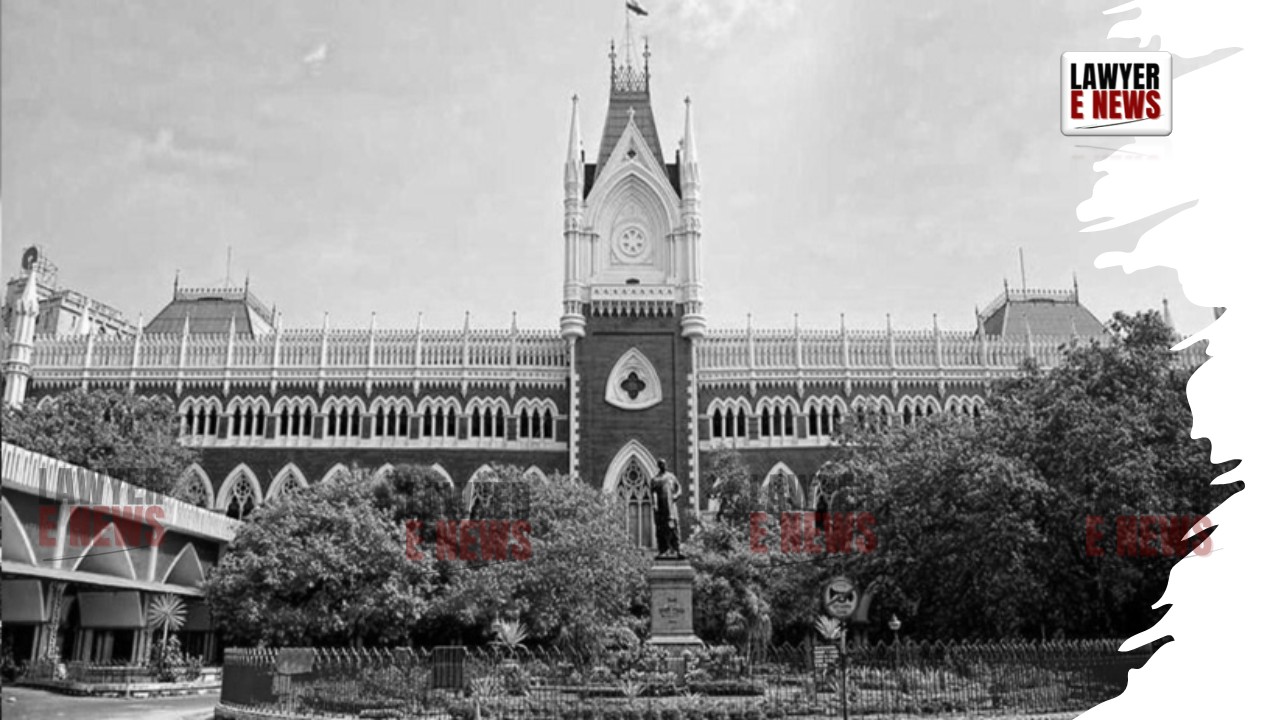
“Uncontested Allegations, Social Media Proof, and Admission by Conduct — Disqualification Proven on Preponderance of Probabilities”, In a significant verdict Calcutta High Court emphatically overturned the Speaker’s decision rejecting disqualification proceedings against a legislator who defected from the BJP to the AITC, holding that the Speaker misapplied the law by treating the disqualification proceedings akin to a criminal trial and erroneously demanding a standard of proof “beyond reasonable doubt”.
A Division Bench of Justice Debangsu Basak and Justice Md. Shabbar Rashidi ruled that Respondent No. 2, a sitting MLA, had voluntarily given up BJP membership by publicly appearing at a press conference held at Trinamool Bhavan on June 11, 2021, which was “broadcast on official AITC platforms and widely reported by the media”.
Rejecting the Speaker’s reasoning as perverse, the High Court declared the MLA disqualified with retrospective effect from June 11, 2021, under Paragraph 2(1)(a) of the Tenth Schedule of the Constitution, and quashed his subsequent appointment as Chairman of the Public Accounts Committee (PAC).
The Court said:
“The respondent No. 1 had no basis to hold that the proceedings for disqualification were quasi-criminal in nature and that the yardstick of proof is beyond reasonable doubt... The standard of proof is preponderance of probabilities, and not beyond reasonable doubt as no criminal liability is involved.” [Para 47]
“Once Presence at Trinamool Bhavan Was Not Denied and Defection Was Aired on Social Media, Disqualification Was Inevitable”
The High Court placed great weight on the admitted presence of the MLA at the AITC press conference and the absence of any specific denial from him regarding the core allegation of defection.
The Court noted:
“The respondent No. 2 did not deny his presence in the press conference held on June 11, 2021... He did not deny the contents of such press conference... He has not denied the statements attributed to him in the disqualification petition.” [Para 36]
In the face of such non-denial, the Court held that the material facts stood admitted. The doctrine of non-traverse squarely applied. Citing the Supreme Court’s ruling in Badat & Co. v. East India Trading Co., the Court explained that when allegations are not specifically denied, they must be deemed admitted.
“The averments and assertions relating to disqualification... were not denied by the respondent No. 2... The material allegations... had remained uncontroverted... The Speaker misdirected his enquiry by applying a wrong standard of proof.” [Para 48]
“Speaker Ignored Electronic Evidence and Social Media Proof Without Justification — Certification Under Section 65B Was Filed”
The Speaker had dismissed screenshots, transcripts, and a CD of the press conference, on grounds that they lacked proper Section 65B certificates under the Indian Evidence Act, 1872. The Court, however, held that the certificate was indeed submitted, and even otherwise, the transcripts and pleadings were sufficient to establish defection.
“The pleadings filed before the respondent No. 1 had both transcripts of the press conference as also the electronic evidence... and certificates under Section 65B of the Evidence Act, 1872.” [Para 52]
Justice Basak further noted that even if one were to exclude electronic materials, the transcripts and uncontroverted pleadings themselves formed a sufficient basis for disqualification:
“Even excluding the electronic records, the transcripts and pleadings proved defection... Should have been taken into consideration on the basis of the principle of preponderance of probabilities.” [Para 55]
“Speaker’s Decision Based on No Evidence or Misapplication of Law Is Vitiated by Perversity”: Court Exercises Constitutional Review Power
The Bench categorically rejected the Speaker’s finding, terming it perverse. Relying on the test laid down in Sumitomo Heavy Industries Ltd. v. ONGC, the Court held:
“A perverse finding is one based on no evidence or one that no reasonable person could have arrived at... The Speaker’s decision is clearly vitiated by perversity and the deployment of a wrong legal yardstick.” [Para 57]
“No reasonable person could have arrived at the conclusion as returned by the respondent No. 1 on the basis of the materials placed before him.” [Para 57]
The Speaker's attempt to dismiss the petition on hypertechnical evidentiary grounds and his failure to appreciate the admitted facts were found to be sufficient to invoke judicial review.
“Disqualification Comes Into Force on Date of Defection — Subsequent Events Cannot Cure Constitutional Wrong”
The Court reaffirmed that disqualification takes effect from the date of defection, not the date of adjudication. It held:
“The second writ petitioner has been able to establish that the respondent No. 2 defected from BJP to AITC on June 11, 2021... Subsequent events do not erase the disqualification already incurred.” [Para 60]
Relying on Dr. Mahachandra Prasad Singh v. Chairman, Bihar Legislative Council, the Court clarified that:
“Disqualification comes into force and becomes effective on the happening of the event... The Speaker must only confirm it through adjudication.” [Para 59]
The Court also found it improper that the Speaker had actively defended Respondent No. 2, who did not even contest the High Court proceedings:
“It is not for the Speaker or the State to set up a defence on behalf of the disqualified MLA, particularly when the MLA has not contested the claim.” [Para 60]
“Remanding to Speaker Would Delay Justice Further — High Court Declares Disqualification Itself”
Given the inordinate delay in the Speaker's handling of the disqualification petition — filed in June 2021, rejected once in February 2022, and again in June 2022 — the Court held that remanding the matter would defeat constitutional morality.
“Given the quantum of time spent... and misapplication of law by the Speaker... remanding the disqualification petition will not subserve the ends of justice.” [Para 65]
“We have no hesitation in allowing the disqualification petition and declaring the MLA disqualified under the Tenth Schedule of the Constitution, with effect from June 11, 2021.” [Para 66]
Consequently, the Court also quashed the appointment of the disqualified legislator as Chairman of the PAC, stating:
“Since the respondent No. 2 is declared to have suffered disqualification... his nomination as Chairman of the PAC stands set aside.” [Para 68]
This ruling marks a watershed moment in judicial scrutiny of Speaker’s decisions under the Tenth Schedule. The High Court asserted its constitutional duty to uphold legislative integrity, especially when the adjudicating authority itself has failed in applying settled legal principles.
The verdict reaffirms that political defection cannot be shielded by technical evasions or judicial lethargy. The principles laid down — on standard of proof, admissions by conduct, and preponderance of probabilities — will have far-reaching implications for anti-defection jurisprudence across India.
Date of Decision: 13 November 2025





