-
by sayum
27 August 2026 3:32 PM







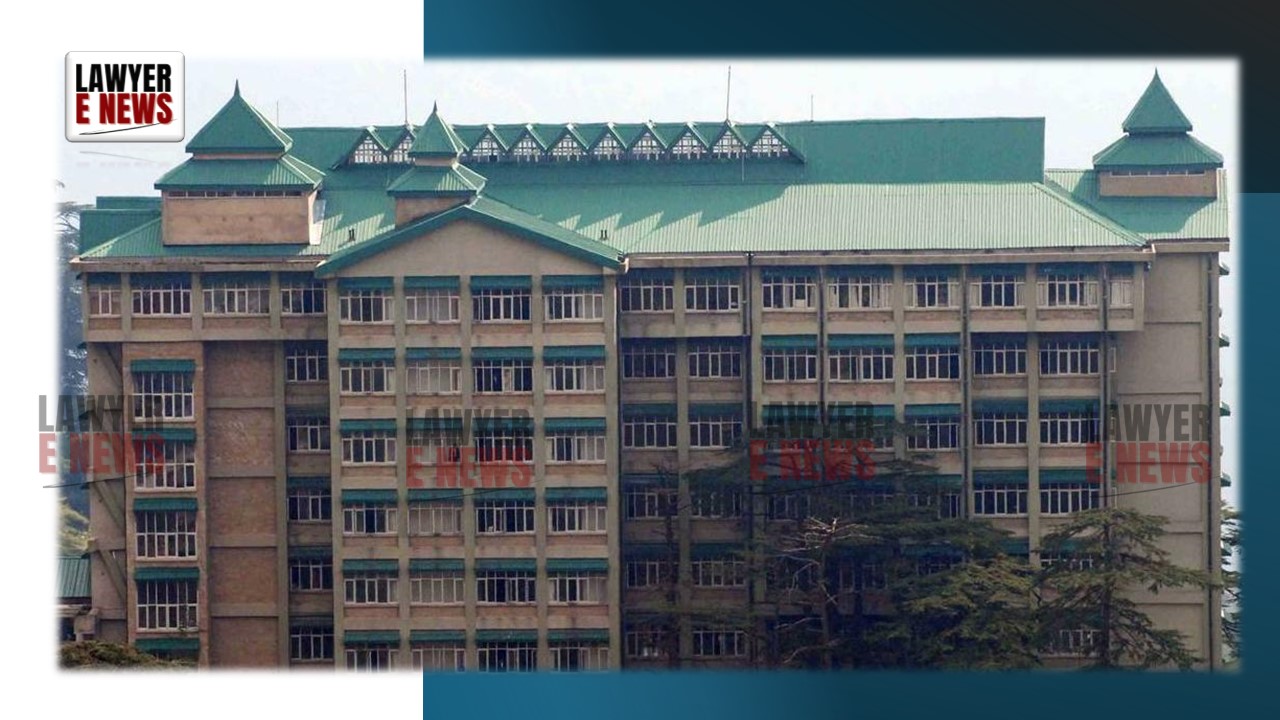
"Order XXVI Rule 9 CPC is not a panacea that can be used by litigants as a tool whenever they feel that they are not in a position to prove their case," Himachal Pradesh High Court, in a significant ruling , held that a Local Commissioner cannot be appointed under Order XXVI Rule 9 of the CPC merely to assist a party in collecting evidence to support their allegations.
A Single Judge bench of Justice Romesh Verma observed that the onus of proving encroachment lies squarely on the party alleging it, and they must stand on their own legs by adducing independent evidence rather than relying on the Court to generate proof for them.
The petitioner, Prem Nath, filed a suit for permanent prohibitory and mandatory injunction alleging that the respondents had encroached upon and raised construction over a 'Kuhl' (water channel) situated on government land. The plaintiff claimed this interference affected his rights and those of other local residents. After an initial application for a Local Commissioner was dismissed in 2014, the petitioner filed a fresh application in 2024, which was also rejected by the Trial Court.
The primary question before the Court was whether a Local Commissioner should be appointed to demarcate the suit land and ascertain alleged encroachment when the plaintiff has not approached revenue authorities. The Court was also called upon to determine if the provisions of Order XXVI Rule 9 CPC can be invoked to bridge gaps in a party's evidence.
Onus Of Proof Lies On The Alleging Party
The Court emphasized the fundamental principle that the burden of proof remains with the person who makes the allegations. Justice Verma noted that since the plaintiff alleged interference and encroachment despite an existing injunction order, it was incumbent upon him to substantiate the case through material documents. The Court found that the petitioner had failed to provide any independent evidence to back his claims.
"The plaintiff cannot take an aid of the Court to collect evidence in order to corroborate his case. It has neither been pleaded nor proved by the plaintiff that any efforts were made by him to invoke the authority of the Revenue Department or that any steps were taken to demarcate the suit land," the bench observed.
Court Cannot Assist Non-Diligent Litigants
The bench highlighted a lack of due diligence on the part of the petitioner. It noted that the Court will not step in to assist a party that has failed to take basic administrative steps, such as seeking a demarcation from the Revenue Department. The judgment clarified that judicial intervention through a Local Commissioner is a discretionary power meant to "elucidate" a matter, not to perform the duties of a litigant.
Court Refuses To Act As Evidence-Gathering Tool
Addressing the scope of Order XXVI Rule 9, the Court held that these provisions cannot be invoked in a routine manner. It noted that such applications can only be allowed in cases that are bona fide and necessary for determining the actual controversy. The bench warned against using the Court process as a shortcut for parties who fail to lead cogent evidence.
"The plaintiff/petitioner has to stand on his own legs by adducing independent and reliable evidence and he cannot invoke the provisions of Order XXVI Rule 9 CPC and call upon the Court to generate evidence for him," the Court held.
Reliance On Precedents And State Ownership
The Court took note of the fact that the disputed land (Khasra No. 722) was owned by the State of Himachal Pradesh, yet the State was not made a party to the suit. Citing the precedent in Diwakar Dutt Shastri vs. Ranjit Singh, the Court reiterated that Trial Courts are not expected to create evidence for any party. It further cited Naseeb Deen vs. Harnek Singh to establish that demarcation by a Commissioner is impermissible if the plaintiff hasn't first approached revenue authorities.
"The plaintiff or the defendant has to stand on its own legs and provisions of Order 26, Rule 9 of the Code cannot be used to garner or gather evidence for them through the Court process," the bench remarked, quoting previous Himachal Pradesh High Court rulings.
The High Court concluded that there was no jurisdictional error or perversity in the Trial Court's decision to dismiss the application. It held that the recourse to a Local Commissioner cannot be had to determine the nature and extent of encroachment when the plaintiff has not fulfilled their primary burden of proof. Consequently, the petition was dismissed as being devoid of merit.
Date of Decision: 17 April 2026