-
by sayum
27 August 2026 7:40 AM







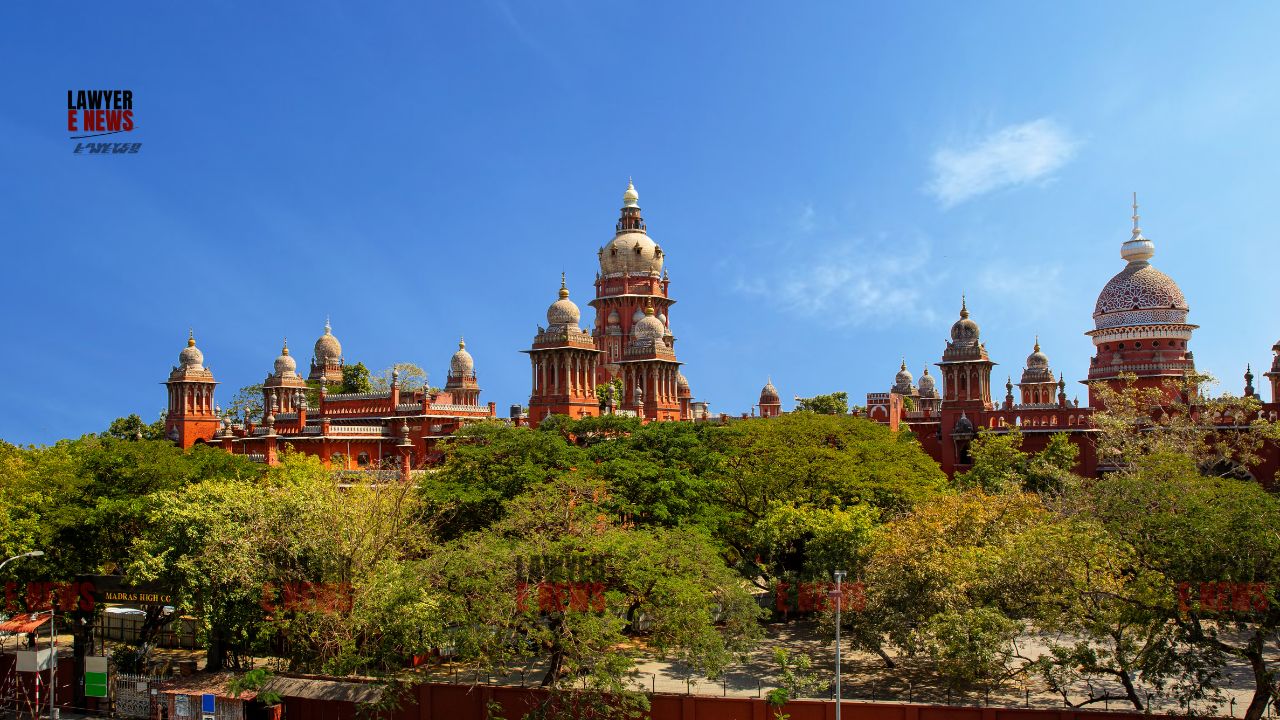
"Object of wearing a helmet is primarily a safety measure intended to minimize or prevent the severity of head injuries — it does not, in any manner, prevent the happening of the accident", Madurai Bench of the Madras High Court delivered a significant ruling in a motor accident compensation appeal, firmly rejecting the argument that a deceased victim's failure to wear a helmet should substantially reduce the compensation payable to his family.
A Division Bench of Justice N. Anand Venkatesh and Justice K.K. Ramakrishnan dismissed the appeal filed by the Tamil Nadu State Transport Corporation, Madurai, and confirmed the award of Rs. 28,85,790/- in favour of the dependants of the deceased.
On August 31, 2021, at around 7:00 p.m., one Pitchamani was riding his two-wheeler on the Usilampatti–Patelangur Road when a bus belonging to the Tamil Nadu State Transport Corporation, coming from the opposite direction, hit him in a rash and negligent manner. Pitchamani was rushed to the Government Hospital, Usilampatti, and subsequently referred to Government Rajaji Hospital, Madurai, where he succumbed to his injuries. His dependants filed a claim petition before the Motor Accidents Claims Tribunal, Dindigul, seeking Rs. 80,00,000/- in compensation. The Tribunal, after appreciating the evidence — including an FIR registered against the bus driver and departmental proceedings initiated against him — fixed 93% negligence on the Corporation's driver and 7% on the deceased for not wearing a helmet, ultimately awarding Rs. 28,85,790/-. The Transport Corporation appealed, seeking to enhance the contributory negligence of the deceased to 20% and to reduce the notional income fixed by the Tribunal.
Two questions arose before the Division Bench. First, whether the non-wearing of a helmet by the deceased, who sustained fatal head injuries, warranted an enhancement of his contributory negligence from 7% to 20%. Second, whether the Tribunal's fixation of the deceased's monthly income at Rs. 18,000/- — in the absence of documentary proof — was legally sustainable.
Helmet Violation Is Not Contributory Negligence Without a Causal Link
The High Court squarely addressed the Transport Corporation's principal argument and rejected it with clarity. The Court held that merely because the deceased was not wearing a helmet, and merely because he died of head injuries, the Corporation could not automatically demand a higher deduction from the compensation payable to his family.
"Mere violation of statutory provisions, such as non-wearing of a helmet, does not ipso facto confer a right upon the tortfeasor to plead contributory negligence, unless it is established that such violation had a direct nexus with the occurrence of the accident."
The Court drew a crucial distinction that goes to the heart of contributory negligence law in motor accident cases. A helmet is a protective device — it minimises injury after an accident occurs. It has no bearing on whether the accident happens in the first place. The negligence that caused the collision was entirely the bus driver's. There was no evidence that the deceased was riding rashly or in any manner that contributed to the impact.
The Court noted that while earlier decisions of the Madras High Court had, in peculiar factual circumstances, applied a limited deduction for helmet non-wearing, the subsequent development of law by the Supreme Court has clarified that a statutory violation alone, without more, cannot found a finding of contributory negligence. "There must either be a causal connection between the violation and the accident or a causal connection between the violation and the impact of the hit upon the victim." Even fatal head injuries, the Court emphasised, cannot automatically generate an inference of contributory negligence in the absence of any negligent conduct in riding by the deceased.
The FIR had been registered against the bus driver. Departmental proceedings had been initiated against him and concluded adversely. Two eyewitnesses — P.W.1 and P.W.2 — had categorically deposed that the accident was caused solely by the rash and negligent driving of the Corporation's bus. The appellant adduced no counter-evidence and drew nothing material from the witnesses in cross-examination. In these circumstances, the Court found that the Tribunal's balanced fixation of 7% contributory negligence was well-reasoned and warranted no enhancement.
Notional Income Can Be Fixed on Oral Evidence and Prevailing Conditions
On the second issue of income fixation, the Court upheld the Tribunal's determination of Rs. 18,000/- per month as the notional monthly income of the deceased. The deceased, aged 41 years at the time of his death, was engaged in the wood contract business. P.W.3 had deposed, without contradiction, that the deceased had employed more than five persons in his work. This oral evidence, the Court held, was sufficient foundation for a reasonable notional income fixation, particularly in the absence of any counter-evidence from the Corporation.
"The determination of income was founded on a careful appreciation of the oral evidence, duly supported by relevant precedents and considering the prevailing economic conditions, including the rising cost of living."
The Court relied on the Supreme Court's ruling in Syed Sadiq v. Divisional Manager, United India Insurance Co. Ltd. (2014) 2 SCC 735, which recognises the necessity of adopting a reasonable notional income where strict documentary proof is unavailable, and on the Division Bench ruling in Andal v. Avinav Kannan (2019). The Court found no infirmity or perversity in the Tribunal's approach and declined to interfere.
The Civil Miscellaneous Appeal was accordingly dismissed, with the full award of Rs. 28,85,790/- confirmed in favour of the family of the deceased. No costs were awarded.
Date of Decision: April 6, 2026