-
by sayum
27 August 2026 7:40 AM







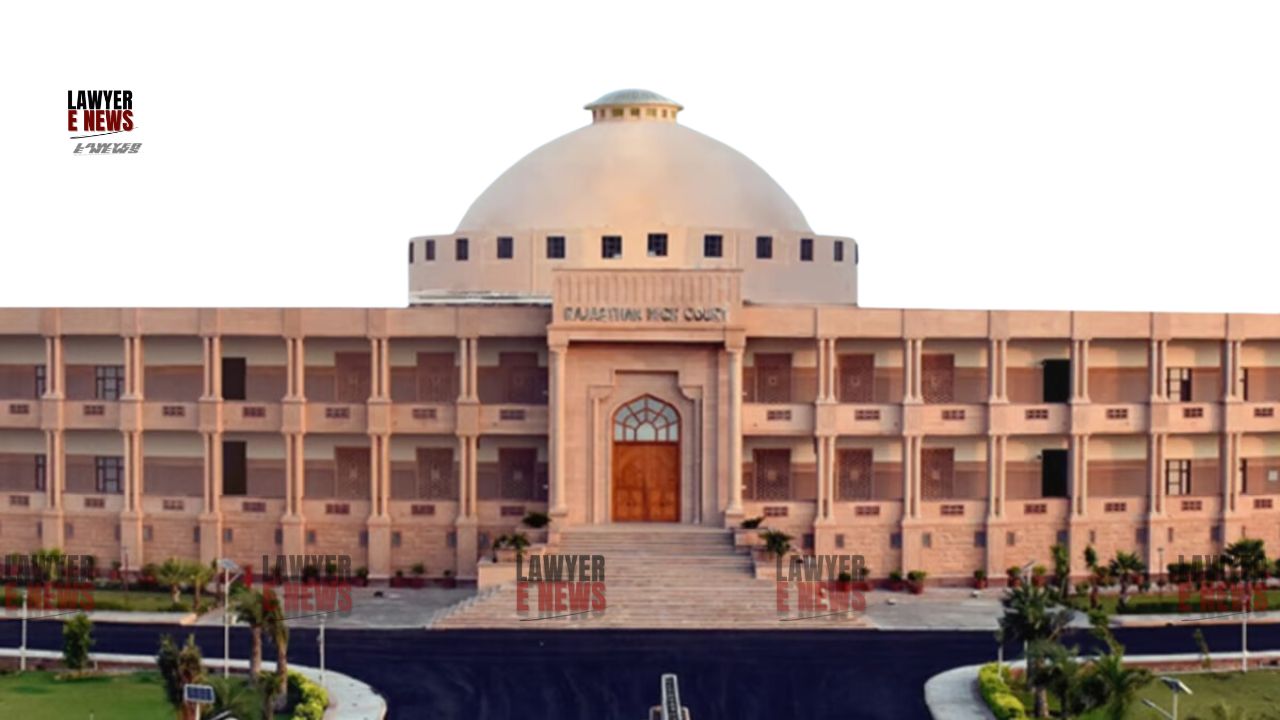
"Driving without a valid licence, by itself, may not lead to a finding of negligence — no finding was arrived at that the deceased was driving rashly and negligently" Rajasthan High Court enhanced motor accident compensation from Rs. 4,49,384/- to Rs. 8,43,705/- for the family of a barber killed in a road accident, quashing the Tribunal's finding of 20% contributory negligence against the deceased for not possessing a valid driving licence and carrying two pillion riders. Justice Sandeep Taneja held that statutory violations under the Motor Vehicles Act do not automatically translate into contributory negligence — there must be a causal connection between the violation and the accident itself.
Background of the Case
On April 21, 2010, Mahaveer was riding his motorcycle with two relatives — Shanti Devi and Santosh Devi — from Kekri to village Jhadali in Rajasthan. At around 11:00 a.m., a Jeep coming from the opposite direction, driven rashly and negligently, collided with the motorcycle. Mahaveer sustained injuries and subsequently died. His widow Pushpa and other dependants filed a claim petition before the Motor Accident Claims Tribunal, Kekri, seeking Rs. 79,45,000/- in compensation. The Tribunal found the Jeep driver solely responsible for the accident but still imposed 20% contributory negligence on the deceased for not having a valid driving licence and for carrying two pillion riders. The Tribunal also assessed the deceased's income on the basis of minimum wages for an unskilled worker, despite him being a barber — a skilled occupation. The family appealed seeking enhancement.
Legal Issues
Two principal questions arose. First, whether the absence of a valid driving licence and the presence of two pillion riders on the motorcycle could constitute contributory negligence when the Tribunal itself had recorded that the accident was caused solely by the rash driving of the Jeep. Second, whether a barber's income should be assessed on the basis of minimum wages for an unskilled or a skilled worker.
Court's Observations and Judgment
Statutory Violation Is Not Contributory Negligence Without Causal Link
Justice Sandeep Taneja found a fundamental contradiction in the Tribunal's approach. The Tribunal had specifically recorded a finding of fact that the accident occurred solely due to the rash and negligent driving of the Jeep driver and that no negligence was attributed to the deceased — and yet proceeded to impose 20% contributory negligence on him for technical violations of the Motor Vehicles Act.
The Court relied on the Supreme Court's ruling in Sudhir Kumar Rana v. Surinder Singh (2008) 12 SCC 436, which had held with clarity: "If a person drives a vehicle without a licence, he commits an offence. The same, by itself, may not lead to a finding of negligence as regards the accident. No finding of fact has been arrived at that he was driving the two-wheeler rashly and negligently. If he was not driving rashly and negligently which contributed to the accident, we fail to see as to how, only because he was not having a licence, he would be held to be guilty of contributory negligence."
On the question of three persons riding a motorcycle, the Court applied the Supreme Court's ruling in Mohammed Siddique v. National Insurance Company Ltd. (2020) 3 SCC 57, which held that carrying more than one pillion rider is a statutory violation but "such violation by itself, without anything more, cannot lead to a finding of contributory negligence, unless it is established that his very act of riding along with two others, contributed either to the accident or to the impact of the accident upon the victim." There must be a causal connection between the violation and the accident or its impact — and no such connection was established or even alleged by the Insurance Company here.
The finding of 20% contributory negligence was accordingly quashed entirely.
Barber Is a Skilled Worker — Minimum Wages Fixed Accordingly
On the income question, the Court found that the Tribunal had wrongly applied the minimum wage rate for an unskilled worker to assess the deceased's income. The State of Rajasthan, in exercise of its powers under the Minimum Wages Act, 1948, has specifically categorised the occupation of Barber as a skilled worker in its minimum wage notifications. The Court held that in the absence of documentary proof of income, the deceased's monthly income must be assessed on the basis of minimum wages applicable to a skilled worker — Rs. 115/- per day — and not on the lower unskilled worker rate applied by the Tribunal.
Compensation Recalculated
With contributory negligence removed and income corrected to skilled worker rates, the Court recalculated the entire compensation. Future prospects were fixed at 25% — not 30% as the Tribunal had awarded — given the deceased's age of 45 years at the time of the accident. Applying the multiplier of 14 corresponding to his age, loss of dependency was assessed at Rs. 5,43,375/-. Following the Supreme Court's guidelines in Pranay Sethi and Nanu Ram, loss of consortium was awarded at Rs. 40,000/- each to all six dependants — totalling Rs. 2,40,000/- — along with Rs. 15,000/- for loss of estate and Rs. 15,000/- for funeral expenses. The total compensation came to Rs. 8,43,705/- — nearly double the Tribunal's award of Rs. 4,49,384/-. The respondents were directed to deposit the enhanced amount of Rs. 3,94,321/- within two months, carrying interest from the date of filing of the claim petition.
Date of Decision: April 7, 2026