-
by sayum
27 August 2026 3:32 PM







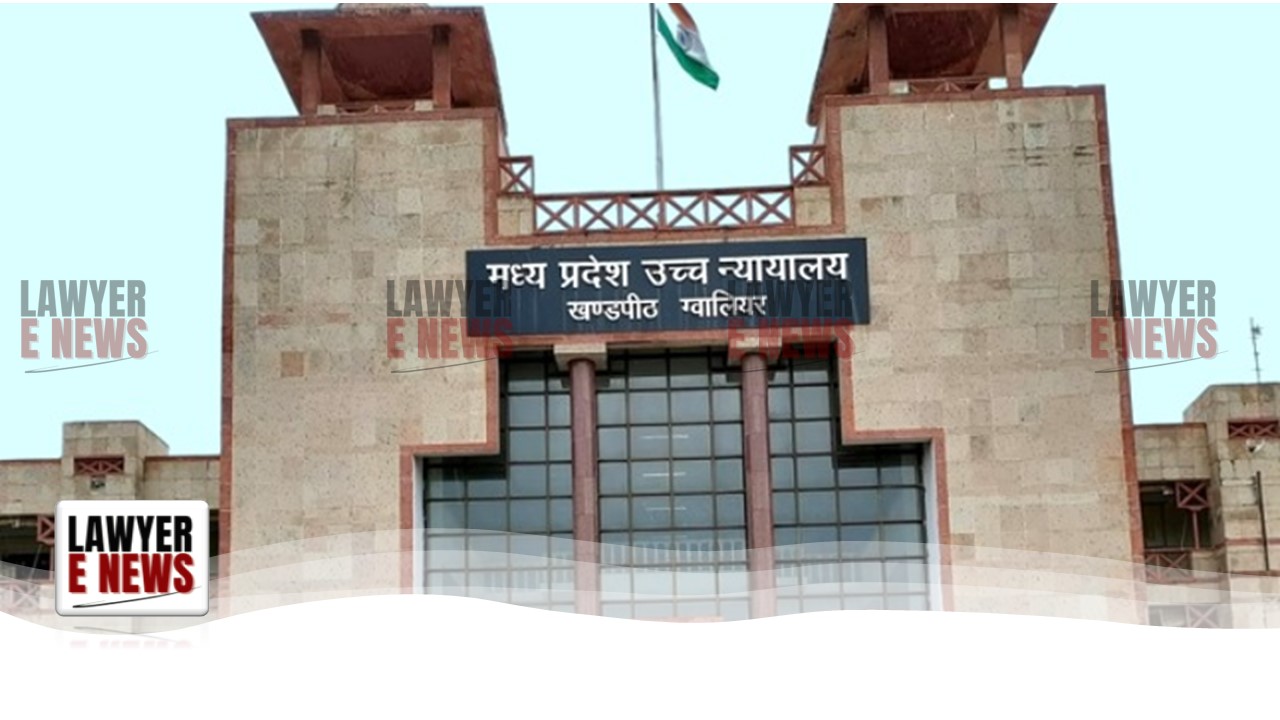
"Authorities are dutybound to pass reasoned and speaking orders, strictly confining their scrutiny to the four corners of the prevailing policy without importing alien or unwritten criteria, such as the deceased's past service record," Madhya Pradesh High Court, in a significant ruling, held that a claim for compassionate appointment cannot be rejected on grounds extraneous to the prevailing policy, such as the "unsatisfactory service record" of the deceased employee.
A single-judge bench of Justice Jai Kumar Pillai observed that importing alien criteria to deny survival benefits is "demonstrably arbitrary" and "legally perverse." The Court noted that such mechanical rejections defeat the welfare objective of benevolent schemes designed to provide immediate succour to families in distress.
The petitioner, Nikhil Kol, sought a writ of certiorari to quash a 2018 order passed by Union Bank of India rejecting his application for compassionate appointment following his father’s death in harness in 2016. The petitioner’s father had served the Bank for over 22 years before his sudden demise, leaving behind a destitute family of six, including three minor sisters. Despite the petitioner applying promptly under the Bank's 2015 scheme, the Bank took 28 months to issue a cryptic rejection citing the deceased's "unsatisfactory service record."
The primary question before the Court was whether the Bank could validly reject a compassionate appointment claim based on the past service record of the deceased employee when no such exclusionary clause existed in the applicable policy. The Court was also called upon to determine whether the inordinate delay in decision-making and the Bank's failure to contest the writ petition amounted to an arbitrary exercise of power.
Compassionate Appointment Is An Exception To General Recruitment Rules
The Court began by reiterating that compassionate appointment is not a vested right or an alternative source of recruitment, but a departure from general rules under Articles 14 and 16. Relying on the Supreme Court’s decision in The State of West Bengal v. Debabrata Tiwari (2023), the Court emphasized that the sense of immediacy is the foundation of such schemes. The bench noted that the objective is to enable the family to tide over a sudden financial crisis caused by the death of the sole breadwinner.
"The sense of immediacy is evidently lost by the delay on the part of the dependent in seeking compassionate appointment, but it is equally improper for authorities to keep such cases pending for years."
Rejection Based On Alien Criteria Is Legally Perverse
Upon scrutinizing the impugned order, the Court found that the Bank had "weaponized" the alleged service record of the petitioner’s father without any policy backing. The Court observed that the respondents failed to demonstrate any clause in the 2015 scheme that allowed for rejection based on the quality of the deceased's past service. By importing this unwritten criterion, the Bank bypassed the strict text of its own policy.
Authorities Cannot Import Unwritten Criteria Into Decision-Making
The Court expressed "utter surprise" at how a clean record of 22 years could be ignored to facilitate a rejection on extraneous grounds. It held that the authorities are duty-bound to remain within the "four corners of the prevailing policy." The bench noted that the petitioner's family was in a state of acute destitution, and the Bank’s action in defeating a legitimate claim on unsupported grounds was a violation of administrative law principles.
"The rejection is demonstrably arbitrary, legally perverse, and entirely against the established statutory law of compassionate appointment."
Inordinate Delay And Administrative Apathy Deprecated
The Court took strong exception to the 28-month delay by the Bank in deciding the application and its subsequent failure to appear or file a reply in the High Court for over five years. The bench remarked that this conduct "smacks of glaring arbitrariness" and a "unilateral approach" toward a welfare measure. It noted that the petitioner was forced to endure prolonged financial agony and legal hardship due to the Bank’s mechanical and apathetic approach.
Failure To Pass Speaking Orders Invites Judicial Displeasure
Justice Pillai recorded a "strict word of caution" for administrative authorities regarding the necessity of passing reasoned and speaking orders. The Court held that recording explicit, policy-backed reasons is essential to safeguard against the arbitrary exercise of executive power. The bench warned that future orders found to be based on "fabricated grounds" outside the governing policy would be viewed with "profound judicial displeasure."
"Subjecting dependents to mechanical, cryptic, or arbitrary rejections based on extraneous grounds cruelly defeats the very objective of the welfare measure."
Final Directions and Imposition of Costs
The Court quashed the rejection order dated January 30, 2018, and directed the Bank to reconsider the petitioner's claim afresh within 60 days. It clarified that the reconsideration must be strictly according to the policy and uninfluenced by the previous "unsatisfactory service record" ground. To compensate the petitioner for "unwarranted harassment," the Court imposed a cost of Rs. 50,000/- on the Bank, payable within 30 days.
The High Court concluded that while compassionate appointment is an exception to the rule, the discretion of the employer is not absolute and must be exercised within the limits of the scheme. The judgment reinforces the principle that administrative bodies cannot invent new grounds for rejection that are absent from the written policy, especially in matters concerning the survival of a deceased employee's family.
Date of Decision: 24 April 2026