
-
by sayum
25 August 2026 12:32 PM







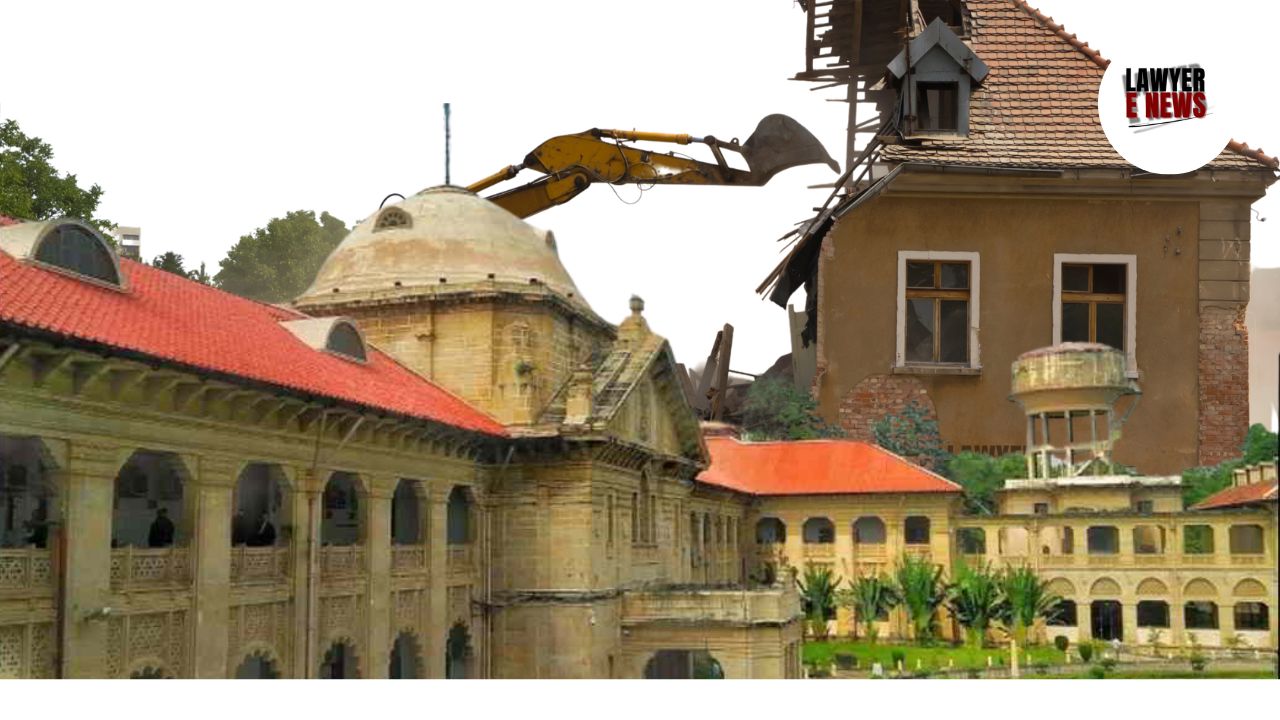
In a significant hearing held on a Sunday evening, October 20, 2024, the Allahabad High Court addressed a PIL (Public Interest Litigation) challenging the Uttar Pradesh Government's demolition notices issued to individuals accused in the Bahraich violence case. The PIL, filed by the Association for Protection of Civil Rights, sought to stop the demolition of properties linked to the accused, arguing that the action unfairly targeted members of the Muslim community.
Background of the Bahraich Violence and Government's Demolition Notices
The case stems from communal violence that broke out in the Maharajganj/Mehsi area of Bahraich district on October 13, 2024, during the final day of Durga Puja celebrations. Tensions escalated when local members of the Muslim community objected to loud music played by a religious procession, resulting in the death of a 22-year-old man named Ram Gopal Mishra. Mishra, reportedly, climbed onto the roof of a house and replaced a green Islamic flag with a saffron flag, leading to a confrontation. He was shot and killed, triggering widespread violence in the area.
Following the incident, the Uttar Pradesh Government issued demolition notices to properties allegedly belonging to individuals accused of participating in the violence. The authorities cited violations of the Road Control Act of 1964, claiming that the structures in question were built within 60 feet of the central point of a rural road, which is illegal. The PwD's notices demanded that occupants either produce proof of construction approval or remove the illegal structures within three days. The notices also warned that failure to comply would result in the demolition of the properties, with costs recovered through revenue proceedings.
The bench of Justice Attau Rehman Masoodi and Justice Subhash Vidyarthi granted the affected individuals 15 days to respond to the demolition notices, extending the original three-day deadline provided by the Public Works Department (PwD). This comes after the notices, dated October 18, required the occupants to justify the legality of their constructions within a short window.
Court Notes Short Timeline in Demolition Notices and Seeks Clarification
The court expressed concern over the brevity of the deadline given to the accused to respond to the demolition orders. The bench highlighted the lack of clarity in the notices regarding the number of properties authorized for construction on the specified road in the Bahraich district. The court remarked:
"...what pricks the conscience of this court is the issuance of notices to submit the reply within a short span of three days. As to what number of houses situated on kilometer-38, of Kundasar-Mahasi-Nanpara-Maharajganj, District Road have been duly authorized for construction is also not much evident from the notice which may require clarity."
The court allowed three additional days for the State Counsel to gather complete details on the legality of the constructions and provide the necessary clarification.
No Direct Stay on Demolitions, But Court Assures Compliance with Supreme Court Orders
Although the Allahabad High Court did not explicitly stay the demolition process, it expressed confidence that the Uttar Pradesh Government would comply with the Supreme Court's September 17, 2024 order on demolitions. The apex court had ordered that no demolitions should take place without judicial permission, except in cases involving public encroachments on roads, footpaths, railways, or water bodies.
“The Apex Court, in so far as, the demolition of construction is concerned, an order has already been passed on September 17, 2024. We have no reason to believe that the UP Govt will not follow the order passed by the Supreme Court,” the court stated.
The court refrained from interfering with the demolition notices but emphasized that it expects the individuals concerned to respond within the extended deadline of 15 days.
The court raised questions regarding the legitimacy of the PIL filed by an association rather than the affected individuals themselves. It observed that such PILs could have broader consequences and that the victims had not directly approached the court to challenge the demolition orders. The bench stated:
"Notices issued against a limited number of persons who are to participate in the proceedings cannot be viewed to be a matter of general public importance... unless the vulnerability of an aggrieved person is such that he is unable to approach the court for availing the remedy available under law."
The court further noted that the petition had little meaning in the absence of direct participation from the affected individuals. It reaffirmed that those receiving the notices should participate in the legal process and submit their replies to the PwD.
Court Extends Time for Affected Parties to Respond
During the hearing, the petitioner's counsel raised concerns about the grim situation in Bahraich, arguing that the accused individuals had fled their homes out of fear of malicious prosecution. The counsel emphasized that these individuals were unable to participate in the proceedings and respond to the demolition notices within the tight deadline.
Responding to these concerns, the court granted the accused individuals 15 days to submit their replies to the demolition notices and directed the authorities to issue a reasoned order based on the replies received. The court's order stated:
"We further provide that in case they file their reply to the notice within a period of 15 days from today, the competent authority shall consider and decide the same by passing a speaking and reasoned order which shall be communicated to the parties aggrieved."
The bench reiterated that the authorities must follow due process and ensure that the decisions are based on reasoned considerations.
The Allahabad High Court's ruling grants temporary relief to individuals accused in the Bahraich violence case by extending the deadline to respond to demolition notices. Although no stay was issued on the demolitions, the court placed emphasis on ensuring that due process is followed, and affirmed its trust that the Uttar Pradesh Government will adhere to the Supreme Court's guidelines on demolitions. The court expects the government to act in accordance with the law while dealing with the situation in Bahraich.
Date of Order: October 20, 2024
Association for Protection of Civil Rights v. State of Uttar Pradesh & Ors. PIL





