
-
by kapil
21 November 2026 3:55 PM







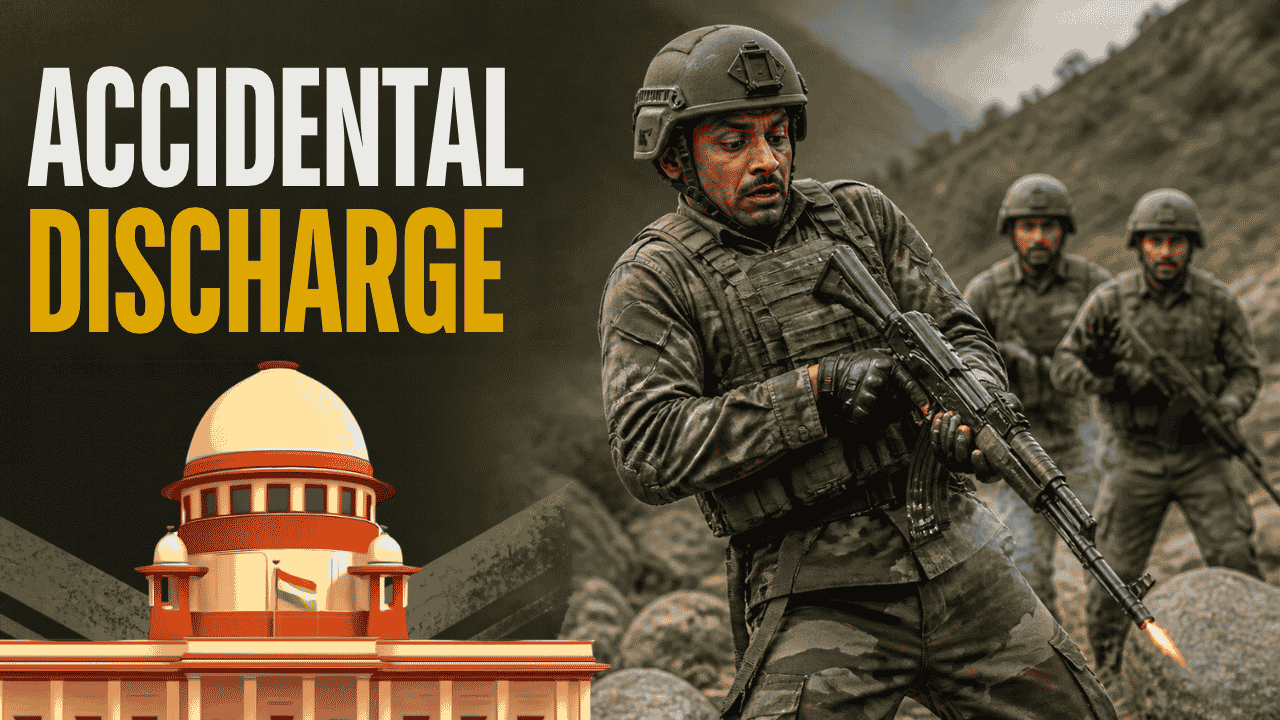
"In the absence of contrary contemporaneous material, an officially recorded accident cannot be converted into a self-inflicted injury merely because the weapon belonged to the appellant," Supreme Court.
NEW DELHI: The Supreme Court, on November 20, 2026, held that an accidental gunshot injury caused by the discharge of a soldier's own weapon during an active military operation cannot be classified as a self-inflicted injury and entitles the personnel to the War Injury Element under Regulation 103 read with Regulation 82 of the Pension Regulations for the Army. A bench comprising Justice Satish Chandra Sharma and Justice Nongmeikapam Kotiswar Singh ruled that weapon ownership cannot be conflated with intent, and the loss of primary unit records in official custody or the omission of a soldier's name from a subsequent digital database cannot defeat a claim established by contemporaneous military records.
The appellant, who retired as an Honorary Lieutenant after 33 years of military service, sustained a grievous gunshot wound on August 7, 2002, while deployed with 31 Sub Area Signal Company in Jammu and Kashmir during Operation Rakshak, when his loaded service rifle accidentally discharged. Although the Release Medical Board assessed his permanent disability at 40% and contemporaneous field records designated the occurrence as a battle casualty wound, the Armed Forces Tribunal dismissed his claim for enhanced war injury pension because his name was absent from the Adjutant General’s digital database and primary unit files had been submerged during the 2014 floods.
The Apex Court was called upon to determine whether an accidental discharge of a service personnel's own weapon is excluded as a self-inflicted injury under Army Order 1/2003/MP, whether the operational nexus under Category 'E' of Regulation 82 was established, and whether the absence of digital records and the loss of primary inquiry records could override surviving signed contemporaneous Army documents.
Analyzing the pensionary framework, the Court observed that Regulation 103 of the Pension Regulations for the Army, Part I, 2008 does not cover all service disabilities, but requires the injury to have been sustained under the specific operational circumstances enumerated in Category 'E' of Regulation 82.
Accidental discharge during counter-insurgency operations falls squarely within Category 'E' of Regulation 82
The bench examined the contemporaneous Part II Order BC-59, which bore the heading 'Battle Casualty Wound Op Rakshak Op Parakram' and noted that the appellant was injured due to an accidental discharge while on duty in the unit area. The Court held that this operational heading, coupled with subsequent Attributability Certificates issued by Signals Records, proved that the soldier was not merely physically present in a sensitive location, but engaged in active counter-insurgency duty.
The Court noted that Operation Rakshak was directed against militants and extremists, which brought the injury directly within the first limb of Clause (h) of Category 'E', namely action against extremists or anti-social elements.
Ownership of weapon does not establish intention to inflict self-injury
Addressing the Union’s contention that the casualty was non-qualifying, the Court scrutinized Army Order 1/2003/MP, which excludes "self-inflicted" injuries from the definition of battle casualties. The bench made a vital distinction between a soldier's own weapon being the mechanical source of the bullet and a conscious act of self-harm.
The Court observed that weapon ownership and intention are legally distinct facts and the former cannot prove the latter without corroborating evidence. The bench reasoned that inadvertent trigger pressure, weapon impact, snagging, or mechanical defects frequently cause accidental firing without any intention to avoid duty or inflict bodily harm.
Cumulative requirements under Army Order 1/2003/MP satisfied by surviving records
The Court highlighted that Paragraph 69 of Army Order 1/2003/MP explicitly recognizes gunshot wounds sustained accidentally while carrying out operations against militants as a qualifying battle casualty, subject to the twin parameters of operational circumstance and grievous severity.
The bench found that Parameter No. 1 stood satisfied by the field entries and operational orders linking the incident to Operation Rakshak, while Parameter No. 2 was conclusively established by the Severity Certificate signed by medical specialists and approved by the Major General (Medical), which certified the injury as grievous.
Absence of digital database entries cannot negate contemporaneous official field certificates
Relying on the precedent in Union of India v. Saroj Devi, the bench emphasized that contemporaneous certificates executed by field and commanding authorities carry authoritative evidentiary weight, as local commanders possess direct institutional knowledge of operational reality.
The Court held that the destruction of original unit files during the 2014 floods occurred while in official custody and could not prejudice the appellant, particularly when Army Headquarters had itself authorized reconstruction from secondary papers. The absence of an entry in a subsequent digital database was held to be merely a lack of secondary corroboration, wholly insufficient to rebut surviving, unimpugned official records.
Allowing the appeal, the Supreme Court set aside the Armed Forces Tribunal's orders and directed the Union of India to sanction and release the War Injury Element of pension under Regulation 103 with effect from the date of the appellant's retirement, adjusting ordinary disability payments already disbursed, within three months.
Date of Decision: November 20, 2026