-
by sayum
27 August 2026 7:40 AM







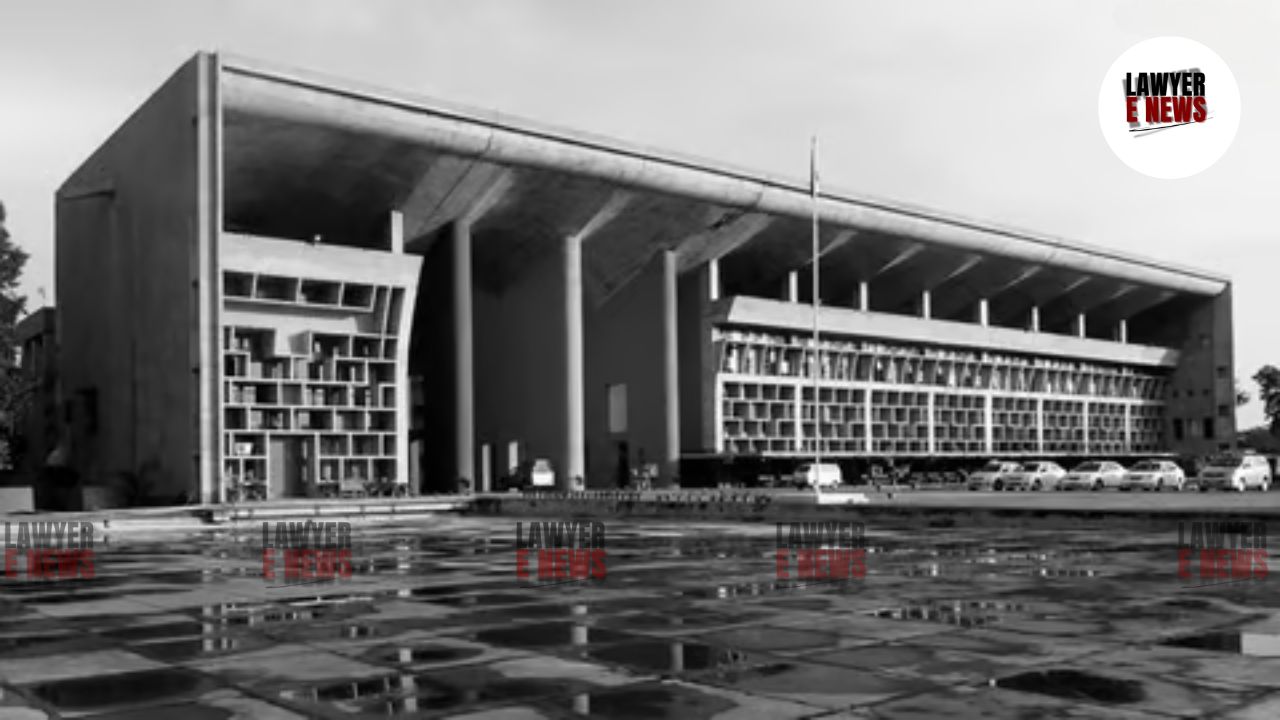
"A member of a uniformed force does not forfeit his humanity at the altar of discipline. Institutional discipline and individual dignity are not antithetical but are complementary constitutional values." Punjab and Haryana High Court, in a significant ruling, held that the absence of a uniformed officer from duty cannot be treated as willful misconduct or desertion if it is backed by contemporaneous medical evidence.
A single-judge bench of Justice Sandeep Moudgil observed that the power to dismiss an employee carries severe civil consequences and cannot be exercised mechanically, emphasizing that a member of a disciplined force does not lose their constitutional right to fairness and human dignity.
The petitioner, enrolled as a Constable in the Central Reserve Police Force (CRPF) in 2006, failed to rejoin duty after his sanctioned leave expired in June 2018 due to severe injuries sustained in a road accident. Following prolonged hospitalization for a non-healing foot ulcer and subsequent spinal injuries, the CRPF declared him a "proclaimed person" and dismissed him from service via an ex parte departmental enquiry. The petitioner challenged the 2018 declaration and the 2019 dismissal order, arguing that his absence was entirely involuntary and the extreme punishment was grossly disproportionate to the allegations.
The primary question before the court was whether an absence from duty occasioned by medical exigencies could be legally construed as willful desertion under the CRPF Act and Rules. The court was also called upon to determine whether the ex parte dismissal order violated the principles of natural justice and the judicial doctrine of proportionality.
Absence Per Se Is Not Misconduct Unless Deliberate
The court critically examined the premise of the disciplinary action, observing that the fundamental charge of "wilful absence" was structurally flawed. Relying on the Supreme Court's decision in Krushnakant B. Parmar v. Union of India, the bench noted that absence without leave cannot be automatically equated with misconduct. The court found that the petitioner's medical records, which indicated continuous treatment and hospitalization for months, were neither discredited nor meaningfully considered by the disciplinary authorities.
"The law is unequivocal that absence per se does not constitute misconduct unless it is deliberate."
Desertion Requires Animus Deserendi
Analyzing Rule 31 of the Central Reserve Police Force Rules, 1955, and Section 11(1) of the Central Reserve Police Force Act, 1949, the court drew a sharp doctrinal distinction between absence without leave and desertion. Citing the Supreme Court in Captain Virendra Kumar v. Chief of the Army Staff, the court emphasized that desertion necessarily implies an intention to permanently abandon service, known as animus deserendi. The bench held that since the petitioner's absence was rooted in medical distress rather than an intent to abscond, escalating the charge to desertion was legally unsustainable.
Statutory Power Must Be Tethered To Reason
The court strongly deprecated the mechanical invocation of statutory rules by the commanding authorities. The bench observed that declaring the petitioner a deserter without examining his physical capacity to report back amounted to a gross non-application of mind. The judgment stresses that administrative powers carrying severe civil consequences must be exercised with both procedural rigour and substantive satisfaction regarding the contumacious nature of the act.
"Statutory power cannot be exercised in abstraction of facts and it must be tethered to reason."
Ex Parte Enquiry Is A Façade Of Fairness
Addressing the procedural infirmities, the court found that the ex parte departmental enquiry flagrantly violated the principles of natural justice. The bench held that the mere dispatch of notices to the petitioner's recorded address did not satisfy the constitutional mandate of affording a fair opportunity to be heard. Referring to State of Orissa v. Dr. (Miss) Binapani Dei, the court observed that an administrative order visiting civil consequences requires real and effective service, without which the proceedings become a mere façade of fairness.
Dismissal Is Shockingly Disproportionate
On the quantum of punishment, the court applied the doctrine of proportionality, holding that the penalty of dismissal was vindictive, unduly harsh, and in outrageous defiance of logic. The bench noted that the petitioner had rendered unblemished service from 2006 until his accident, and punishing an absence intertwined with medical exigencies with the harshest possible penalty shocked the conscience of the court. Relying on Ranjit Thakur v. Union of India and Om Kumar v. Union of India, the court reiterated that a punishment must necessarily suit both the offence and the offender.
"The State, even in its capacity as employer in a disciplined force, is bound by fairness under Articles 14 and 21."
Constitutional Rights Of Uniformed Personnel
The court concluded its analysis by reinforcing the fundamental rights of armed forces personnel. The bench ruled that treating involuntary absence as deliberate defiance constitutes a substitution of assumption for adjudication, which the law strictly prohibits. The court firmly established that institutional discipline cannot override the fundamental fairness guaranteed under Articles 14 and 21 of the Constitution of India.
The High Court allowed the writ petition, setting aside both the 2018 order declaring the petitioner a deserter and the 2019 dismissal order. The court directed the respondents to reinstate the petitioner in service with continuity for all purposes, alongside the release of all consequential benefits and arrears of salary with 6% annual interest.
Date of Decision: 18 March 2025