
-
by sayum
26 August 2026 1:49 PM







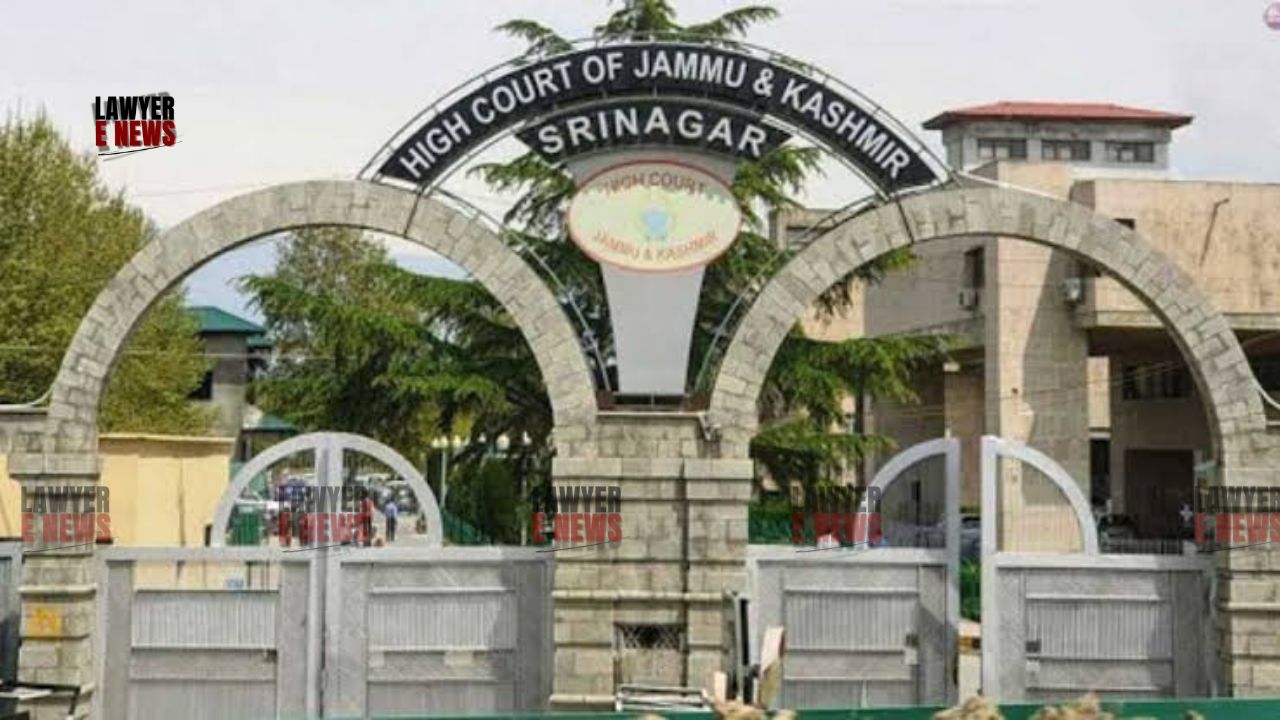
“The test of ‘sufficient cause’ cannot be substituted by an examination of the merits of the case… Condonation of delay is a matter of discretion based on explanation for the delay, not on the prospects of success in the litigation.” - In a decisive pronouncement reiterating the primacy of limitation law in land dispute adjudication, the High Court of Jammu & Kashmir and Ladakh dismissed a writ petition filed by Romesh Kumar challenging mutation orders passed over two decades ago under the Jammu and Kashmir Agrarian Reforms Act. The Court held that the delay of more than 24 years in filing the challenge was unexplainable and legally indefensible, and ruled that the petitioner could not revive lapsed legal remedies merely by alleging illegality or projecting the strength of his case.
The judgment was delivered by Justice Sanjay Dhar, who categorically held that “the petitioner is estopped from pleading ignorance when his own father and other co-owners had actively participated in the attestation of the impugned mutation orders.”
“Law of Limitation is Not a Technicality – It is a Substantive Shield Against Endless Litigation”
The High Court’s ruling stemmed from a land dispute concerning a series of mutation orders passed between 1981 and 1986 under Sections 4 and 8 of the J&K Agrarian Reforms Act in favour of one Sh. Isher Lal, the predecessor of the contesting respondents. These orders conferred proprietary rights upon him regarding land measuring over 22 kanals in village Kallar Himmiti, Tehsil and District Udhampur.
The petitioner Romesh Kumar, claiming through a will from one Sh. Parmanand, filed appeals against these mutation orders only in 2009, arguing that the mutations were illegal as the land was classified as "banjar kadeem" and could not be conferred upon non-agricultural classes such as the Mahajan community. The Commissioner (Agrarian Reforms), however, dismissed the appeals citing delay. Subsequent revision petitions before the J&K Special Tribunal were also rejected, leading to the present writ petition under Article 226 of the Constitution.
“Strong Claim on Merits Is No Justification for Delay – Substantive Justice Cannot Override Statutory Finality”
Justice Sanjay Dhar laid down a categorical reaffirmation of the settled position that “merits of a case are irrelevant to the question of condonation of delay”. The Court relied heavily on recent Supreme Court decisions, notably:
In Pathapati Subha Reddy v. Special Deputy Collector, 2024 SCC OnLine SC 513, the Supreme Court observed: “Merits of the case are not required to be considered in condoning the delay… Delay condonation must rest on ‘sufficient cause’, not on how legally or factually strong the claim appears.”
Similarly, in Shivamma (Dead) by LRs v. Karnataka Housing Board, 2025 LiveLaw (SC) 899, the Court reiterated:
“Strong case on merits is no ground for condonation of delay… If courts begin examining merits at the preliminary stage, it would blur the line between procedural scrutiny and final adjudication.”
Relying on these authoritative pronouncements, the High Court held:
“Even if it is assumed that the petitioner’s case may be meritorious, the huge delay of 24 years in filing the appeals cannot be condoned merely because the petitioner claims that he has a strong case.”
“Petitioner Cannot Feign Ignorance When His Own Father Participated in Mutation Proceedings – Knowledge Attributable from Family’s Participation”
On the issue of the petitioner’s claim that the mutation orders were passed behind his back, the Court held such contention to be “factually and legally untenable”. The record revealed that the petitioner’s father, Dina Nath, was present and signed the mutation orders, and co-owner Des Raj also participated. The Court noted:
“That the petitioner’s predecessor-in-interest, Sh. Parmanand, never challenged the mutations during his lifetime—even though he died in 1992, well after the orders were passed—indicates acquiescence and knowledge. The petitioner, residing in the same village, cannot plausibly claim ignorance.”
This factual matrix, in the Court’s view, demolished any plea of ‘sufficient cause’ under Section 5 of the Limitation Act, making the delay fatal and beyond judicial indulgence.
“Judicial Review Not an Appeal – Writ Court Cannot Reappreciate Findings of Quasi-Judicial Forums Absent Perversity or Illegality”
Justice Dhar also reiterated the limited scope of writ jurisdiction under Article 226 when reviewing decisions of statutory and quasi-judicial authorities. He stated:
“A writ Court must only satisfy itself as to whether the order passed by the authority below is vitiated due to any material irregularity, want of evidence, or contravention of law. In the present case, both the appellate and revisional forums rightly declined to condone the delay. There is no perversity or illegality.”
Consequently, the High Court refused to interfere in the impugned order of the Special Tribunal, which had upheld the limitation-based dismissal of the petitioner’s appeals.
The judgment delivers a strong message against litigative procrastination and revival of stale claims. The Court’s clear demarcation between procedural compliance and substantive adjudication stands as a reaffirmation of the principle that “legal certainty must triumph over speculative justice”. The High Court has laid down that limitation is not an idle formality, but a structural necessity for rule of law.
The writ petition was accordingly dismissed, without examination of the underlying land dispute, solely on the ground of inexcusable and uncondonable delay.
Date of Decision: 18 October 2025





