-
by sayum
25 August 2026 11:12 PM







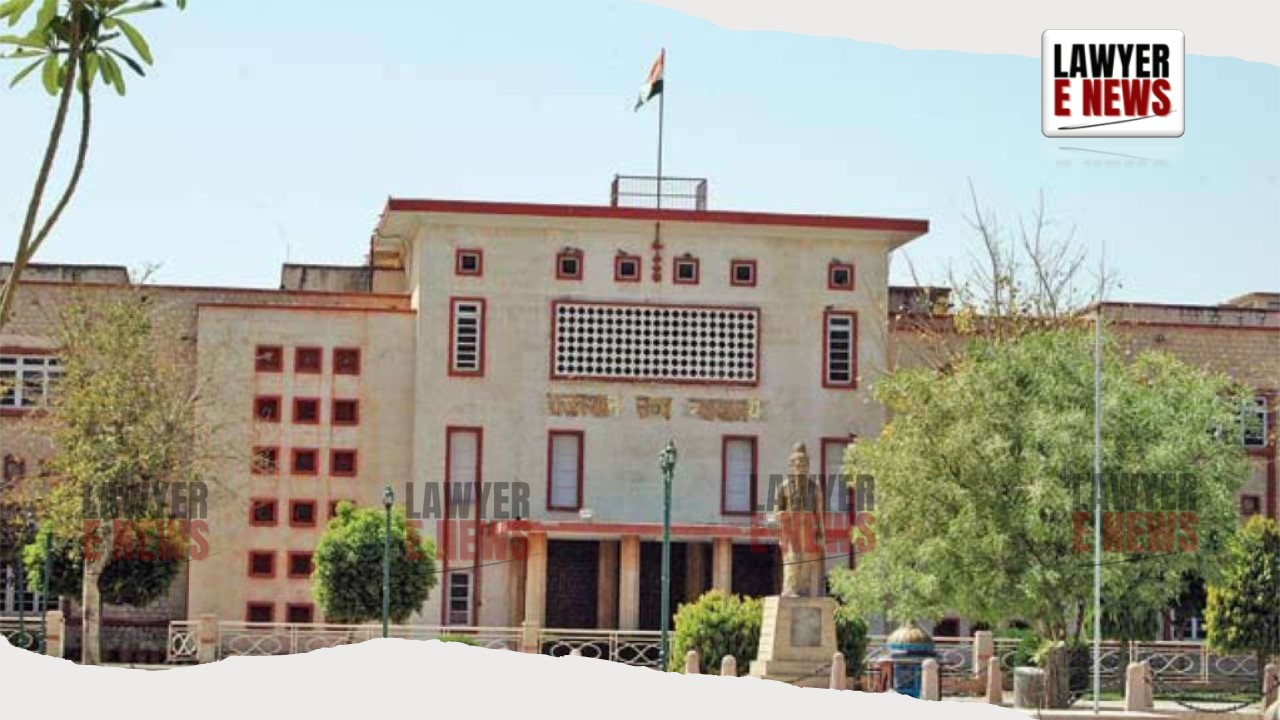
“A Litigant Cannot Be Allowed to Accept the Benefits Flowing from a Statutory Framework and Subsequently Question Its Legality”, Rajasthan High Court decisively rejecting a constitutional challenge to Rules 35, 36 and 39 of the Rajasthan Jails Subordinate Service Rules, 1998.
The Division Bench of Justice Inderjeet Singh and Justice Ravi Chirania held that employees who had consciously opted for circle-wise seniority in 2011 and accepted promotions under the 1998 Rules between 2014 and 2019 could not later turn around and assail the very framework as unconstitutional merely because it no longer suited their promotional prospects.
The Court reaffirmed that subordinate legislation can be struck down only on limited constitutional grounds and not on the basis of hardship or dissatisfaction with seniority outcomes.
From State-Wide Seniority to Circle-Wise Structure
The petitioners were initially appointed as Warders under the Rajasthan Jails Subordinate Service Rules, 1976, from 1987 onwards. Under the 1976 regime, promotions were governed on a State-level seniority basis.
However, the 1976 Rules were repealed and replaced by the Rajasthan Jails Subordinate Service Rules, 1998. A fundamental structural shift was introduced — promotion to the post of Head Warder was to be made on a “circle basis” instead of State-wide seniority.
In furtherance of Rule 35, a circular dated 28.02.2011 invited options from Warders to select their respective circles. The circular categorically provided that the option once submitted would be final and that any transfer on personal request would result in placement at the bottom of the seniority list in the new circle .
The petitioners exercised their options. A circle-wise seniority list was published on 08.09.2011. Thereafter, promotions were granted under the 1998 Rules from 2014 onwards — promotions which the petitioners accepted without challenge.
It was only in 2020, nearly six years after accepting promotion and more than two decades after the 1998 Rules came into force, that the present writ petitions were filed.
“Merely Because It Is Not Suiting Them Now”: Court Rejects Article 14 and 16 Challenge
The petitioners contended that juniors appointed later had secured earlier promotions to higher posts due to the circle-wise structure, thereby violating Articles 14 and 16 of the Constitution.
The Court was unimpressed.
It observed that after repeal of the 1976 Rules and notification of the 1998 Rules, the petitioners never challenged the change in criteria. They voluntarily exercised circle options and accepted promotions under the new framework.
The Bench categorically recorded:
“Merely because the circle opted by them in the year 2011 is now not suitable or because of that they have been placed below certain persons who opted a different circle at that time, does not give them any right to question the rules at a belated stage.”
The Court held that long acquiescence coupled with acceptance of benefits disentitled them from invoking writ jurisdiction to reopen settled seniority.
“You Cannot Blow Hot and Cold”: Doctrine of Approbate and Reprobate Applied
In a strongly worded passage, the High Court invoked the doctrine of approbate and reprobate.
The Bench observed:
“A litigant cannot be allowed to blow hot and cold by first accepting the benefits under the new Rules and subsequently assailing the same when it ceases to be advantageous.”
Relying on Adani Gas Limited v. Union of India (2022) 5 SCC 210, the Court emphasized that a party who derives advantage from a statutory framework cannot later challenge it merely because circumstances have become inconvenient.
The Court concluded that the petitioners, having consciously exercised options and accepted promotion, were estopped from challenging Rules 35, 36 and 39.
Scope of Judicial Review of Subordinate Legislation Reiterated
The Bench reiterated the settled principles governing judicial review of subordinate legislation.
Referring to Goa Glass Fibre Ltd., Cellular Operators Association of India, and P. Krishnamoorthy, the Court reaffirmed that subordinate legislation can be invalidated only on limited grounds such as:
lack of legislative competence,
violation of constitutional provisions, or
manifest arbitrariness of such a degree that it could not reasonably emanate from delegated authority.
The petitioners, the Court noted, “failed to show any grounds so as to declare the impugned Rules 35, 36 and 39 of the Rules of 1998 as ultra vires” .
The Bench further observed:
“The seniority finalised in 2011 and consequent promotion made in 2014 under the Rules of 1998 cannot be unsettled now after passing of more than twelve years.”
Non-Impleadment of Affected Parties Proved Fatal
The petitioners also sought quashing of the seniority list dated 28.07.2020. However, none of the officers who would be affected by such relief were impleaded as parties.
The Court held that no relief disturbing promotions could be granted in absence of necessary and proper parties .
Constitutional Challenge Fails, Promotions Stand Protected
In conclusion, the Rajasthan High Court dismissed the writ petitions, holding that the petitioners had neither established constitutional infirmity nor shown manifest arbitrariness in the impugned Rules.
The Court declined to exercise judicial review to unsettle a settled service structure after long delay and conscious acceptance of benefits.
The decision stands as a firm reminder that service jurisprudence does not permit employees to challenge the very regime under which they have advanced, simply because promotional outcomes later prove disadvantageous.
Date of Decision: 17 February 2026






