-
by sayum
25 August 2026 11:12 PM







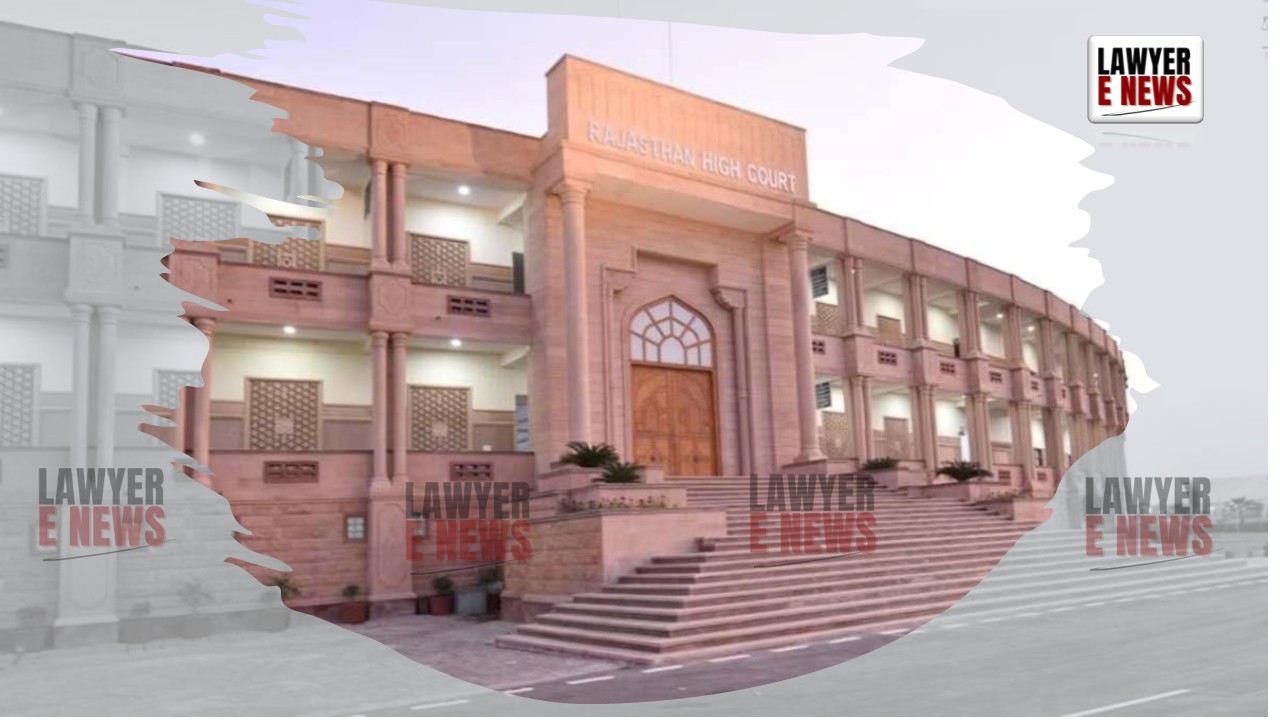
In a significant ruling on university governance and the limits of judicial review, the Rajasthan High Court has upheld the suspension and removal of the Vice-Chancellor of Maharaja Surajmal Brij University, Bharatpur.
Justice Anand Sharma dismissed the writ petition challenging the suspension order dated 28.03.2025 and the removal order dated 11.11.2025 passed under Section 11A of the Maharaja Surajmal Brij University Act, 2012.
The Court held that Section 11A is a “distinct and self-contained mechanism” for suspension and removal of a Vice-Chancellor and cannot be equated with disciplinary jurisprudence applicable to civil servants under Article 311.
“Reasonable Opportunity Is Contextual” – No Mandatory Full-Fledged Departmental Enquiry Required
The central challenge raised by the petitioner was that the expression “reasonable opportunity” under the second proviso to Section 11A(1) mandated a full-fledged departmental enquiry with formal charges, recording of oral evidence and cross-examination.
Rejecting this contention, the Court held that the expression “reasonable opportunity” cannot be read in a rigid or mechanical manner. It observed that it “cannot be equated mechanically with the elaborate disciplinary procedures applicable to civil servants under Article 311 of the Constitution.”
The Court emphasized that Section 11A does not prescribe framing of formal charges or examination of witnesses. What is required is that the Vice-Chancellor be made aware of the material against him and be afforded a fair chance to respond.
Relying upon Mohinder Singh Gill, the Court reiterated that “the glory of the law is not that sweeping rules are laid down but that it tailors principles to practical needs.” Referring to P.D. Agrawal, it added that natural justice “is not applied in a vacuum… It is no unruly horse. It cannot be put in a straitjacket formula.”
On facts, the Court noted that the enquiry report dated 11.06.2025 was supplied to the petitioner, time was granted for reply, extension was allowed, a detailed representation was submitted, and personal hearing was afforded on 17.07.2025. The reply was reconsidered and a further report dated 19.09.2025 reaffirmed findings before consultation with the State Government and issuance of the removal order.
Thus, compliance with the statutory requirement of “reasonable opportunity” stood established.
“Section 11A Begins With a Non Obstante Clause” – Special Statute Overrides General Service Rules
The Court underscored that the Vice-Chancellor “is not an ordinary employee of the University” but a statutory functionary occupying the highest executive office. His appointment and removal are governed exclusively by the MSBU Act, 2012.
Section 11A, introduced by amendment, provides a special and overriding mechanism for removal. The Court observed that importing the entire framework of departmental enquiry applicable to subordinate employees “would defeat legislative intent.”
The judgments relied upon by the petitioner, including Khem Chand, Pepsu Road Transport Corporation, and other service law precedents, were held distinguishable as they pertained to civil servants and Article 311 jurisprudence.
The High Court clarified that action under Section 11A must be tested within the statutory framework of the Act and not through the lens of general service law.
“Action May Be Taken ‘On the Report of the State Government or Otherwise’” – Inquiry Under Section 9(2) Can Form Basis
A key argument of the petitioner was that an inquiry under Section 9(2) of the Act is merely a visitation or supervisory inquiry into the affairs of the University and cannot be converted into a disciplinary proceeding under Section 11A.
The Court rejected this submission, holding that Section 11A permits action “on the report of the State Government or otherwise.” The expression “otherwise,” the Court held, is of “wide amplitude” and authorizes the Chancellor to act upon any credible material forming the basis of satisfaction.
There was no statutory prohibition against acting on material emerging from a Section 9(2) inquiry. Moreover, the notice dated 04.07.2025 clearly indicated that action under Section 11A was under contemplation, thereby negating any allegation of procedural surprise.
Suspension Preventive in Nature – Challenge Became Academic After Removal
The suspension dated 28.03.2025 was challenged on the ground that no prior opportunity was granted.
The Court held that suspension pending inquiry is expressly authorized under the first proviso to Section 11A(1) and is preventive, not punitive, in nature. It does not require prior hearing.
Further, after the removal order dated 11.11.2025, the suspension order merged into the final order and ceased to have independent existence. The challenge to suspension therefore became academic.
“Academic Eminence Is Not Enough” – Higher Standards Apply to Vice-Chancellor
Addressing the argument that the petitioner was a distinguished academic of international repute, the Court observed that “mere distinction or eminence in the academic field, by itself, does not suffice to meet the requirements of the office.”
The Vice-Chancellor, being the principal executive and academic authority, is entrusted with wide-ranging statutory and financial powers. Therefore, “the standards of discipline, integrity, transparency, and administrative efficiency expected from a Vice-Chancellor are necessarily of a much higher degree.”
The Court rejected the defence that irregularities were attributable to vacant posts of Registrar and Financial Controller. As the principal executive authority, the Vice-Chancellor bears ultimate supervisory responsibility. Administrative vacancies cannot justify financial deviation or irregular exercise of power.
Speaking Order to Be Read With Inquiry Material
The petitioner contended that the removal order was non-speaking and unreasoned.
The Court held that the removal order must be read in conjunction with the inquiry reports and the entire record preceding it. Where an order is based upon detailed reports forming part of the record and known to the affected person, it cannot be termed arbitrary merely because it is concise.
Limited Scope of Judicial Review Under Article 226
Reaffirming settled principles, the Court held that judicial review is concerned with the legality of the decision-making process and not with reappreciation of evidence.
Quoting State of U.P. v. Maharaja Dharmander Prasad Singh, the Court emphasized that it cannot sit as an appellate authority over factual findings. Interference is warranted only in cases of jurisdictional error, procedural illegality, mala fides, or perversity.
On the record, the Chancellor had jurisdiction, consulted the State Government, conducted inquiry, supplied the report, granted hearing, and formed an opinion based on material. No manifest arbitrariness or mala fide was established.
University Autonomy Does Not Mean Absence of Accountability
Rejecting the plea that the action undermined university autonomy, the Court observed that autonomy “does not imply absence of accountability.” The MSBU Act itself vests supervisory powers in the Chancellor. Exercise of power in accordance with statute cannot be termed interference.
Writ Petition Dismissed
On an overall consideration, the Court held that the suspension order dated 28.03.2025 was within statutory competence and the removal order dated 11.11.2025 was passed after due inquiry and compliance with principles of natural justice.
The writ petition was dismissed and pending applications disposed of.
Date of Decision: 17/02/2026