-
by sayum
25 August 2026 11:12 PM







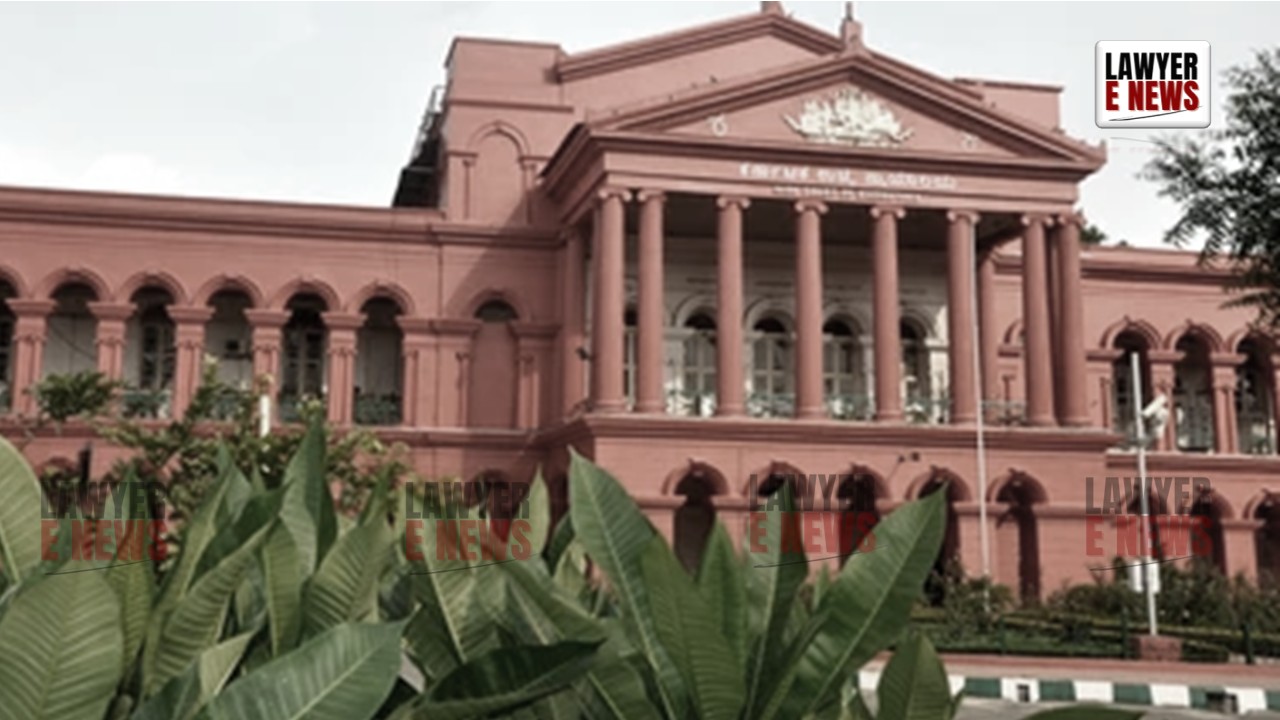
“Civil Court Cannot Stall Statutory Recovery” – In a significant ruling strengthening the hands of financial institutions, the Karnataka High Court has held that a civil court cannot injunct a bank from proceeding under a corporate guarantee when the matter squarely falls within the domain of the DRT or NCLT.
A Division Bench comprising Hon’ble Mr. Vibhu Bakhru, Chief Justice and Hon’ble Mr. Justice C.M. Poonacha set aside an interim injunction granted by the Commercial Court which had restrained State Bank of India from acting on a corporate guarantee executed by Patel Engineering Limited.
The Court made it clear that where special statutes like the SARFAESI Act, the RDB Act and the Insolvency and Bankruptcy Code provide a complete mechanism, civil court intervention is not only unwarranted but statutorily barred.
“No Injunction Shall Be Granted… In Respect of Any Action Taken or To Be Taken” – Expansive Bar Under Section 34 SARFAESI
The controversy arose after SBI sanctioned a ₹49 crore term loan to a real estate developer. Patel Engineering Limited executed a corporate guarantee. Upon default, SBI classified the account as NPA, issued a notice under Section 13(2) of the SARFAESI Act, and initiated proceedings under Section 7 of the IBC before the NCLT.
Instead of contesting liability before the statutory forums, the guarantor filed a commercial suit seeking a declaration that no liability accrued under the guarantee, or alternatively, that its liability be determined before any coercive steps were taken. The Commercial Court granted an injunction restraining the bank from proceeding further.
The High Court emphatically disagreed.
Referring to Section 34 of the SARFAESI Act, the Bench observed that it contains a dual prohibition. First, civil courts cannot entertain matters which the DRT or Appellate Tribunal is empowered to determine. Second, “no injunction shall be granted by any court or other authority in respect of any action taken or to be taken” under SARFAESI or the RDB Act.
Relying on Mardia Chemicals and Punjab & Sind Bank v. Frontline Corporation, the Court reiterated that the expression “taken or to be taken” includes even prospective actions. It clarified that “the prohibition covers even matters which may be taken cognizance of by the DRT though no measure in that direction has so far been taken.”
Thus, even if recovery proceedings were yet to be filed before the DRT at the time of institution of the suit, the civil court was statutorily barred from issuing any injunction that would restrain such proceedings.
“Suit Is Essentially a Defence” – Declaratory Relief Cannot Circumvent Section 18 RDB Act
The High Court examined the plaint and found that Patel Engineering Limited had not raised any independent claim against the bank. Instead, it sought a declaration that no liability accrued under the guarantee.
The Court observed that the suit “is essentially to reaffirm its defence to the claim set up by SBI.” It held that merely couching a defence as a declaratory suit does not confer jurisdiction on a civil court.
Under Section 17 of the RDB Act, the DRT has jurisdiction to entertain applications by banks for recovery of debts. Section 18 bars civil courts from exercising jurisdiction “in relation to matters specified in section 17.”
The Bench held that the subject matter of the suit, being the determination of liability under the guarantee forming part of the bank’s recovery claim, fell squarely within the DRT’s exclusive jurisdiction. Therefore, the suit was clearly barred.
The Court also referred to the Supreme Court’s decision in Bank of Rajasthan v. VCK Shares, cautioning that even if a defendant files an independent suit, “there can be no question of stay of those proceedings” before the DRT. The expeditious recovery mechanism under special statutes cannot be impeded by parallel civil litigation.
“Liability of a Guarantor Is Co-Extensive” – No Prior Determination Required Before Action
A central argument advanced by the guarantor was that its liability was limited to the value of its share in the mortgaged land and that such value required prior adjudication before the bank could proceed.
The Commercial Court had accepted this prima facie and held that the guarantor could not be proceeded against without determination of its liability.
The High Court found this approach to be legally untenable.
Although a notation appeared against the guarantor’s name referring to value of its share of land mortgaged, the body of the guarantee deed contained no restrictive covenant limiting liability. The operative clauses imposed unconditional, joint and several liability, describing the guarantee as “continuing” and “independent and distinct from any security.”
The Court reiterated the settled principle that the liability of a surety is co-extensive with that of the principal borrower unless clearly restricted.
It rejected the contention that the bank must first seek a civil court’s determination before invoking SARFAESI, RDB or IBC remedies. The plea regarding limited liability was nothing but a defence to be raised before the competent statutory forum.
In categorical terms, the Court held that SBI’s right to initiate proceedings “is not contingent on the determination of PEL’s liability in a separate action.”
“Civil Court Cannot Interdict NCLT” – Section 63 IBC Bars Interference
SBI had also initiated proceedings under Section 7 of the IBC against the guarantor. The High Court examined Section 7(4), which mandates the NCLT to ascertain the existence of default.
The Bench noted that the question whether the guarantor had defaulted in its obligations under the guarantee squarely falls within the NCLT’s jurisdiction.
Section 63 of the IBC clearly provides that “no civil court or authority shall have jurisdiction to entertain any suit or proceedings in respect of any matter on which” the NCLT or NCLAT has jurisdiction.
By restraining SBI from proceeding under the guarantee, the Commercial Court had effectively interdicted the NCLT from exercising its statutory power to determine default. Such interference was impermissible.
Jurisdictional Bar Can Be Raised at Any Stage
The guarantor argued that SBI had not expressly pleaded the bar of jurisdiction and was therefore precluded from raising it in appeal.
The High Court rejected this contention, holding that a pure question of law going to the root of jurisdiction can be raised at any stage. Courts are duty-bound to take note of statutory bars even if not specifically pleaded.
“Commercial Court Completely Misdirected Itself” – Appeal Allowed
Concluding the matter, the Division Bench held that the Commercial Court had no jurisdiction to entertain the suit and, in any event, could not have granted an injunction restraining statutory recovery mechanisms.
The impugned order dated 25.07.2024 was set aside and the appeal allowed.
The judgment sends a clear message from the banking law perspective: civil courts cannot be used as strategic shields to delay or derail recovery under SARFAESI, RDB Act or IBC. Where Parliament has created specialised tribunals and provided an overriding statutory framework, attempts to pre-empt recovery through declaratory suits will not survive judicial scrutiny.
Date of Decision: 17/02/2026